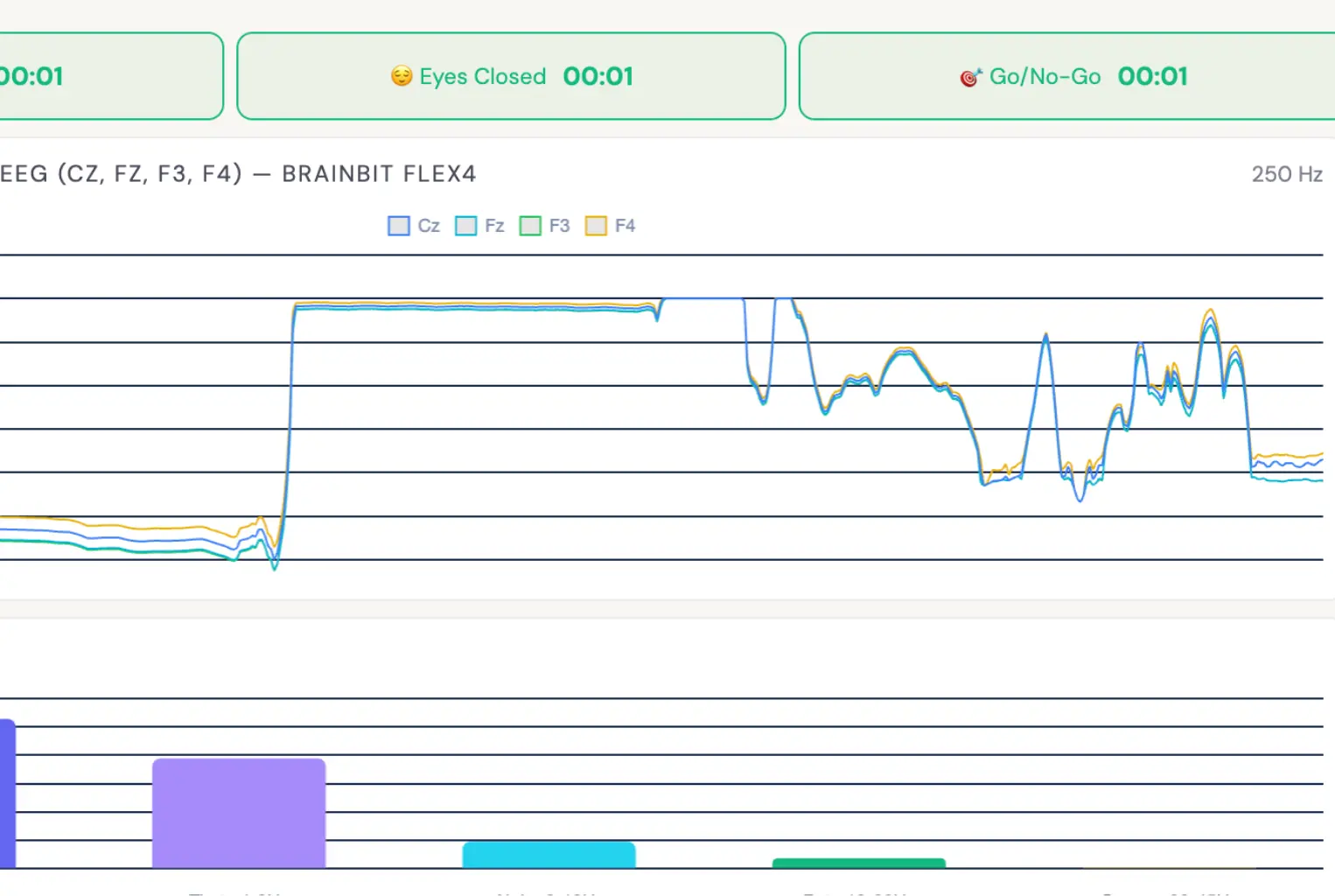
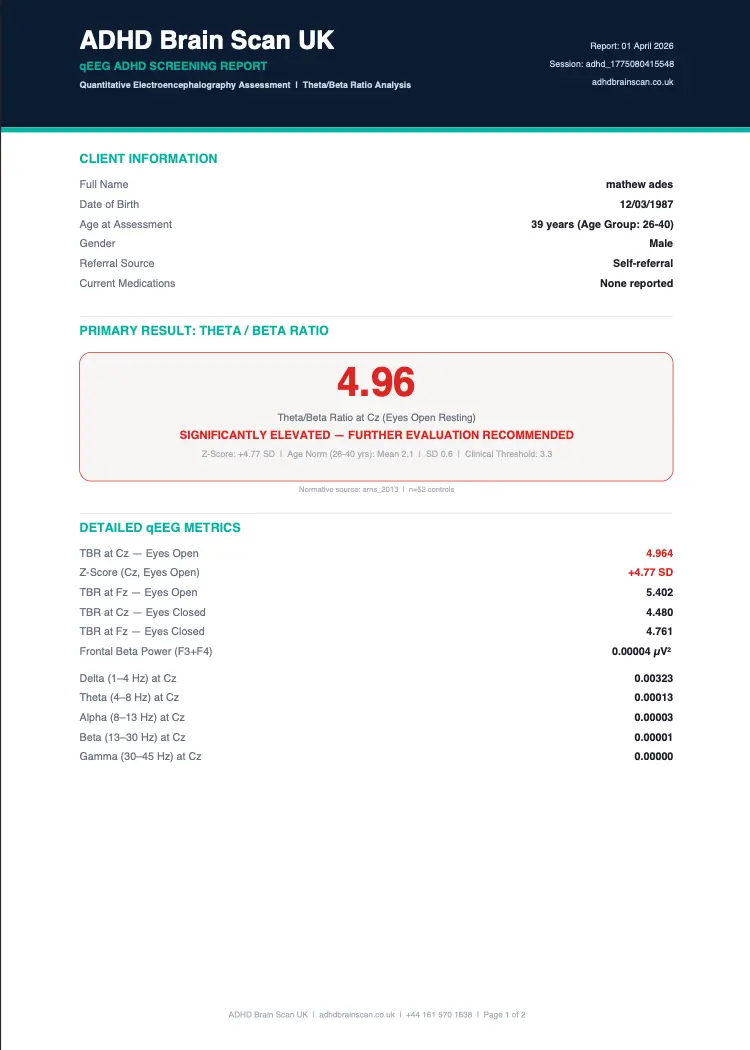
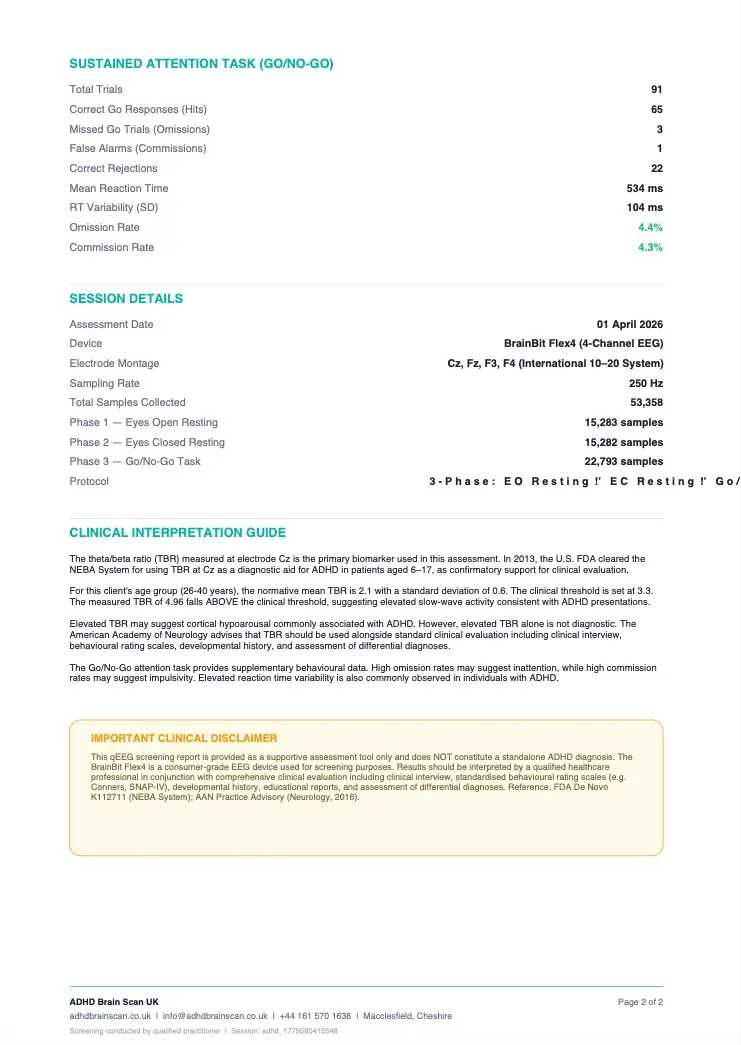
Our most complete screening package. Everything in the standard brain screening, plus a face-to-face results consultation where we walk you through your data, a written clinical letter for your GP, and personalised guidance on next steps. Plus full access to our ADHD support hub with guides on everything from medication to workplace rights.
The complete three-phase recording: eyes-open resting, eyes-closed resting, and Go/No-Go attention task. Identical protocol to our standard screening — no corners cut on the data.
Primary and secondary TBR measurement at the FDA-referenced electrode sites, compared against published age-matched normative data.
Full computerised attention assessment with reaction time, omission rate, commission rate, and variability metrics — all compared against age norms.
We sit with you after the scan and walk through every data point. What your theta/beta ratio means, how your attention task compared to norms, what the frequency bands show, and what it all means for you or your child.
A formal letter summarising our findings in clinical language, suitable for presenting to your GP, psychiatrist, school SENCO, or employer. Includes specific recommendations for next steps.
Based on your results, we advise on whether further assessment is warranted, what type of professional to see, and how to use your report most effectively in the NHS or private pathway.
This is our most popular package for a reason. Parents want to understand what the numbers mean — our results explained guide helps. Adults want clear guidance on what to do next. GPs and psychiatrists appreciate receiving a professional letter rather than just raw data. If you want the full picture and a clear path forward, this is it.
The Comprehensive Assessment is designed for anyone who wants more than raw data — you want expert interpretation, a formal clinical letter, and a clear roadmap for what to do next. While our standard ADHD Brain Screening (£595) gives you the full qEEG data and professional PDF report, the Comprehensive package adds the human element: a qualified technician sitting with you, explaining every metric, answering your questions, and producing a formal letter that carries weight with healthcare professionals and education panels.
If you need evidence for an Education, Health and Care Plan (EHCP) application, the clinical interpretation letter is essential. SENCOs and education panels expect formal clinical documentation with proper citations and specific recommendations — not just a data report. Our letter is formatted as professional medical correspondence that panels recognise and take seriously. Many SENCOs across the North West now actively recommend the Comprehensive package to parents for this reason.
If you are planning to present your results to a GP or private psychiatrist, the clinical letter provides the formal documentation that expedites referrals. The letter summarises your results in clinical language, cites the relevant peer-reviewed research, and includes specific recommendations that a GP can act on immediately. For Right to Choose applications, having a formal clinical letter alongside your screening data significantly strengthens the case for NHS-funded assessment through providers like Psychiatry-UK.
If you need formal documentation for Access to Work funding or workplace reasonable adjustments under the Equality Act 2010, the clinical letter provides exactly the kind of evidence that applications require. Several of our clients have had Access to Work applications approved on the first attempt using our clinical letter, whereas the standard screening report alone may not carry sufficient formal weight for these purposes.
Not everyone is comfortable interpreting z-scores, frequency band data, and attention task metrics on their own. The 20-minute consultation ensures you leave with complete understanding of what your brain data means, how it relates to your specific symptoms, and what your options are. For women who have been missed for years, for adults who have spent decades wondering, and for parents making important decisions about their child's future, this clarity is worth the additional investment.
During the consultation, we also explain the broader context of your results — what the theta/beta ratio means neurologically, how it relates to cortical arousal and prefrontal function, why some people with ADHD show elevated TBR while others do not, and what other factors might be influencing your brain activity pattern. If your results suggest possible comorbidities — for example, unusually high alpha activity that might indicate anxiety, or elevated delta suggesting fatigue or sleep issues — we discuss these observations and recommend appropriate follow-up through our sleep guide or coping strategies. This level of personalised interpretation goes far beyond what any standard screening report can provide.
The standard ADHD Brain Screening (£595) gives you the full qEEG protocol, all six objective metrics, z-score normative comparison, and a professional same-day PDF report. It is the right choice if you are comfortable interpreting the data yourself or with the help of our results explained guide, and if you do not need a formal clinical letter. Many clients start with the standard screening and upgrade later if they decide they need the consultation and letter — the upgrade cost is £250.
The Family Package (£1,095) screens two family members with individual reports for each. It does not include a consultation or clinical letter, but families can add a Comprehensive upgrade for either or both children. The Medication Comparison Scan (£345) is a rescan for clients who have already had a baseline screening and want to measure the effect of medication on their brain activity. See our full pricing page for a side-by-side comparison of all packages.
The NICE ADHD guidelines (NG87) recommend comprehensive assessment including clinical interview, behavioural rating scales, developmental history, and consideration of other conditions. Our Comprehensive package provides the objective neurological data that this standard assessment pathway does not include — a theta/beta ratio measured against published normative data from Arns et al. (2013) and other peer-reviewed sources, combined with a behavioural attention task.
With average NHS waiting times exceeding two to five years and the standard NHS diagnostic pathway relying entirely on subjective measures, families and adults are increasingly seeking objective evidence to strengthen their position within the system. The Comprehensive package — with its clinical letter, consultation, and follow-up support — gives you the strongest possible foundation for whichever pathway you choose: Right to Choose, private assessment, or expedited NHS referral. The American Academy of Neurology reports 89-94% accuracy when TBR data is combined with clinical evaluation — and our clinical letter is designed to facilitate exactly this combination.
For children specifically, the Comprehensive package provides a complete evidence package for engaging with schools. The clinical letter can be submitted directly to your child's SENCO as part of an EHCP application, used to request exam access arrangements such as extra time or a separate room, or presented at SEN review meetings to demonstrate objective neurological evidence of attention difficulties. For teenagers approaching GCSEs or A-levels, having this documentation in place before exam season can make a meaningful difference to the support they receive. Our parent's guide covers every aspect of navigating the education system with ADHD evidence, from initial conversations with teachers to formal EHCP tribunal submissions.
After your seven-minute qEEG recording, we sit down with you for a detailed 20-minute consultation. We display your results on screen and walk through every metric: your theta/beta ratio at electrodes Cz and Fz, your z-scores against our normative database of 311+ research subjects from published sources including Arns et al. (2013) and Monastra et al. (1999), your full frequency band analysis across delta, theta, alpha, beta, and gamma, and your Go/No-Go sustained attention task performance including reaction time, omission errors, commission errors, and variability.
We explain what each metric means in practical terms — not just numbers, but what they suggest about how your brain processes attention, how they relate to the symptoms you experience, and how they compare to published ADHD research. For parents of children, we explain results in the context of your child's age group and developmental stage. For adults, we discuss how the results relate to the daily difficulties you described in your intake form.
The consultation includes a clear action plan tailored to your specific results and circumstances. If your TBR is significantly elevated, we discuss the strongest pathways to formal assessment — whether that is a GP referral, Right to Choose, or private assessment. We provide specific advice on what to say to your GP, which pathway is likely to be fastest in your area, and what to expect at each stage. For borderline results, we discuss the nuances and help you decide whether further investigation is warranted. Our GP appointment guide includes word-for-word scripts you can take with you.
For parents seeking EHCP evidence, we explain how to present the clinical letter to your child's school SENCO and what additional evidence may be needed. For adults pursuing Access to Work funding, we outline the application process and how our clinical letter supports it. The goal is that you leave the consultation with complete clarity on what your results mean and exactly what to do next.
Within 24 hours of your appointment, you receive a formal clinical interpretation letter in addition to your standard PDF report. This letter is addressed to your GP, psychiatrist, school SENCO, or employer — whoever you need it for. It summarises your screening results in clinical language, cites the relevant peer-reviewed literature including the FDA NEBA clearance and American Academy of Neurology guidelines, provides specific clinical recommendations, and is formatted as professional medical correspondence that healthcare professionals and education panels recognise and respect.
The letter differs from the standard PDF report in tone and purpose. While the report presents the raw data, z-scores, and normative comparisons, the letter interprets that data in the context of your individual presentation and provides actionable clinical recommendations. It includes a summary of your presenting concerns, the screening methodology used, your key results with clinical significance markers, a comparison against published normative data with effect sizes, references to the relevant ADHD literature, and specific recommendations for your next steps. Many clients tell us the letter is the single most valuable part of the comprehensive package, because it gives their GP or psychiatrist exactly the kind of formal documentation they need to act quickly.
For EHCP applications, the letter includes additional educational context — how the screening findings relate to learning, attention in classroom settings, and the need for reasonable adjustments. For Access to Work applications, it addresses workplace functioning and the potential impact of ADHD on productivity, time management, and task completion. For private psychiatric assessment, it provides the neurological data point that the assessing psychiatrist can integrate with their own clinical findings. The NICE ADHD guidelines (NG87) support the use of supplementary clinical evidence alongside standard assessment, and our letters are designed to meet this standard.
Unlike the standard screening, the Comprehensive package includes ongoing follow-up support. Within a week of your appointment, we contact you by phone or email to check how your GP appointment went, answer any further questions about your results, and provide additional guidance if needed. If your GP has questions about the report or letter, we are available to speak with them directly — several GPs in the North West have taken us up on this offer, and the conversation typically resolves any uncertainty about the screening methodology or how to interpret the results.
This support continues until you have a clear pathway to formal assessment — whether through the NHS, Right to Choose, or private assessment. For families navigating the often complex landscape of CAMHS referrals, school SEN processes, and EHCP applications, having someone to call who understands both the science and the system can make a significant practical difference. Our parent's guide, next steps guide, and full support hub provide comprehensive resources for every stage of the journey, and Comprehensive clients receive priority access to all of these resources.
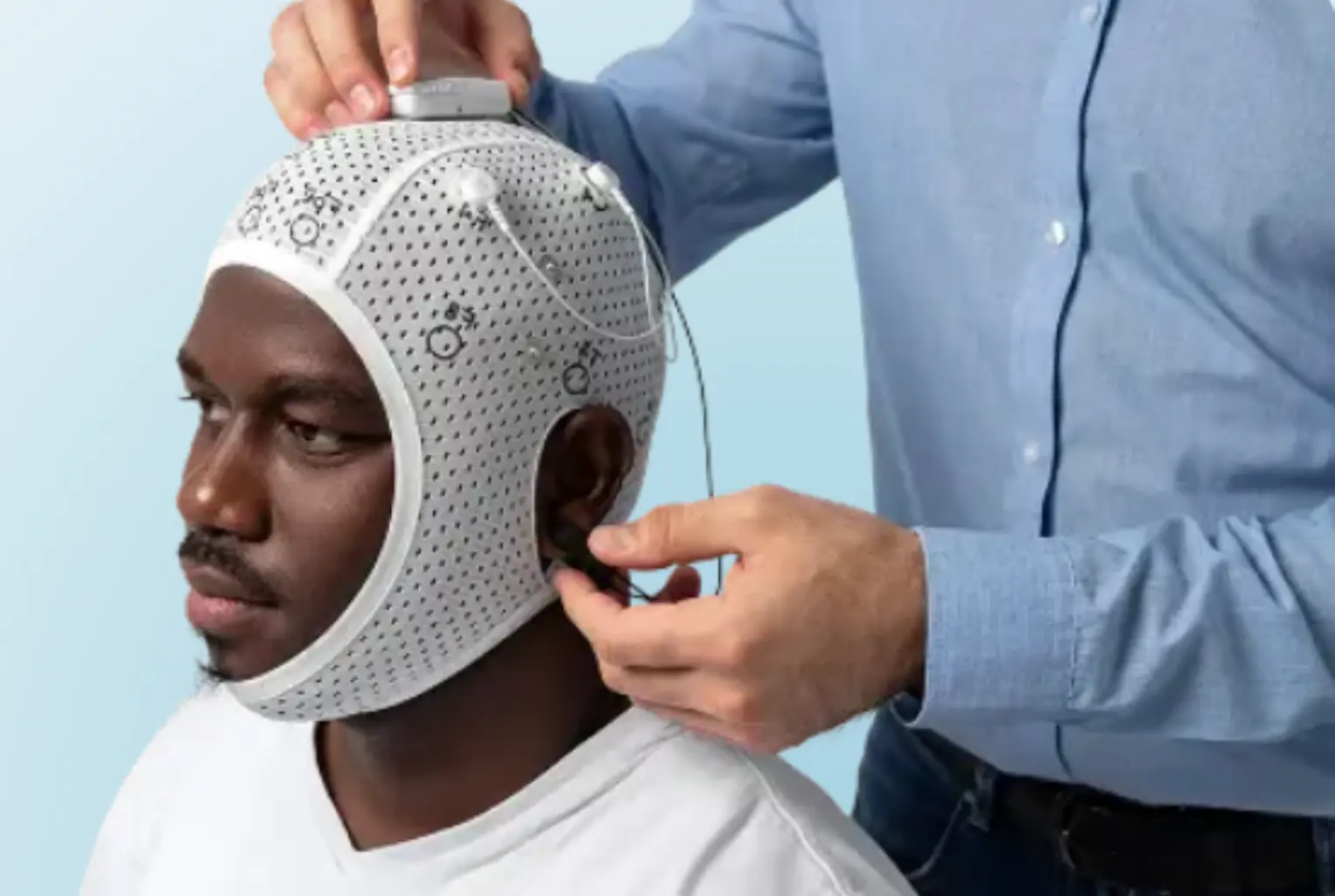
Certified EEG technician with hands-on experience conducting over 200 qEEG screenings. Our protocol is based on the FDA-cleared NEBA System methodology (2013) and normative data from six published peer-reviewed sources.
Last reviewed: April 2026 · Sources: Arns et al. (2013), Monastra et al. (1999), FDA NEBA, NICE NG87
Our Family Package (£1,095) covers two children from the same family with individual reports and a family overview — saving £95 compared to two separate screenings. Also consider using the clinical letter for a Right to Choose referral.
View Family package →The brain scan itself is identical — same protocol, same electrodes, same data. The comprehensive package adds a 20-minute face-to-face consultation where we explain your results in plain English, a formal clinical interpretation letter suitable for GPs, psychiatrists, schools, and employers, personalised next-steps guidance, and 7 days of phone/email follow-up support.
The letter is a formal clinical document summarising your screening findings, including your theta/beta ratio with z-score interpretation, attention task performance analysis, comparison against published normative data with citations, a clinical opinion on whether the results are consistent with ADHD presentation, and specific recommendations for next steps. It's formatted for medical professionals and carries peer-reviewed references.
Yes. Several SENCOs use our clinical letters as supporting evidence for EHCP applications and SEN assessments. The letter provides objective neurological data that panels can consider alongside educational psychology reports and teacher observations. We can format the letter specifically for educational contexts on request. Our parent's guide covers the full EHCP process and exam access arrangements.
Absolutely. The clinical interpretation letter includes the objective data and professional language that Access to Work assessors require. Several of our adult clients have successfully used our letters in their ATW applications to secure workplace adjustments, coaching, or equipment. We can tailor the letter's focus to workplace impact on request. Our workplace rights guide covers Access to Work (up to £66k/year), reasonable adjustments and how to apply.
Immediately after the scan, we sit with you and walk through every data point. We explain what your theta/beta ratio means in context, how your attention task compared to age norms, what your frequency bands reveal about your brain's arousal state, and whether the pattern is consistent with ADHD or suggests other possibilities. We then discuss recommended next steps — whether that's a GP referral, private psychiatrist, or further investigation.
Our letters are professionally formatted with peer-reviewed citations, z-scores, and clear clinical language. Many GPs in the region have already received our letters and used them to support CAMHS referrals or Right to Choose applications. The letter provides objective data that supplements their clinical judgement — most clinicians welcome this. Our GP appointment guide includes word-for-word scripts for presenting your results.
For 7 days after your appointment, you can reach us by phone or email with any questions about your results, your report, or your next steps. If your GP has questions about the letter, we're happy to speak with them directly. If you need the letter amended or reformatted for a specific purpose (e.g. employer vs school), we'll do that at no extra charge.
No. Even with the comprehensive package, this is an objective brain screening — not a formal ADHD diagnosis. Diagnosis requires assessment by a qualified psychiatrist or specialist. What we provide is high-quality objective data and a clinical letter that significantly supports that diagnostic process. Many clients find this accelerates their pathway to diagnosis by months or even years.
Yes, though we recommend booking comprehensive from the start if you think you'll need the consultation and letter. The consultation is most effective immediately after the scan when we can show you the live data on screen. If you've already had a standard screening, contact us to discuss adding a consultation and letter at a reduced upgrade rate.
Allow approximately 50 minutes total: 5 minutes for cap setup, 7 minutes for the three-phase EEG recording, and 20 minutes for the results consultation. The PDF report and clinical letter are emailed to you the same day. Some clients find the consultation naturally extends a few minutes if there's a lot to discuss — we don't rush you.
A 60-second look at the ADHD brain screening experience.
Secure online payment. We'll confirm your appointment within 24 hours.