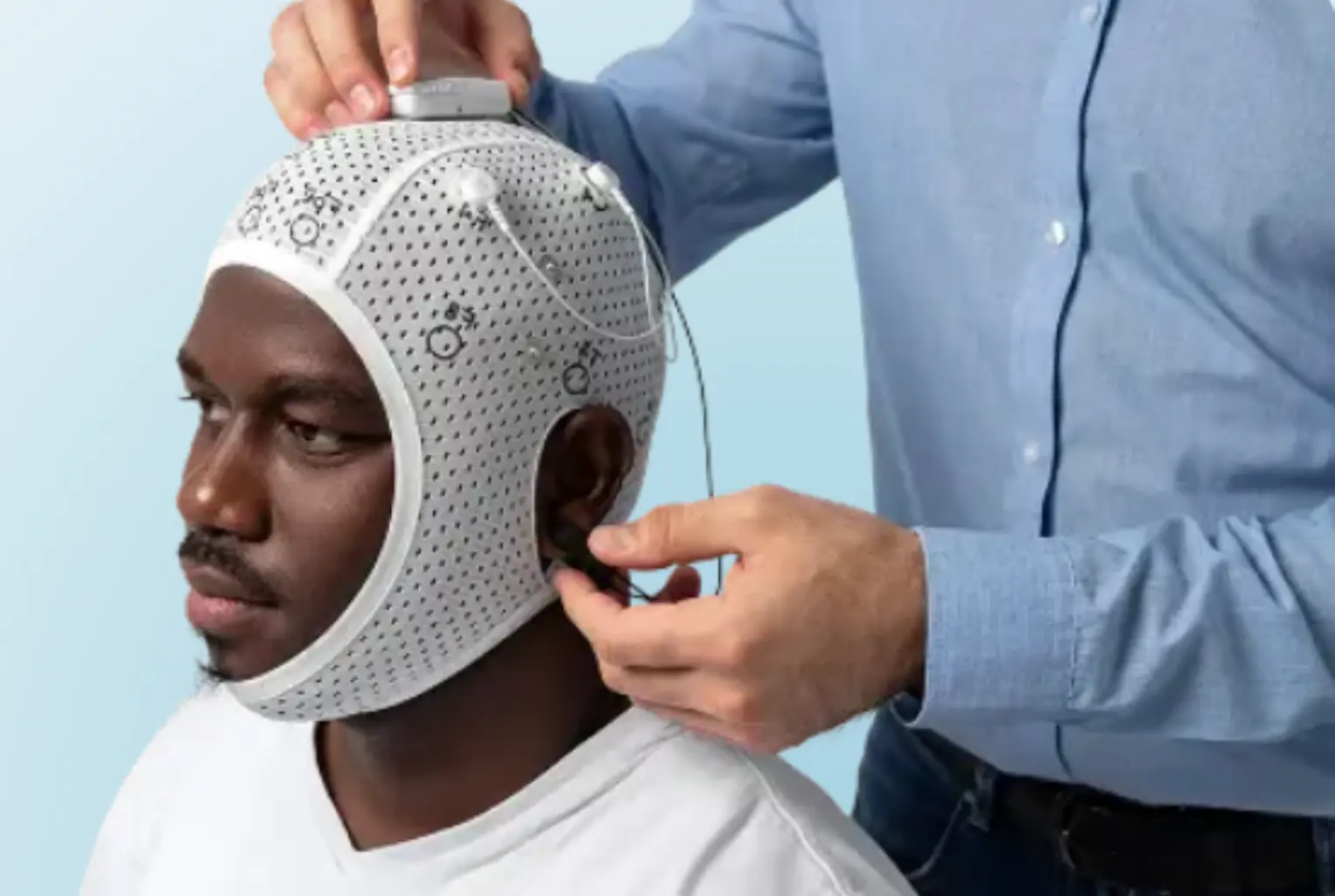
You’re not lazy. You’re not “just anxious.” You’re not bad at being an adult. You might have a neurological condition that was designed to be invisible in people like you — and we can measure it.
The diagnostic criteria for ADHD were built from studies of hyperactive boys in the 1970s. The loud, disruptive child who can’t sit still. The kid who gets sent out of class. That stereotype became the clinical blueprint — and everything that didn’t match it got missed.
Women and girls with ADHD rarely match that blueprint. Instead of hyperactivity, you got internal restlessness. Instead of being disruptive, you became a people-pleaser who masked. Instead of failing at school, you overcompensated with anxiety-driven perfectionism. And because you didn’t look like the stereotype, nobody thought to check.
3:1
Boys are diagnosed with ADHD three times more often than girls — not because boys have it more, but because the diagnostic system was built to find them. Research suggests the true ratio may be closer to 1:1.
The gap between who has ADHD and who gets diagnosed
Childhood diagnosis ratios versus likely true prevalence. The system was built around hyperactive boys — girls and women fall through it.
The result? Millions of women living with undiagnosed ADHD, often misdiagnosed with anxiety, depression, borderline personality disorder, or chronic fatigue. By the time many women reach their 30s or 40s, they’ve internalised their struggles as personal failings. “If I just tried harder.” “Everyone else manages.” “I’m just not good enough.”
Standard ADHD screening questionnaires ask about behaviours: “Do you fidget?” “Do you interrupt people?” “Do you leave your seat?” Women who’ve spent decades masking these behaviours will score low — even if their brain is screaming with ADHD. Our qEEG screening measures the neurology directly. Your brain can’t mask a theta/beta ratio — a biomarker validated by Arns et al. (2013) and referenced in the FDA-cleared NEBA System.
Sound familiar?
How ADHD actually presents in women
Forget the stereotype of the hyperactive boy. This is what ADHD looks like when you’ve spent your whole life compensating.
Mental overwhelm
Your mind never stops. A thousand tabs open. You can’t prioritise because everything feels equally urgent. The mental load of running a household or managing a career feels crushing — not because it’s too much, but because your brain can’t filter what matters.
Masking & perfectionism
You appear competent, organised, successful. Nobody sees the 3am panic planning, the obsessive list-making, the paralysing fear of being “found out.” Your coping strategy is perfectionism — and it’s exhausting.
Emotional sensitivity
Rejection sensitivity disproportionate to the situation. Quick to tears. Intense emotional reactions that others call “dramatic” or “oversensitive.” This isn’t a personality flaw — it’s neurological.
Exhaustion from compensating
By Friday you’re destroyed. Not from the work itself, but from the invisible effort of staying organised, staying focused, and staying “normal.” Weekends are for recovering, not living.
Time blindness & deadlines
You’re always running late despite caring deeply about punctuality. Projects expand to fill all available time. You can’t estimate how long things take. “I’ll just do this quickly” turns into three hours.
Hyperfocus then abandonment
New hobby? All in for two weeks. Then nothing. New project? Obsessively productive, then suddenly can’t look at it. It’s not laziness — it’s dopamine-driven attention that you can’t steer.
Misdiagnosed as anxiety
You’ve been given SSRIs for anxiety. Maybe they helped a bit. But the underlying restlessness, the overwhelm, the inability to switch off — that never went away. Because it’s not anxiety. It’s ADHD.
Triggered by motherhood
Many women’s ADHD becomes unmanageable after having children. The increased cognitive load, sleep deprivation, and loss of structured routine overwhelms the coping strategies that held things together before.
Beyond questionnaires
Why brain screening is particularly important for women
Women who mask their ADHD symptoms will often score low on standard behavioural questionnaires. They’ve learned to suppress fidgeting, rehearse social responses, and build elaborate systems to compensate. A clinician who relies only on questionnaire scores may conclude “not ADHD” — when the underlying neurology tells a completely different story.
Our qEEG screening bypasses the behaviour entirely. It measures the electrical activity of your brain — specifically the theta/beta ratio, the most-studied EEG biomarker for ADHD. Theta activity (slow waves, unfocused states) relative to beta activity (fast waves, focused concentration). If your cortex is hypoaroused, we’ll see it in the data — regardless of how well you’ve learned to hide it socially.
89-94%
Accuracy when theta/beta ratio data is combined with clinical evaluation, according to the American Academy of Neurology. Your clinician brings the interview. We bring the brain data. Together, they cut through the masking.
This is why several GPs in our region now specifically recommend our screening for women who present with anxiety or depression symptoms that haven’t fully responded to treatment. The report provides the objective evidence they need to pursue an ADHD assessment pathway.
Your brain data doesn’t mask
The theta/beta ratio measures cortical arousal directly. It doesn’t depend on how well you’ve learned to compensate, how put-together you appear, or whether a GP thinks you “look like you have ADHD.” If your prefrontal cortex is underactivated, the data shows it.
The misdiagnosis problem
What women with undiagnosed ADHD are often told instead
Common misdiagnoses in women
Generalised anxiety disorder
Depression / recurrent depressive disorder
Borderline personality disorder
Chronic fatigue syndrome
Bipolar disorder (type II)
“Stress” or “burnout”
“Just needs to manage time better”
What brain data can reveal
Elevated theta/beta ratio (cortical hypoarousal)
Low frontal beta (executive function underactivity)
Elevated alpha (may indicate anxiety comorbidity)
Go/No-Go impulsivity and inattention metrics
Z-score deviation from age-matched norms
Objective data your clinician can act on
Evidence to differentiate ADHD from anxiety/depression
Many women have been on SSRIs for years for “anxiety” that never fully resolved. That’s because ADHD and anxiety share overlapping symptoms — but they have different neurological signatures. The NHS recognises that ADHD is diagnosed less often in women because inattentive symptoms are harder to spot. Our brain screening can help distinguish between them, giving your clinician the data to reassess your treatment approach. Read more about the science behind the screening.
The hormonal connection
How hormones affect ADHD in women
Oestrogen drives dopamine. When it drops, ADHD gets worse.
Female ADHD symptoms track inversely to oestrogen across life. This is why so many women crash at perimenopause — and why so many are first diagnosed there.
Sources: Quinn & Madhoo (2014), NHS PMS guidance, and consensus on hormonal modulation of dopamine and executive function. Individual experience varies.
One of the most significant and least discussed aspects of female ADHD is the relationship between hormones and symptoms. Oestrogen supports dopamine function in the brain — and dopamine is exactly what ADHD brains underproduce. When oestrogen levels fluctuate or drop, ADHD symptoms can intensify dramatically. This means women often experience ADHD as a condition that changes across their lifetime, not one that stays constant.
Menstrual cycle
Many women with ADHD report that their symptoms worsen in the luteal phase (the week or two before their period) when oestrogen drops. Focus deteriorates, emotional regulation becomes harder, impulsivity increases, and the ability to cope with everyday demands plummets. This cyclical pattern is frequently misdiagnosed as PMS or PMDD — treated with SSRIs or hormonal contraceptives that address the secondary symptoms but not the underlying ADHD.
Pregnancy and postpartum
Pregnancy brings dramatic hormonal shifts. Some women find their ADHD symptoms temporarily improve during pregnancy (when oestrogen is elevated), then crash severely postpartum when oestrogen drops. Postpartum ADHD escalation is frequently misdiagnosed as postnatal depression or anxiety. The overlap is real — but if the core issue is ADHD, treating only the depression misses the root cause.
Perimenopause and menopause
For many women, perimenopause (typically mid-40s) is when ADHD becomes impossible to mask. Oestrogen declines permanently, and the compensatory strategies that worked for decades start to fail. Women who functioned adequately (if exhaustingly) for 20+ years suddenly find they can’t hold things together. This is one of the most common triggers for late ADHD diagnosis in women — and one of the most commonly misattributed to “just menopause.”
Our qEEG brain screening measures cortical arousal directly and is unaffected by where you are in your hormonal cycle. The theta/beta ratio reflects your underlying neurology, not your current oestrogen level. This makes it particularly valuable for women whose symptoms fluctuate — the brain data provides a stable, objective baseline that hormonal variation doesn’t obscure.
ADHD and motherhood
When your child’s diagnosis leads to your own
One of the most common routes to ADHD diagnosis for women is through their children. A mother takes her son or daughter for assessment, reads about ADHD symptoms during the process, and has a moment of recognition: “Wait — that sounds exactly like me.” ADHD has a strong genetic component. If your child has ADHD, the probability that a parent does too is significantly elevated.
Motherhood with undiagnosed ADHD is a particular kind of exhaustion. The mental load — school forms, packed lunches, appointment schedules, birthday parties, homework supervision — requires exactly the executive function skills that ADHD impairs. Women with ADHD often describe feeling like they’re failing at motherhood while watching neurotypical mothers appear to manage effortlessly. The guilt is compounding: not only are you struggling, but you’re struggling with something that “should” come naturally.
If this resonates, our family screening package (£1,095) is designed for exactly this situation — screening both parent and child with individual reports. Many families discover that understanding both brains transforms the household dynamic entirely. See our children’s screening guide and adult screening guide for more on each pathway.
Girls & ADHD
Spotting ADHD in your daughter
Everything that applies to women applies to girls — just earlier, and with higher stakes. A girl with undiagnosed ADHD doesn’t just struggle at school. She internalises the struggle as “I’m stupid” at an age when self-concept is still forming.
Girls with ADHD are more likely to present with the inattentive subtype: daydreaming, slow processing, losing things, difficulty following multi-step instructions. They’re less likely to be disruptive, which means they’re less likely to be flagged by teachers. They often compensate by working harder than their peers — getting adequate grades through sheer effort rather than ease.
We screen children aged 6 and above with age-specific norms for each age group. If you’re concerned about your daughter, our screening provides the objective data that can kickstart the process — whether that’s a GP referral, a Right to Choose application, or evidence for an EHCP.
Screening siblings? Our Family Package (£1,095) covers two children with individual reports and a comparative overview.
You’re not broken. Your brain just works differently.
Years of being told you’re anxious, lazy, or not trying hard enough. Objective brain data can finally give you — and your GP — the evidence to rewrite that narrative.
What women say about us
4.9
★★★★★
Based on 199 verified reviews
★★★★★
I’m 42 and was diagnosed with ADHD last month — this brain scan was the catalyst. For years I thought I was just bad at adulting. Seeing the actual data was validating in a way no questionnaire ever was.
SC
Sophie Campbell
Age 42 · March 2026
Verified client
★★★★★
My daughter is the quiet, daydreamy type — not hyperactive at all. Everyone dismissed our concerns because she wasn’t disruptive. The scan showed elevated theta. Inattentive ADHD, exactly as we suspected.
RA
Rachel Adams
Parent of girl (11) · February 2026
Verified client
★★★★★
Women with ADHD are chronically underdiagnosed. This screening provides objective data that helps cut through the diagnostic bias. I now recommend it to female patients who suspect ADHD.
LH
Dr Leila Hassan
Psychiatrist · February 2026
Healthcare professional
★★★★★
I’d been on sertraline for “anxiety” for 6 years. This scan showed elevated TBR and low frontal beta — classic ADHD pattern. My GP switched me to an ADHD pathway. The sertraline was treating the symptom, not the cause.
JH
Jenny Harris
Age 38 · March 2026
Verified client
★★★★★
My ADHD became unmanageable after my second child. I thought it was postnatal depression. The brain scan showed otherwise. Now diagnosed and on Elvanse — life-changing. I wish I’d known 10 years ago.
KW
Kate Woodward
Age 35, mother of 2 · March 2026
Verified client
★★★★☆
Really professional experience. My results came back borderline — elevated but not dramatically. They were honest about what that means and suggested comprehensive assessment. Appreciated the transparency rather than overselling.
AM
Alison Murray
Age 29 · January 2026
Verified client
★★★★★
Got screened after my daughter was diagnosed. Turns out the apple doesn’t fall far. My TBR was even higher than hers. 39 years of “why can’t I just be normal” finally explained. Cried in the car park. Happy tears.
TE
Tanya Edwards
Age 39 · March 2026
Verified client
★★★★★
The clinical letter was key. My GP had dismissed ADHD twice because I “didn’t seem hyperactive.” The brain data changed his mind. Right to Choose referral accepted within two weeks.
NR
Nicola Richardson
Age 44 · February 2026
Verified client
★★★★★
I used the report for my Access to Work application. Having neurological evidence rather than just a self-reported questionnaire made all the difference. Approved for coaching and noise-cancelling headphones.
PJ
Priya Jayawardena
Age 31 · January 2026
Verified client
★★★★★
My therapist suggested I look into ADHD after years of anxiety treatment not fully working. The brain scan confirmed elevated TBR. Knowing it’s neurological — not a character flaw — has changed how I relate to myself.
LC
Laura Chen
Age 33 · March 2026
Verified client
★★★★★
Screened both my daughters together. One classic inattentive — the daydreamer. The other combined type — more obvious. Without the scan, we’d have only pursued assessment for the noisy one. The quiet one needed it more.
CP
Claire Pemberton
Mother of 2 girls · March 2026
Verified client
★★★★★
At 51 I finally understand why my career has been a rollercoaster of brilliant starts and abandoned projects. The scan data was undeniable. I’m not lazy. I’m not broken. My brain just works differently.
DH
Diana Henderson
Age 51 · February 2026
Verified client
★★★★★
The medication comparison scan three months later showed my TBR dropping from 4.2 to 2.1 on Elvanse. Objective proof the meds are working. My psychiatrist said it was the clearest evidence she’d seen.
SC
Sarah Collins
Age 36, medication scan · March 2026
Verified client
Scroll for more reviews →
Questions from women
Everything women ask us about ADHD screening
ADHD diagnostic criteria — as outlined in NICE guidelines (NG87) — were developed primarily from studies of hyperactive boys. Women and girls more often present with inattentive symptoms — daydreaming, disorganisation, internal restlessness — which don’t match the stereotypical image. Add masking behaviours and compensatory strategies, and the result is a condition that’s systematically overlooked. Our brain screening measures the neurology directly, bypassing the behavioural bias.
Yes. That’s the whole point. Questionnaires measure reported behaviour — which masking distorts. Our qEEG measures electrical brain activity directly. Your theta/beta ratio reflects your cortical arousal state regardless of how well you’ve learned to compensate socially. Your brain can’t fake a TBR.
Possibly. ADHD and anxiety share overlapping symptoms (restlessness, difficulty concentrating, sleep problems) but have different neurological signatures. Our screening can help differentiate: elevated TBR suggests cortical hypoarousal (ADHD pattern), while elevated alpha may indicate anxiety. Many women have both — the scan data helps your clinician untangle which is primary. See our science page for more on frequency bands.
This is exactly why we exist. The comprehensive package includes a clinical interpretation letter with z-scores and peer-reviewed citations — objective neurological evidence your GP can’t dismiss as subjective. Several women have successfully used our reports to overturn a GP’s initial dismissal and secure a Right to Choose referral. See our guide on ADHD evidence for your GP.
Absolutely. We screen girls aged 6 and above with age-specific norms. The inattentive presentation — quiet, dreamy, slow to process — is exactly what our EEG screening is designed to detect. The brain data doesn’t care whether your daughter is disruptive or not — it measures cortical arousal directly.
Hormonal fluctuations can affect ADHD symptoms and potentially EEG readings. For the most representative results, we suggest booking during a time when you feel “typically yourself” rather than during PMS or perimenstrual days when symptoms tend to worsen. That said, a screening at any point provides useful data — we note the context in your report.
Yes. The comprehensive package includes a clinical letter that Access to Work assessors accept. Several women have used our reports to secure workplace coaching, assistive technology, and reasonable adjustments.
Extremely common. The increased cognitive load, sleep deprivation, reduced personal structure, and hormonal changes of motherhood can overwhelm the coping strategies that previously kept ADHD manageable. Many women first seek assessment after becoming mothers. Our screening can provide objective data on whether ADHD is contributing to what might feel like “just struggling with motherhood.”
Same-week appointments are usually available. Contact us or book directly via our pricing page. We’re based in Macclesfield, Cheshire — accessible from Manchester (30 min), Stockport (20 min), Wilmslow (10 min), and the wider North West.
Yes. Oestrogen supports dopamine function, so ADHD symptoms often worsen when oestrogen drops — before your period, postpartum, and during perimenopause. Many women report a cyclical pattern where focus and emotional regulation deteriorate in the luteal phase. Our brain screening measures cortical arousal directly and is unaffected by hormonal fluctuations, providing a stable baseline.
Absolutely. Perimenopause is one of the most common triggers for women seeking ADHD assessment, because declining oestrogen unmasks symptoms that were previously manageable. The screening is equally valid at any life stage and provides objective data your GP or psychiatrist can use alongside your hormonal history.
You’re not broken. Your brain just works differently.
Get the data that explains what you’ve always felt. Same-day report. Objective evidence.