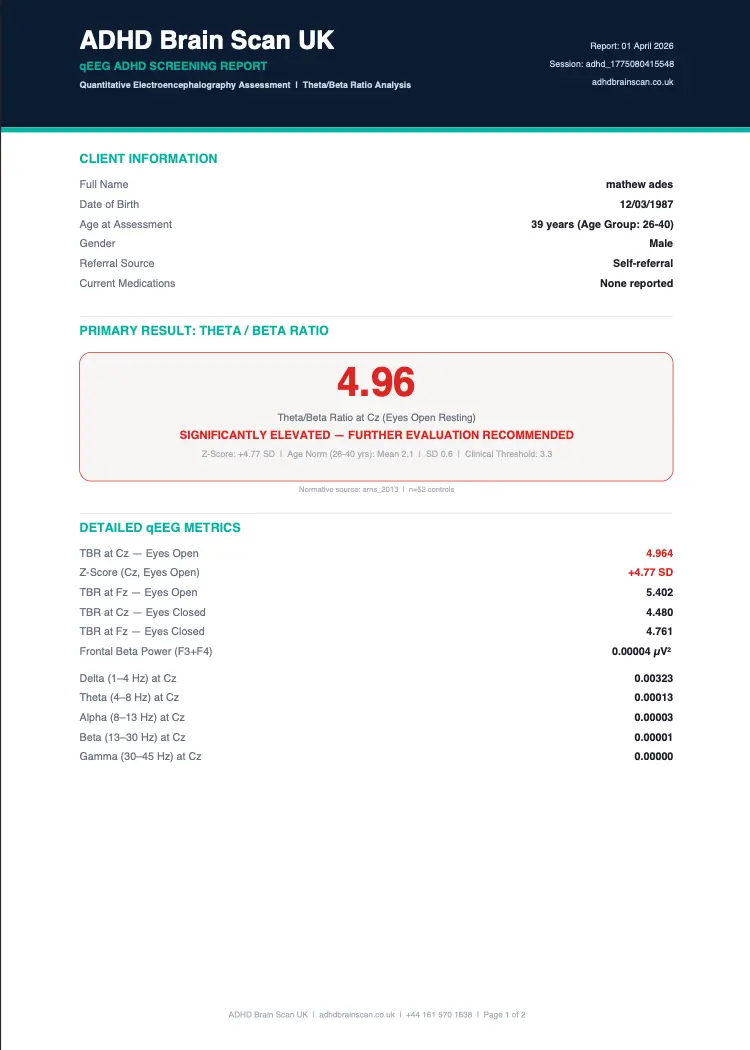
Our foundational qEEG screening. Objective brain data measuring the FDA-referenced theta/beta ratio, a full sustained attention task, and a professional report your GP will take seriously. All in one 30-minute session. Our results explained guide walks you through every metric.
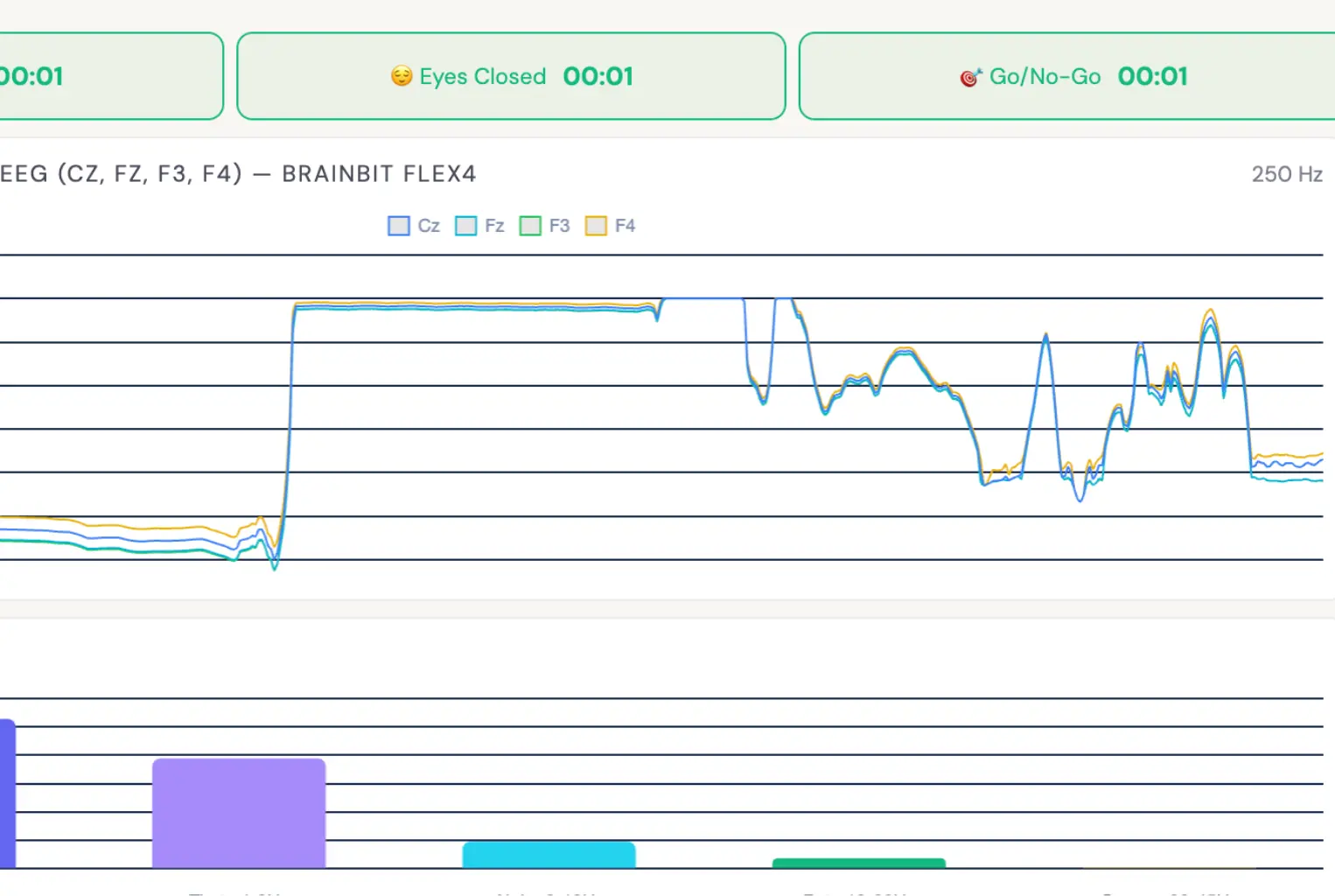
Two minutes eyes-open resting EEG, two minutes eyes-closed, and a three-minute Go/No-Go sustained attention task. Covers all the recording conditions used in published ADHD research.
We measure the theta/beta ratio at electrode Cz — the exact site specified in the FDA clearance of the NEBA system — plus Fz as a secondary corroborating site.
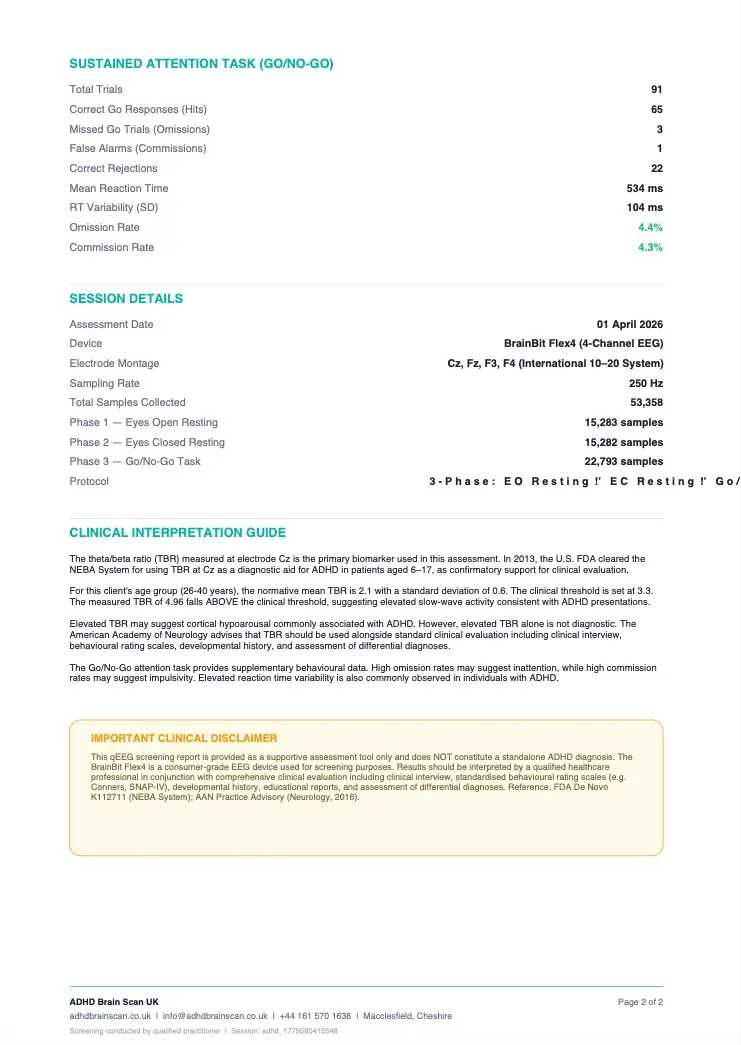
A computerised task measuring reaction time, omission errors (inattention markers), commission errors (impulsivity markers), and response time variability.
Your results are compared against age-matched norms from 311+ research subjects across published peer-reviewed datasets. We show exactly how many standard deviations you fall from the healthy average.
Complete spectral decomposition across all five EEG bands: delta, theta, alpha, beta, and gamma. Each frequency tells a different story about your brain's arousal and processing state.
A comprehensive clinical-grade report including all metrics, z-scores, normative citations, Go/No-Go performance, and a clinical interpretation guide. Designed to present to your GP or psychiatrist.
This screening is ideal for parents concerned about their child's attention, adults who suspect they may have ADHD, women who've been missed, or anyone who wants objective neurological data before committing to a full private assessment. It provides the evidence — your clinician provides the diagnosis. See our parent's guide or next steps guide for what happens after.
When you book your ADHD brain screening, we send you a short intake form to complete before your appointment. This covers basic details, presenting concerns, any existing diagnoses, and current medications. Completing this beforehand means we can use your full 30-minute appointment for the actual screening rather than paperwork. We recommend washing your hair on the morning of your appointment with no heavy products, wax, or oils — clean hair ensures the best possible electrode contact and signal quality.
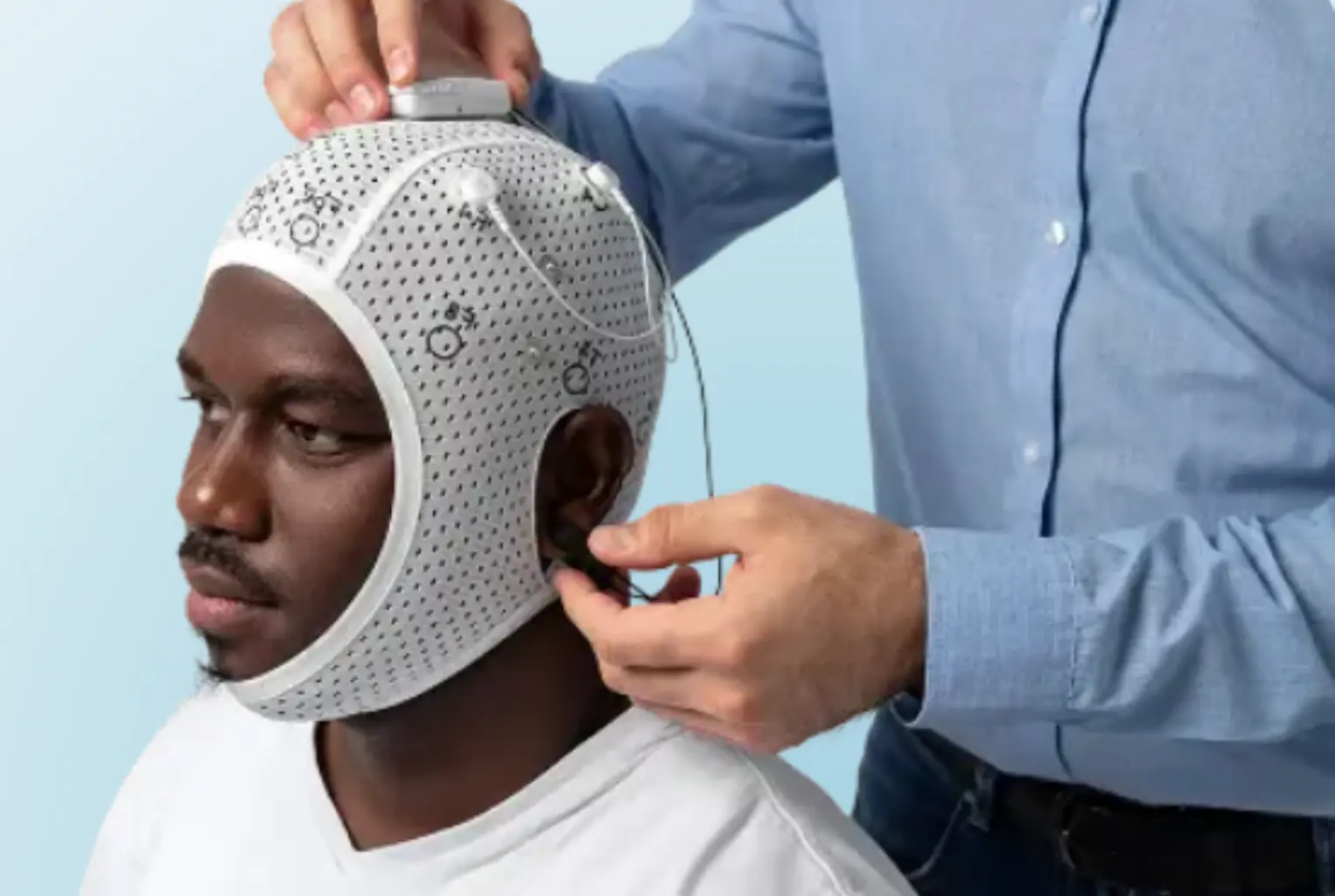
When you arrive at our Macclesfield clinic, we walk you through the process and answer any questions. We then place a lightweight EEG cap on your head with four medical-grade electrodes positioned at international 10-20 system locations: Cz (central midline), Fz (frontal midline), F3 (left frontal), and F4 (right frontal). These are the exact electrode sites used in published ADHD research, including the FDA-cleared NEBA System. We apply a small amount of conductive gel to each electrode site to ensure clean signal acquisition. The entire setup is completely painless — the electrodes simply sit on the surface of the scalp and listen to the tiny electrical signals your brain naturally produces. No electricity enters your body at any point. Children can sit with a parent present throughout, and we take extra time to make younger subjects feel comfortable.
The actual EEG recording consists of three phases. First, two minutes of eyes-open resting EEG — you sit still, look at a fixation point, and relax while we record your baseline brain activity. This condition captures your resting-state theta/beta ratio, the primary metric used in ADHD screening research. Second, two minutes of eyes-closed resting EEG — we ask you to close your eyes and remain calm while we capture your alpha blocking response and resting-state spectral profile. The eyes-closed condition is important because it reveals your alpha rhythm dynamics and provides a comparison condition for detecting abnormal spectral patterns. Third, a three-minute Go/No-Go sustained attention task — you watch a screen and press a button when you see a target stimulus, while inhibiting your response to non-target stimuli. This computerised task directly measures your brain's ability to sustain attention, control impulses, and maintain consistent response timing — the exact cognitive functions affected by ADHD.
The recording environment is quiet and calm, designed to minimise external distractions that could affect your data quality. For children, a parent can remain in the room throughout. We allow breaks between recording phases if needed, and for younger children we take extra care to ensure they are settled and comfortable before each phase begins. Saturday morning appointments are popular with families for this reason — children tend to be more rested and cooperative. The entire appointment from arrival to completion typically takes 30 minutes, including setup and a brief informal discussion of what to expect from your report.
During the seven-minute protocol, our system captures your raw EEG data and processes it using Fast Fourier Transform (FFT) analysis to extract the power spectral density across all five standard frequency bands: delta (1-4 Hz), theta (4-8 Hz), alpha (8-13 Hz), beta (13-30 Hz), and gamma (30-45 Hz). The primary metric is your theta/beta ratio (TBR) at electrode Cz — the exact biomarker studied in over 1,770 ADHD subjects across published meta-analyses and the basis for the FDA's 2013 NEBA clearance. The Go/No-Go task produces four additional metrics: mean reaction time, omission errors (missed targets indicating inattention), commission errors (false responses indicating impulsivity), and reaction time variability (inconsistency — a hallmark of ADHD).
Every client receives their report by email on the same day as their screening. The report is a comprehensive clinical-grade PDF designed to be presented directly to a GP, psychiatrist, CAMHS team, school SENCO, or employer.
The report presents your theta/beta ratio at electrodes Cz and Fz as both absolute values and z-scores compared against our normative database of 311+ research subjects compiled from six published peer-reviewed sources including Arns et al. (2013) and Monastra et al. (1999). A z-score above +1.5 at electrode Cz is considered clinically significant for ADHD screening purposes.
The full spectral decomposition shows your relative power across all five frequency bands, providing context for interpreting your TBR results. Your Go/No-Go attention task results cover mean reaction time, omission errors, commission errors, and reaction time variability — each compared against age-appropriate norms. Our results explained guide walks you through every metric in detail.
The report concludes with clinical context citing the relevant peer-reviewed literature and clear next-steps guidance. Common pathways include presenting it to your GP to support a referral, using it for a Right to Choose application, providing it to a private psychiatrist, or submitting it for an EHCP application. Our GP appointment guide includes word-for-word scripts for presenting your results. The NICE ADHD guidelines (NG87) and NHS ADHD pathway both support additional clinical evidence alongside standard assessment.
Average NHS waiting times for ADHD assessment now exceed two to five years in many areas of the UK, with some regions reporting waits of seven years or more. During this wait, children may fall behind academically, adults may struggle at work, and families experience significant stress without formal support.
When an NHS assessment does eventually happen, it relies entirely on subjective measures — clinical interviews, behavioural questionnaires such as the Conners Rating Scale or DIVA-5, school observations, and developmental history. There is no standard brain measurement in the conventional NHS ADHD diagnostic pathway.
Our screening fills this gap. The American Academy of Neurology reports that combining the theta/beta ratio with clinical evaluation achieves an accuracy of 89-94%. Whether you are on the NHS list, pursuing Right to Choose, or going private, objective brain data strengthens every pathway.
For women and girls, who are systematically underdiagnosed because inattentive ADHD lacks visible hyperactivity, objective brain data is particularly valuable. The theta/beta ratio is elevated across all three ADHD presentations, making it useful regardless of how symptoms manifest outwardly. If you have spent years wondering why you struggle with organisation, time management, and sustained focus despite being intelligent and capable, our screening provides a quantitative answer that goes beyond self-report.
ADHD rarely occurs in isolation. Research published by the National Institute for Health and Care Excellence (NICE) estimates that up to 80% of individuals with ADHD have at least one co-occurring condition. Common comorbidities include anxiety disorders, depression, autism spectrum conditions, dyslexia, oppositional defiant disorder in children, and sleep disorders. Some of these conditions can independently influence EEG patterns, which is why our reports include detailed recording conditions and contextual notes to help clinicians interpret your results appropriately. A skilled clinician reviewing your qEEG data alongside your developmental history, behavioural symptoms, and known comorbidities can distinguish between different causes of an elevated theta/beta ratio. Our coping strategies guide covers practical approaches that work alongside formal assessment.
Our ADHD brain screening is most valuable for several groups. Parents of children aged 6 and above who are on long NHS waiting lists and need objective evidence to expedite referrals or support EHCP applications. Adults who have spent years wondering whether their difficulties with focus, organisation, and time management might have a neurological basis. Women and girls who are statistically underdiagnosed due to the inattentive presentation being less visible to teachers and parents. Teenagers approaching exams who need evidence for access arrangements or additional support. Individuals already on ADHD medication who want objective evidence of whether treatment is producing the expected neurological change — our medication comparison scan (£345) is designed specifically for this purpose. And professionals who need neurological evidence for Access to Work applications or workplace reasonable adjustment requests under the Equality Act 2010.
The internet is full of ADHD self-assessment tools — questionnaires like the ASRS (Adult ADHD Self-Report Scale) or informal symptom checklists. While these can be a useful first step in recognising possible ADHD symptoms, they measure only self-reported behaviour and are subject to mood, expectation, and recall bias. They cannot measure what is actually happening inside your brain. Our qEEG screening directly measures the electrical activity of your cortex and compares it against published normative databases using the same methodology that led to the FDA's first-ever clearance of a brain wave test for ADHD. The difference is the difference between guessing and measuring — between opinion and data. If you want to move beyond questionnaires and get objective neurological evidence, this screening provides exactly that.
Your report arrives by email as a professional PDF on the same day as your screening. We recommend reading our results explained guide alongside your report — it walks through every metric, explains what your z-scores mean in plain language, and helps you understand whether your brain activity pattern is within normal limits, borderline, or significantly elevated. If your theta/beta ratio z-score at electrode Cz is above +1.5, this is considered clinically significant and provides objective evidence that your brain's arousal pattern is consistent with published ADHD research findings.
It is important to understand what a normal result means. A theta/beta ratio within the normal range does not definitively rule out ADHD — some individuals with ADHD, particularly those with predominantly hyperactive-impulsive presentation, may not show the classic elevated TBR pattern. Conversely, an elevated TBR in isolation does not confirm ADHD, as other factors such as fatigue, medication effects, or comorbid conditions can influence the ratio. This is precisely why our reports are designed as supplementary evidence for a qualified clinician, not as a standalone diagnostic tool. The combination of objective brain data with clinical expertise produces the most accurate assessment — an approach endorsed by the American Academy of Neurology with reported accuracy of 89-94%.
The most common next step is to book a GP appointment and present your report. Our GP appointment guide includes word-for-word scripts for explaining qEEG technology to a doctor who may not be familiar with it. Key points to emphasise include: the theta/beta ratio is an FDA-referenced biomarker, your results are compared against published peer-reviewed normative data, and the American Academy of Neurology endorses its use as a supplementary diagnostic tool. Many GPs welcome objective neurological data because it strengthens their referral letters to CAMHS or adult ADHD services. Our evidence for your GP guide provides additional context for healthcare professionals.
Not everyone takes the GP route. Some clients use their report to support a Right to Choose referral to a private provider such as Psychiatry-UK at NHS cost. Others present it directly to a private psychiatrist as supplementary neurological evidence alongside their clinical assessment. Parents frequently use the report as part of an EHCP application for their child, where objective neurological data strengthens the case for additional school support, exam access arrangements, or specialist provision. Adults may use the report for Access to Work applications or workplace reasonable adjustment requests. Whatever pathway you choose, our ADHD support hub provides comprehensive guidance for every step.
If you receive an ADHD diagnosis and start medication, you may want to return for a medication comparison scan (£345). This follow-up screening uses the same protocol to measure your brain activity on medication, producing a before-and-after comparison that shows objective changes in your theta/beta ratio and attention task performance. This data provides both you and your prescriber with quantitative evidence of whether your medication is producing the expected neurological change, whether a dosage adjustment might be needed, or whether a different medication class might be more effective. Read our full medication guide for information on all UK ADHD medication options.
If after receiving your report you feel you would benefit from a detailed results consultation, you can upgrade to our Comprehensive Assessment by paying the difference (£250). This adds a 20-minute consultation where we walk through every metric in your report, answer your questions, and provide a written clinical interpretation letter designed for your GP or psychiatrist. Families with more than one child may also consider our Family Package (£1,095) for future screenings.
Certified EEG technician with hands-on experience conducting over 200 qEEG screenings for children, adolescents, and adults. Our screening protocol is based on the FDA-cleared NEBA System methodology (2013) and normative data from six published peer-reviewed sources.
Last reviewed: April 2026 · Sources: Arns et al. (2013), Monastra et al. (1999), FDA NEBA Clearance, NICE NG87
The Comprehensive Assessment (£845) adds a 20-minute consultation and clinical interpretation letter for your GP, school SENCO, or employer. The Family Package (£1,095) screens two family members. See all pricing.
Our Comprehensive ADHD Assessment (£845) includes everything above plus a 20-minute results consultation, written clinical letter, and personalised next-steps guidance.
View Comprehensive package →A quantitative EEG (qEEG) measures the electrical activity of your brain using sensors placed on your scalp via a lightweight cap. It's completely non-invasive — no needles, no radiation, no discomfort. We analyse the patterns in your brain waves, specifically the ratio between theta and beta frequencies, which is an FDA-referenced biomarker for ADHD.
No. This is an objective brain screening that provides quantitative data to support or inform a clinical evaluation. ADHD diagnosis requires a comprehensive assessment by a qualified clinician. Our report is designed as additional objective evidence to present to your GP or psychiatrist alongside their clinical evaluation. Our next steps guide explains every pathway from screening to diagnosis.
The American Academy of Neurology reports an accuracy of 89-94% when the theta/beta ratio is combined with clinical evaluation. As a standalone measure, sensitivity is approximately 58% and specificity 74%. This is why we position our screening as supporting data for a clinician's assessment, not a standalone diagnostic tool.
We screen children aged 6 and above, adolescents, and adults of all ages. Our normative database includes age-matched reference data for 10 different age groups from 6-7 years through to 60+, all sourced from published peer-reviewed research.
Our reports include peer-reviewed citations, z-scores against published normative data, and clear clinical context. They are designed to provide objective supplementary data that a GP can use alongside their clinical evaluation. Many GPs welcome neurological data and have used our reports to expedite CAMHS referrals. See our GP evidence guide and GP appointment guide with word-for-word scripts.
A private ADHD assessment (typically £700-£1,500) involves a conversation with a psychiatrist using questionnaires and clinical interview — no brain measurement at all. We provide something they don't: actual objective brain data. Many clients use our screening to support their private assessment, or to provide evidence to their GP for an NHS referral or Right to Choose application.
Wash your hair on the day of the test (avoid heavy styling products, wax, or oils). Try to avoid excessive caffeine on the morning of the scan. If you or your child takes ADHD medication, speak with your prescribing clinician about whether to take it before the screening — we can accommodate either way.
Completely painless and completely safe. The electrodes simply sit on the scalp and listen to the tiny electrical signals your brain naturally produces. No electricity goes into the body at all. Children aged 6 and above tolerate it well — the hardest part is sitting still for a few minutes, which is over quickly.
We are based in Macclesfield, Cheshire — easily accessible from Manchester, Stockport, Wilmslow, Knutsford, and the wider North West. Free parking is available on site. We also offer clinic sessions at selected locations across the region by arrangement.
Your professional PDF report is generated immediately after the screening session and emailed to you the same day. If you've booked the Comprehensive package, we discuss the results with you during the 20-minute consultation immediately after the scan. Our results explained guide helps you understand every metric in your report.
A 60-second look at the ADHD brain screening experience.
Secure online payment. We'll confirm your appointment within 24 hours.