Your child's school says they can't focus. The NHS waiting list is years long. A private psychiatrist costs £1,500 for a conversation. What if you could get objective brain data instead — in 30 minutes, for a fraction of the cost?
Your child is bright — everyone says so. But homework is a battlefield. Their teacher says they "just need to try harder." Reports describe a child who is "easily distracted" and "not meeting potential." You've read the articles. You've taken the online quizzes. You're fairly certain your child has ADHD. But now what?
The NHS route means a CAMHS referral from your GP, then a waiting list. The average wait is 2-3 years in most of England. In some areas it's closer to 5. The NICE guidelines (NG87) recommend timely assessment, but the system can't deliver it. Your child doesn't have 2-3 years to wait — they're struggling now, falling behind now, losing confidence now. Read our guide on NHS ADHD waiting list alternatives for more on this.
The private route means £700-£1,500 for a psychiatrist assessment. But here's the thing most parents don't realise: that assessment is almost entirely based on conversation. Questionnaires. Rating scales. A clinical interview. There is no brain scan, no brain measurement, no objective test. It's a professional opinion — a qualified one, but an opinion nonetheless.
177,404
Children and young people were on NHS ADHD and autism waiting lists in England as of 2024. Many will wait years before being seen.
What each year of waiting costs your child
A child diagnosed at 7 and a child diagnosed at 12 don’t just differ by five years — they differ by five critical developmental windows.
That's exactly what our screening provides. We measure your child's actual brain activity using quantitative electroencephalography (qEEG). Specifically, we measure the theta/beta ratio — the most-studied brain biomarker for ADHD, referenced in the 2013 FDA clearance of the NEBA System. We compare the results against age-matched published norms from 311+ research subjects. And we give you a professional report the same day.
This isn't a diagnosis — only a qualified clinician can diagnose ADHD. But it's something no questionnaire can give you: objective neurological evidence. Evidence your GP can use to expedite a referral. Evidence a private psychiatrist can use alongside their assessment. Evidence that moves the conversation from "we think" to "the data shows."
Recognise the signs?
Common signs of ADHD in children
ADHD presents differently in every child. Some are hyperactive and impulsive. Others are quiet daydreamers who slip through the net. Here are the patterns parents typically notice.
Easily distracted
Starts tasks but drifts off. Can't sustain attention on homework or instructions. Seems to "zone out" mid-conversation. Loses track of what they were doing.
Hyperactive or restless
Can't sit still at the dinner table. Fidgets constantly. Talks excessively. Always on the go as if "driven by a motor." Struggles to wait their turn.
Impulsive
Acts before thinking. Blurts out answers in class. Interrupts conversations. Makes careless mistakes on work they clearly understand. Difficulty following multi-step instructions.
Emotional dysregulation
Meltdowns over minor frustrations. Difficulty managing anger or disappointment. Seems more emotionally reactive than peers. Mood shifts rapidly.
School difficulties
"Bright but underperforming." Reports say "easily distracted" and "not meeting potential." Avoids homework. Forgets to hand in work. Messy, disorganised workspace.
The quiet daydreamer
Not all ADHD is hyperactive. The inattentive type (more common in girls) presents as dreamy, spacey, slow to process, and quietly disengaged. Often missed entirely.
If you recognise several of these patterns, a brain screening can provide objective data on what's happening neurologically. An elevated theta/beta ratio — meaning more slow-wave activity than fast-wave activity — is a well-documented brain pattern associated with ADHD in children, supported by decades of published research.
Child-friendly process
How the screening works for children
We know that the irony of asking a child with suspected ADHD to sit still for a brain scan isn't lost on anyone. Here's how we make it work.
Before the scan
You book online, complete the intake form, and arrive with your child. We explain the process in age-appropriate language — no scary medical jargon. Your child can hold the cap, see the electrodes, and understand that we're just "listening to their brain." You stay in the room the entire time.
The cap
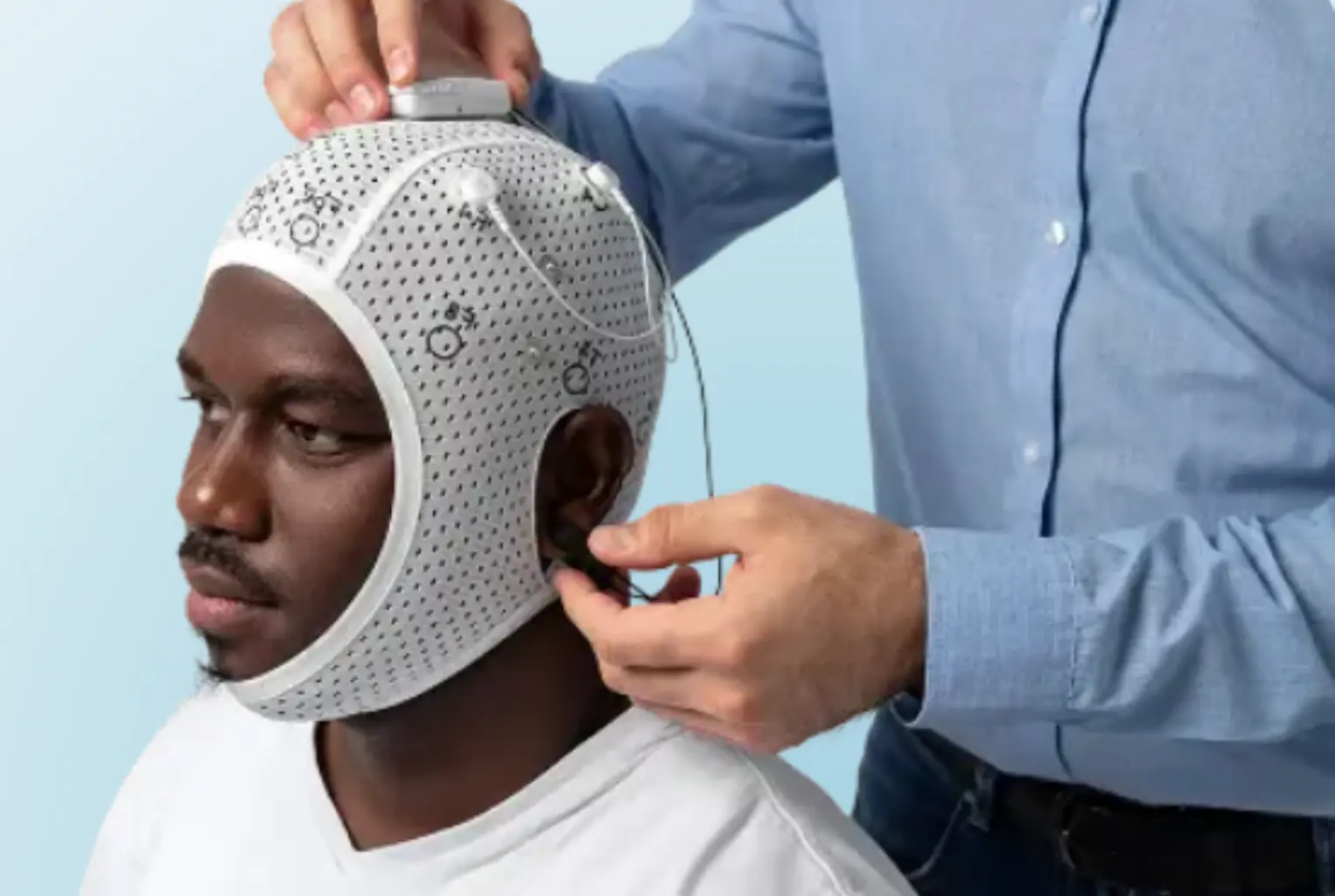
We place a lightweight textile cap on their head with four small, dry, spring-loaded electrodes. No gel, no paste, no needles, no discomfort. The electrodes sit on the scalp through the hair using gentle spring pressure. Two small clips attach to the earlobes. Setup takes about 5 minutes.
The recording (7 minutes total)
Phase 1 (2 minutes): Eyes open, looking at a cross on the screen. "Just look at the cross and try to stay still." Most children manage this well.
Phase 2 (2 minutes): Eyes closed, relaxing. "Close your eyes and relax, like you're about to fall asleep." Children often find this the easiest phase.
Phase 3 (3 minutes): The Go/No-Go game. "Press the button when you see a green circle. Don't press when you see a red square." Children generally enjoy this part — it feels like a game.
7 minutes
Total recording time. Most children aged 6 and above complete the protocol without difficulty. If your child needs a break between phases, we accommodate that at no extra charge.
What happens during the 7 minutes
Painless, non-invasive, and structured around your child’s attention span. Most kids tell us afterwards they didn’t even notice it ended.
Uses the same protocol referenced by the FDA-cleared NEBA System. Equipment: BrainBit 4-channel EEG headset (Cz, Fz, F3, F4), 250 Hz sampling. Fully non-invasive.
If your child struggles to sit still
We get it — that's often why you're here. We take breaks between phases if needed. If a recording phase is too noisy due to movement, we redo it. If your child really can't tolerate the cap, we'll offer a free retry on another day or a 50% refund. We never force a recording — your child's comfort comes first.
The results
Within hours of the scan, you receive a professional PDF report showing your child's theta/beta ratio with z-score, attention task performance, full frequency analysis, and comparison against age-specific norms for their exact age group. A 7-year-old is compared against 6-7 year data, a 12-year-old against 12-13 year data.
Painless, safe, and over in seven minutes
The lightweight cap sits gently on your child’s head with four small electrodes. No needles, no discomfort, no electricity entering the body. Children aged 6 and above tolerate it well, and a parent can stay in the room throughout.
Age-specific comparison
Every child compared against their own age group
Brain activity changes dramatically as children develop. A theta/beta ratio that's completely normal for a 6-year-old might be elevated for a 14-year-old. That's why age-matched norms are essential — and why generic "brain mapping" services that use one-size-fits-all comparisons are scientifically questionable.
Age group
Normative mean TBR
Standard deviation
Clinical threshold
6-7 years
5.1
1.2
7.5
8-9 years
4.5
1.1
6.7
10-11 years
3.9
0.9
5.7
12-13 years
3.4
0.8
5.0
14-15 years
2.9
0.7
4.3
16-17 years
2.5
0.7
3.9
Normative data compiled from Arns et al. (2013), Monastra et al. (1999), Clarke et al. (2001), Ogrim et al. (2012), and our own computed norms from 311 subjects across the Mendeley and IEEE open-access datasets. All sources are peer-reviewed and cited in every report.
Why parents choose us
NHS waiting list vs ADHD Brain Scan
NHS CAMHS pathway
GP referral required first
Average wait: 2-3 years (some areas 5+)
Assessment based on questionnaires and interview
No brain measurement included
Your child falls further behind while waiting
No data to show the school in the meantime
Right to Choose can speed it up but still months
ADHD Brain Scan
Book directly — no referral needed
Same-week appointments available
Objective brain data from real EEG recording
FDA-referenced theta/beta ratio biomarker
Same-day professional PDF report
Report designed for GPs, schools, and psychiatrists
Many GPs use our reports to fast-track referrals
To be clear: our screening does not replace the NHS diagnostic process. ADHD diagnosis requires a comprehensive clinical assessment. But our report gives you objective evidence to take into that process — evidence that can help your GP justify an urgent referral, support a Right to Choose application, or provide your private psychiatrist with data they wouldn't otherwise have. For schools, it can strengthen EHCP applications with objective neurological evidence.
Evidence your GP, school and SENCO can act on today
Your child’s same-day report supports GP referrals, EHCP applications, exam access arrangements and classroom adjustments — all while the formal diagnostic pathway continues in parallel.
Pricing for children
Choose the right package for your child
All packages use the same rigorous 7-minute qEEG protocol. The difference is in the level of support and documentation.
Brain Screening
£595 /session
The full scan with a same-day report. Everything you need as a first step.
Finally got objective data about my son's attention difficulties. The report was thorough and our GP took it seriously. Wish we'd done this a year ago instead of waiting on the NHS list.
SM
Sarah Mitchell
Parent of boy (8) · March 2026
Verified client
★★★★★
We'd been waiting 3 years on the NHS CAMHS list. This scan showed elevated theta/beta in our son and the GP fast-tracked the referral within a week of seeing the report. Life-changing.
RB
Richard & Kate Bradley
Parents of boy (10) · February 2026
Verified client
★★★★★
As a child psychologist, I recommend this to families I work with. The age-specific norms and objective EEG data add real value to the clinical picture. Reports are well-structured with proper citations.
EW
Dr Emily Watson
Child psychologist · February 2026
Healthcare professional
★★★★★
Our daughter (7) was nervous but the team were brilliant with her. They let her hold the cap first and explained everything in a way she understood. Results clearly showed elevated TBR. Now pursuing formal assessment.
LW
Laura Whitfield
Parent of girl (7) · January 2026
Verified client
★★★★★
We screened both our daughters in one session. One came back elevated, the other normal. Having that clarity meant we could focus resources where they were needed. The family package was great value.
CP
Claire Pemberton
Parent of 2 girls · March 2026
Verified client
★★★★☆
Good experience. My 6-year-old found sitting still for the eyes-open phase a bit tough (which kind of proves the point!). They were patient and redid that phase. Results were clear — now our GP has the evidence to refer.
HN
Helen Naylor
Parent of boy (6) · March 2026
Verified client
★★★★★
I'm a SENCO and I've started recommending this to parents at our school. The reports give us objective evidence for EHCP applications. It's changed how we approach SEN assessments.
EH
Emma Hughes
SENCO · February 2026
Education professional
★★★★★
Drove from Liverpool for this. Our son's school had been saying "he'll grow out of it" for two years. The brain scan showed his TBR was 2 standard deviations above normal. He didn't grow out of it. He has ADHD. We finally have proof.
JK
James & Paula Kelly
Parents of boy (9) · March 2026
Verified client
★★★★★
My daughter is the quiet, daydreamy type — not hyperactive at all. Everyone dismissed our concerns because she wasn't disruptive. The scan showed elevated theta. Inattentive ADHD, exactly as we suspected. Validation at last.
RA
Rachel Adams
Parent of girl (11) · February 2026
Verified client
★★★★★
The comprehensive package was perfect. They explained everything in plain English, gave us a clinical letter for the GP, and told us exactly what to say at the appointment. Referral accepted first time.
MT
Maria Thompson
Parent of boy (8) · March 2026
Verified client
★★★★★
Our GP had never seen a qEEG report before but was genuinely impressed. She said having objective data made her referral letter much stronger. Our son is now in the CAMHS pipeline — finally.
JF
Julie Fisher
Parent of boy (12) · March 2026
Verified client
★★★★★
Both our kids are now diagnosed ADHD — combined type for one, inattentive for the other. These brain scans were the catalyst that started the whole process. Before this we were stuck on a waiting list going nowhere.
SW
Steve & Marie Williams
Parents of 2 · January 2026
Verified client
★★★★★
Did the medication comparison scan after our daughter started Elvanse. The before/after data clearly showed her TBR dropping into the normal range. Such a relief to see objective evidence the medication is working.
KF
Karen Fletcher
Parent of girl (10) · February 2026
Verified client
Scroll for more reviews →
Parents' questions
Everything parents ask us
We screen children aged 6 and above. Our normative database includes age-matched data for age groups 6-7, 8-9, 10-11, 12-13, 14-15, and 16-17. Each child is compared against their correct peer group, not a generic adult baseline. There's no upper age limit.
Completely. The electrodes passively listen to the tiny electrical signals the brain naturally produces. No electricity goes into the body. No needles, no radiation, no gel, no discomfort, and absolutely no side effects. It's the same technology used safely in children's hospitals and sleep clinics worldwide. Parents stay in the room throughout.
We understand — difficulty sitting still is often the very reason you're here. The recording is only 7 minutes total, split into three phases with breaks available. We're experienced with children who find it challenging. If a phase is too noisy, we redo it free of charge. If your child really can't tolerate the cap, we offer a free retry on another day or a 50% refund.
Our reports include peer-reviewed citations from published research, z-scores against age-matched norms, and clear clinical context. Many GPs in the region have received our reports and used them to support CAMHS referrals, Right to Choose applications, and school EHCP evidence. The comprehensive package includes a formal clinical letter specifically designed for GP presentation.
No. This is an objective brain screening that provides quantitative data to support a clinical evaluation. ADHD diagnosis in children requires assessment by a qualified clinician including clinical interview, behavioural rating scales (Conners, SNAP-IV), teacher reports, developmental history, and assessment of differential diagnoses. Our report is powerful additional evidence, not a standalone diagnosis.
Absolutely. ADHD has three presentations: predominantly inattentive (the "daydreamer"), predominantly hyperactive-impulsive, and combined type. Inattentive ADHD is significantly underdiagnosed in girls because they often don't display the disruptive hyperactivity that draws attention. Our screening measures brain activity patterns, not behaviour — it can detect the cortical hypoarousal pattern regardless of how it manifests behaviourally.
Yes. Several SENCOs use our reports as supporting evidence for EHCP applications and SEN assessments. The comprehensive package includes a clinical interpretation letter particularly useful for educational contexts. Our reports provide objective, citable neurological evidence that EHCP panels take seriously alongside educational psychology reports and teacher observations.
Wash their hair on the day (no heavy products). Make sure they've had a normal night's sleep and eaten before the appointment. Avoid excessive sugar or caffeine beforehand. Explain that they'll wear a "special hat" that listens to their brain — make it sound interesting, not scary. Bring a book or tablet for them to use while they wait between phases.
For an initial baseline scan, most clinicians prefer an unmedicated recording — discuss with your prescribing doctor. For a medication comparison scan (£345), take the medication as normal so we can measure its effect. We can accommodate either approach and advise during booking.
Our protocol is specifically designed for ADHD screening using the theta/beta ratio biomarker. However, the full frequency analysis can reveal patterns associated with other conditions — elevated alpha may relate to anxiety, specific theta patterns to learning difficulties. We note any unusual findings but don't claim to screen for conditions beyond ADHD.
A normal theta/beta ratio doesn't rule out ADHD — it means this particular biomarker isn't elevated. ADHD is complex with multiple presentations, and not all subtypes show elevated TBR. A normal result is still valuable: it tells the clinician that cortical hypoarousal is likely not the primary factor, helping narrow the diagnostic picture. It may also provide reassurance if you were uncertain.
We're based in Macclesfield, Cheshire — easily accessible from Manchester (30 min), Stockport (20 min), Wilmslow (10 min), Knutsford (15 min), Warrington (35 min), and Chester (45 min). Free parking available. We also offer sessions at selected locations across the North West by arrangement.
Your child doesn't have years to wait
Get objective brain data this week. Same-day report. Evidence your GP will take seriously.