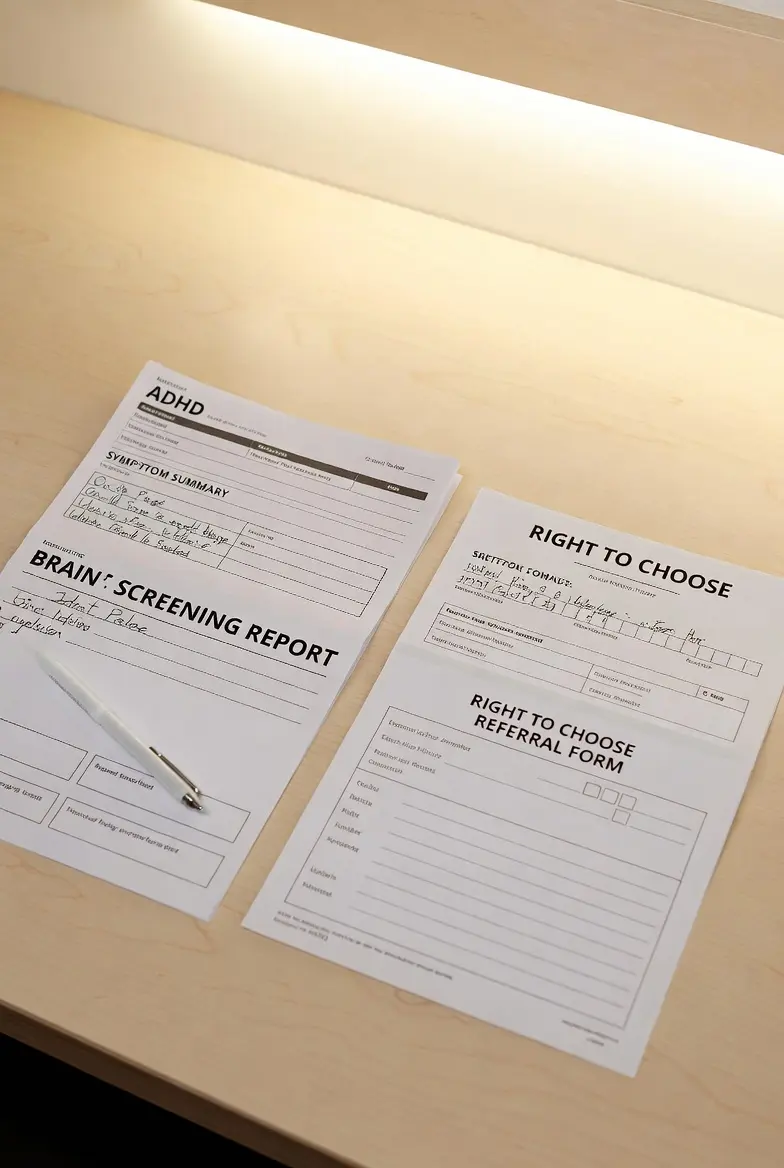
Hand this over in the first minute
Screening report, clinical letter, ASRS questionnaire, symptom summary. Most GP referrals contain only self-reported symptoms — walking in with objective brain data immediately sets yours apart.
Your GP is the gatekeeper to diagnosis. But many GPs have limited ADHD training, limited appointment time, and limited patience for self-diagnosis from TikTok. This guide shows you how to walk in prepared — with the evidence they need to act.
Most people leave their first GP appointment about ADHD feeling dismissed. It’s not always because the GP doesn’t care — it’s because the system isn’t set up for this conversation:
A standard GP appointment is 10 minutes. ADHD is a complex neurodevelopmental condition with multiple presentations, common comorbidities, and significant overlap with anxiety, depression, and sleep disorders. Ten minutes is not enough to explain your lifetime of symptoms, why you think it’s ADHD, and why you need a referral. You need to walk in with your case already built.
Most GPs receive minimal ADHD training during medical school — often just a few hours as part of a broader psychiatry module. Many GPs still associate ADHD primarily with hyperactive boys and are less familiar with inattentive presentations in women or adult ADHD. This isn’t their fault, but it means you may need to educate as well as persuade.
Without objective evidence, the conversation often becomes subjective. “Everyone loses their keys sometimes.” “Lots of people find it hard to focus.” These responses are frustrating but understandable — the GP is hearing symptoms that overlap with normal human experience, stress, and other conditions. What changes the conversation is evidence they can’t dismiss as subjective.
GPs can’t diagnose ADHD themselves (in most cases). Their job is to assess whether a referral is warranted and write a referral letter to the appropriate specialist — either CAMHS for children/teenagers, an adult ADHD service, or a Right to Choose provider. Here’s what strengthens that referral:
GPs need to see that symptoms are causing real problems in daily life — not just that symptoms exist. Bring specific examples: missed deadlines at work, failed exams despite ability, relationship breakdowns, inability to manage household tasks, financial disorganisation. The more concrete and specific, the better.
ADHD affects you everywhere, not just at home or just at work. Bring evidence from at least two settings: work/school AND home life. For children, teacher observations and school reports are particularly valuable. For adults, workplace performance reviews or partner observations add weight.
ADHD is a neurodevelopmental condition — it starts in childhood even if it wasn’t identified. GPs will want to know that difficulties were present before age 12. Bring old school reports if you have them. Comments like “easily distracted,” “could do better,” or “needs to focus” are gold dust.
Complete the ASRS (Adult Self-Report Scale) for adults or Conners/SNAP-IV for children before the appointment and bring the scored results. These are freely available online and are the standard tools GPs expect to see.
This is where most people’s evidence stops — and where ours begins. A qEEG brain screening report provides something no questionnaire can: a direct measurement of brain electrical activity compared against published normative data with z-scores. It moves the conversation from “I think I have ADHD” to “my theta/beta ratio is 2.1 standard deviations above the age-matched mean.”
You have limited time. Don’t waste it on backstory. Here’s a structure that works:
“I’d like to discuss a referral for ADHD assessment. I’ve done significant research and I’ve brought evidence to support my request.” This sets the tone immediately. You’re not asking for a chat about whether you might have ADHD. You’re requesting a specific clinical action and you’ve come prepared.
Give three concrete examples of how suspected ADHD affects your daily life. Be specific: “I’ve received two written warnings at work for missed deadlines in the last year” is better than “I sometimes struggle to focus.” For children: “His teacher reports that he cannot sustain attention for more than 5 minutes and has fallen two years behind in reading age.”
Hand over your evidence pack. Ideally this includes:
“Based on this evidence, I’d like to request a referral to [CAMHS / the adult ADHD service / a Right to Choose provider]. I understand the waiting times are significant, which is why I’ve gathered this evidence proactively.”
If your GP is unfamiliar with Right to Choose, briefly explain: “Right to Choose allows me to be assessed by a private provider at NHS expense. I’d like to be referred to Psychiatry-UK or a similar provider.”
Stay calm and factual. “I understand this can look like other conditions. The qEEG data specifically measures cortical arousal patterns associated with ADHD — it’s referenced in the FDA clearance of the NEBA System and the z-scores show I’m [X] standard deviations above the norm. I’d appreciate a referral so a specialist can make the clinical determination.”
If they still refuse, you have the right to: request a second opinion, see a different GP at the practice, or formally request that they document their refusal and reasoning in your medical record. Most GPs will refer when faced with objective evidence and a clear, reasonable request.
Your theta/beta ratio expressed as standard deviations from the age-matched mean. A z-score of 2.0 means your TBR is 2 standard deviations above normal — clinically significant and impossible to dismiss as “everyone struggles with that.”
Every claim in our report is backed by published research: Arns et al. (2013), Monastra et al. (1999), Clarke et al. (2001). GPs respect evidence-based medicine — our reports speak their language.
Theta, alpha, beta, delta, and gamma power across all electrode sites. This gives the GP (and later the specialist) a complete picture of cortical activity, not just a single number.
Hit rate, miss rate, false alarm rate, and reaction time from the sustained attention task. These directly measure the cognitive functions most affected by ADHD — impulse control, sustained attention, and response variability.
Available with the comprehensive package (£845). A formal letter addressed to your GP explaining the findings, their clinical significance, and recommended next steps. Written in medical language GPs understand and respect.
Clear recommendations on what to do with the results — whether that’s pursuing a formal diagnosis, requesting Right to Choose, or gathering additional evidence for an EHCP application.
A GP refusing to refer for ADHD assessment is not the end of the road. You have several options:
Ask the GP to document their refusal and clinical reasoning in your medical record. This alone often prompts a reconsideration — GPs are understandably cautious about creating a paper trail of denied referrals.
You have the right to see a different GP at the same practice, or to register at a different practice entirely. The NHS Constitution guarantees your right to choose your healthcare provider. ADHD knowledge varies significantly between GPs. A GP with more experience in neurodevelopmental conditions may view the same evidence differently.
If you believe a referral has been unreasonably denied, you can make a formal complaint through the practice’s complaints procedure or contact your local Patient Advice and Liaison Service (PALS). NICE guidelines (NG87) are clear that GPs should refer when ADHD is suspected — they are not expected to diagnose or rule it out themselves.
You can self-refer to a private psychiatrist for assessment without a GP referral. This typically costs £700–£1,500 but avoids the GP gatekeeping issue. Our screening report can be shared directly with the private psychiatrist. Some private providers can then set up shared care arrangements with your GP for ongoing medication.
Read our full guide to NHS ADHD waiting list alternatives for all available pathways.
GPs look for evidence of functional impairment across multiple settings, symptom history (ideally from childhood), and any screening data. Our comprehensive package provides a clinical letter with z-scores and peer-reviewed citations — the strongest objective evidence you can present alongside a completed questionnaire (ASRS for adults, Conners for children).
Get objective data. A qEEG report with z-scores is much harder to dismiss than self-reported symptoms. If the same GP still refuses, ask to document their refusal, see a different GP at the practice, or request a formal second opinion. You also have the right to self-refer to a private psychiatrist.
Most GPs don’t diagnose ADHD directly — it’s outside their usual scope. Their role is to assess whether referral is warranted and submit it. For children this goes to CAMHS, for adults to the adult ADHD service or a Right to Choose provider. The GP’s referral letter quality directly affects how quickly you’re seen.
Before. Walk in with the evidence already in hand. The comprehensive package (£845) includes a clinical letter addressed to your GP. You can hand it over at the appointment and request that it’s added to your medical record and included in the referral letter.
ADHD, anxiety, and depression frequently coexist. Our brain screening can help differentiate: elevated TBR suggests ADHD, elevated alpha may indicate anxiety. You can acknowledge the overlap while requesting that ADHD be specifically investigated. “I’d like ADHD assessed alongside anxiety — the brain data suggests both may be present.” See our page on ADHD in women where misdiagnosis is particularly common.
Tell your GP: “I’d like to exercise my Right to Choose and be referred to [Psychiatry-UK / Clinical Partners] for ADHD assessment.” This is a legal right under the NHS Constitution. The GP submits the referral and the NHS funds the assessment. Our clinical letter strengthens the case for referral. Full details in our Right to Choose guide.
Yes. We produce age-appropriate reports for children (6+), teenagers, and adults. Each uses age-matched norms and the clinical letter is tailored to the appropriate referral pathway (CAMHS for children, adult ADHD services for adults).
Absolutely. The same report supports EHCP applications, JCQ exam access arrangements, and Access to Work claims. The comprehensive clinical letter can be addressed to multiple recipients.
Same-week appointments are usually available. You could have your report in hand before your next GP appointment. Contact us to book or see pricing.
Macclesfield, Cheshire — accessible from Manchester (30 min), Stockport (20 min), Wilmslow (10 min), and the wider North West. Free parking available.
Get objective brain data before your appointment. Same-day report and clinical letter.