Main Home How it works The science Pricing FAQ Blog Services ADHD Brain Screening Comprehensive Assessment Family Package Medication Scan Who it\'s for Children (6+) Adults Women & girls Teenagers Guides NHS waiting list alternatives ADHD evidence for your GP EHCP evidence for ADHD Access to Work & ADHD Right to Choose ADHD Psychiatric assessment ADHD diagnosis guide Book a scan
Home EHCP Evidence
For parents & SENCOs

EHCP evidence for ADHD

EHCP panels need evidence of need — not just a suspicion, not just a waiting list number. Objective brain data showing elevated theta/beta ratios — a biomarker referenced in the FDA-cleared NEBA System — gives your application the neurological evidence that teacher observations alone can’t provide.

Get evidence now → What panels want
★★★★★ 4.9/5 (199 reviews)
🏫 Used by SENCOs across the North West
📄 Same-day clinical letter

What is an EHCP and why does your child need one?

An Education, Health and Care Plan (EHCP) is a legal document that describes a child’s special educational needs and the support they’re entitled to. It’s the most powerful tool available to parents of children with ADHD — under the Children and Families Act 2014, it legally requires schools and local authorities to provide specified support.

Without an EHCP, your child may receive some informal classroom adjustments. With one, they’re entitled to legally enforceable provision: additional teaching assistant time, specific intervention programmes, modified timetables, exam access arrangements, and in some cases funding for specialist placements.

The problem: evidence thresholds

Local authorities reject a significant proportion of EHCP requests — often because the evidence isn’t strong enough to demonstrate that the child’s needs cannot be met through standard SEN support. The panel needs to see that:

Needs, not diagnosis
An EHCP is based on demonstrable need, not on having a formal diagnosis — consistent with NICE NG87 which recognises that support should not wait for a formal label. You don’t need to wait for an NHS ADHD diagnosis to apply. But you do need strong evidence of the needs themselves — and that’s where objective brain data makes a difference.

Most EHCP applications for ADHD rely on teacher observations, behavioural descriptions, and educational psychology reports. These are essential — but they’re all subjective assessments of behaviour. Adding objective neurological data from a qEEG brain screening gives the panel something they rarely see: measurable evidence of neurological difference.

Building the strongest possible EHCP application

EHCP panels assess applications against a high evidence bar. Here’s how to build a comprehensive case with multiple evidence sources:

1. Teacher observations & school data

Classroom behaviour records, attainment data showing underperformance relative to ability, incident logs, and evidence of interventions already tried. Ask the SENCO to compile these formally. The more specific and dated the observations, the stronger they are.

2. Educational psychology report

If the school’s educational psychologist has assessed your child, their report carries significant weight. It provides cognitive profiling and recommendations. If the school hasn’t arranged this, you can request it or commission a private EP assessment.

3. Clinical evidence

This is where many ADHD applications are weakest — because the child is still on the NHS waiting list and has no clinical data. Our comprehensive qEEG screening fills this gap with:

  • Theta/beta ratio with z-score showing deviation from age-matched norms
  • Go/No-Go attention task results (sustained attention, impulse control)
  • Full frequency band analysis across four cortical sites
  • Clinical interpretation letter with peer-reviewed citations
  • Recommended accommodations based on the neurological profile

4. Parental evidence

Your own observations matter. Write a 1–2 page parental statement describing daily challenges, impact on family life, and what support you believe is needed. Use specific examples rather than generalisations.

5. Any existing clinical involvement

If your child has been seen by CAMHS (even if still waiting for full assessment), speech and language therapy, occupational therapy, or a paediatrician, include letters from these professionals. Even a GP referral letter confirming the CAMHS waiting list adds weight.

Extra time, rest breaks, and other exam accommodations

Even without an EHCP, schools can apply for JCQ exam access arrangements for GCSEs, A-levels, and other national examinations. These include:

What’s available

  • 25% extra time — the most common accommodation for ADHD
  • Rest breaks — supervised breaks during the exam to manage attention fatigue
  • Separate room — reduced distractions for inattentive students
  • Word processor — for students whose handwriting is affected by motor difficulties
  • Prompter — someone to redirect attention if the student loses focus

What the school needs from you

JCQ requires the school to demonstrate a “history of need” and “normal way of working.” This means evidence that the accommodation reflects how the student already works in the classroom, not a one-off concession. A clinical letter from our comprehensive package provides the objective evidence of neurological need, while the school provides evidence of classroom practice.

For teenagers facing GCSEs or A-levels, time is critical. Our same-day report means you can have evidence in the school’s hands within days, not the months or years an NHS pathway would take.

25%
Extra time is the most commonly granted accommodation for ADHD. In a 2-hour exam, that’s an additional 30 minutes. For a student with attention difficulties, this can be the difference between a grade 4 and a grade 7.
Parent sharing child's ADHD brain screening report with school SENCO during a meeting to support EHCP application and exam access arrangements
Evidence your SENCO can act on immediately
Our report gives SENCOs objective neurological data for EHCP applications, JCQ exam access requests, and SEN register placement — no diagnosis required. Schools must provide support based on identified need, not diagnosis.

How our report supports EHCP and exam access applications

📊 Age-matched z-scores

Your child’s theta/beta ratio expressed as standard deviations from published norms for their exact age group. A z-score of 2.0+ is clinically significant — objective, measurable evidence of neurological difference that panels take seriously.

🎯 Attention task data

Go/No-Go results showing hit rate, miss rate, false alarms, and reaction time. These directly quantify sustained attention and impulse control difficulties — the core functional impairments that access arrangements are designed to address.

📝 Clinical interpretation letter

Available with the comprehensive package (£845). A formal letter your SENCO can submit directly to the EHCP panel or include in a JCQ application. Written in clinical language with specific accommodation recommendations.

📖 Peer-reviewed citations

Every finding is referenced to published research. EHCP panels and JCQ moderators expect evidence-based documentation — our reports cite Arns (2013), Monastra (1999), Clarke (2001), and other landmark ADHD studies.

🧠 Full frequency analysis

Beyond the theta/beta ratio, the report shows power across all five frequency bands at four cortical sites. This comprehensive profile helps educational psychologists and clinicians understand the full neurological picture.

⏱ Same-day availability

EHCP deadlines and exam registration dates don’t wait for NHS waiting lists. Our report is delivered the same day as the screening. Your SENCO can have it in hand within 48 hours of booking.

A note for school SEN coordinators

If you’re a SENCO reading this, you already know the challenge: families waiting years for CAMHS assessments while their children fall further behind. You need evidence to support SEN register placements, EHCP applications, and JCQ access arrangements — but you can’t get clinical evidence without a clinical appointment that may be years away.

Our qEEG screening provides objective neurological data you can act on now. The report includes age-matched z-scores, attention task metrics, and a clinical interpretation letter. Several SENCOs in the North West now routinely recommend our service to parents whose children are awaiting CAMHS assessment.

The comprehensive package (£845) is specifically designed for educational contexts. The clinical letter includes recommended accommodations based on the neurological profile. For families with multiple children, the family package (£1,095) provides individual reports for two children.

If you’d like to discuss how our reports integrate with your SEN processes, or if you’d like sample reports for your reference, please get in touch. We’re happy to work directly with schools.

SEND Code of Practice and what panels actually look for

The SEND Code of Practice (2015) sets out the framework that local authorities must follow when considering EHCP requests. Under Chapter 9, the local authority must carry out an EHC needs assessment if there is evidence that the child may have special educational needs that cannot be met through standard SEN support. The key phrase is "evidence that the child may have" — not evidence of a diagnosis.

This is why objective brain data is so powerful for EHCP applications. You do not need to wait for a formal ADHD diagnosis to apply. What you need is evidence that your child has neurological differences that impact their learning and that those needs are not being met by the school's current SEN provision. A qEEG report showing elevated theta/beta ratios at statistically significant z-scores — compared against age-matched norms from published research — provides exactly this kind of evidence. It demonstrates a measurable neurological difference that correlates with sustained attention difficulties, independent of teacher observation or parental report.

What makes EHCP evidence strong vs weak

EHCP panels see hundreds of applications. The ones that succeed typically include multiple sources of evidence that converge on the same conclusion. Teacher observations alone are subjective. A parent's letter alone is anecdotal. But when a teacher's observations, a parent's written statement, a SENCO's SEN support records, and an objective qEEG report showing elevated TBR all point to the same attention difficulties, the panel has a clear evidence base to act on. Our reports are designed to be one strong pillar in that multi-source evidence package.

Panels look specifically for: evidence of need across multiple settings (home and school), evidence that SEN support has been tried and is insufficient, evidence of the impact on learning and progress, and — where available — professional or clinical evidence that supports the nature of the difficulty. Our screening provides the clinical evidence component with a level of objectivity that school-based assessments cannot match. The NICE ADHD guidelines support the use of supplementary clinical evidence in the assessment pathway, and our reports meet this standard.

If your EHCP is refused: the SEND Tribunal route

If your local authority refuses to assess, or refuses to issue an EHCP after assessment, you have the right to appeal to the First-tier Tribunal (Special Educational Needs and Disability). Appeals are decided on the evidence. New evidence submitted at tribunal stage — such as a qEEG screening report that was not available at the original decision — can significantly strengthen your case. Several families have used our reports and clinical letters as part of successful tribunal submissions.

The tribunal expects formal, professional documentation. Our Comprehensive Assessment (£845) includes a clinical interpretation letter specifically formatted for this purpose — it summarises the screening methodology, presents the key findings with z-scores and normative references, and includes recommendations for educational support. This is the format that legal representatives and tribunal panels recognise as credible professional evidence. For families with two children who both need evidence, the Family Package (£1,095) provides individual reports for each child plus a comparative overview.

Working with your SENCO

Your child's Special Educational Needs Coordinator (SENCO) is your most important ally in the EHCP process. Share our screening report with them early. Many SENCOs across the North West now actively recommend our service to parents because the reports provide the kind of objective, externally-sourced evidence that strengthens their own professional submissions to the local authority. The report complements the SENCO's school-based evidence — their observations, intervention records, and progress data — with an independent neurological assessment that the panel can weigh alongside the educational evidence.

For teenagers approaching GCSEs, the screening also supports applications for JCQ exam access arrangements — extra time, rest breaks, separate room, or word processor access. These accommodations can be arranged through the school's exam officer using our report as supporting evidence, even before a formal EHCP is in place. Our GP evidence guide and parent's guide provide step-by-step advice for navigating both the education and clinical pathways simultaneously.

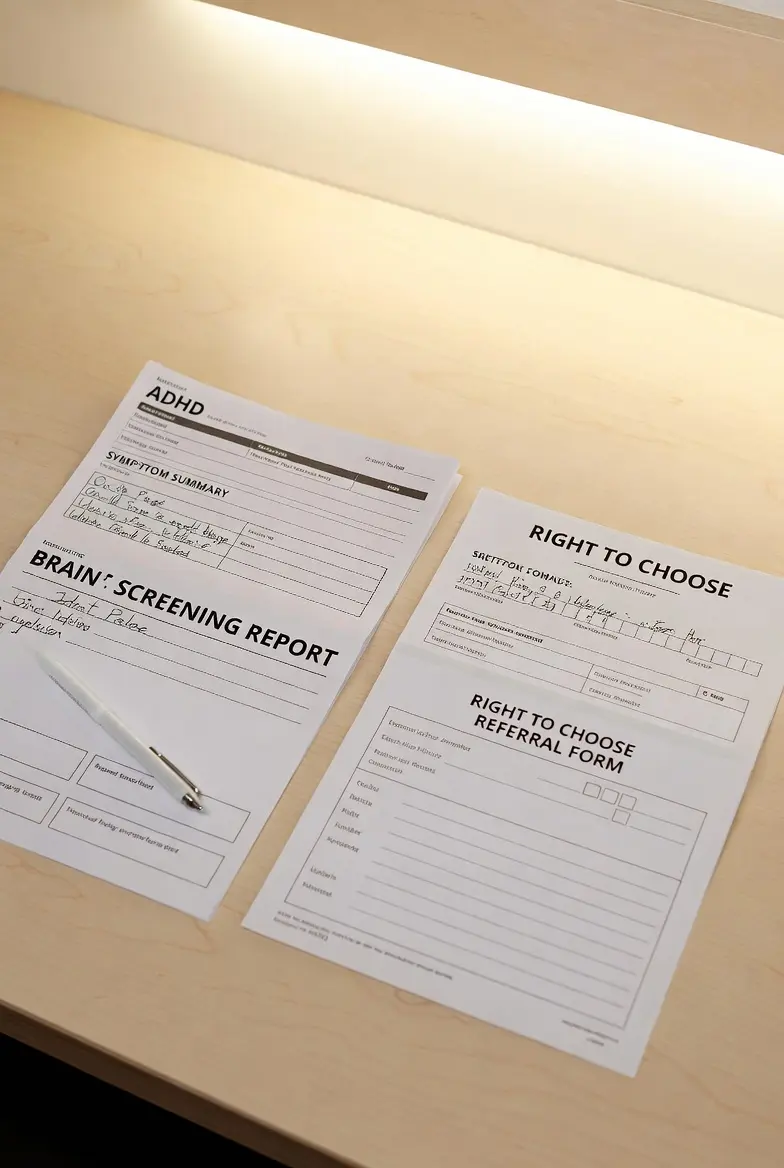
Flat lay of ADHD screening report clinical letter and EHCP supporting documents laid out on a desk for education panel submission
The evidence package EHCP panels take seriously
Screening report with z-scores, clinical letter, teacher observations, and educational psychology input. Panels assess the weight of evidence — objective neurological data adds a dimension that behavioural reports alone cannot provide.
4.9
★★★★★
Based on 199 verified reviews
★★★★★
I’m a SENCO and I’ve started recommending this to parents at our school. The reports give us objective evidence for EHCP applications. It’s changed how we approach SEN assessments entirely.
EH
Emma Hughes
SENCO · February 2026
Education professional
★★★★★
Our daughter sat her mock GCSEs with zero support because we were still on the waiting list. This scan gave us evidence for 25% extra time for her real exams. The difference was enormous — two grades higher across the board.
SF
Sarah & James Foster
Parents, exam access success · March 2026
Verified client
★★★★★
Our son’s GCSEs were approaching and he was drowning. The brain scan confirmed elevated TBR. His school put exam accommodations in place within weeks. Extra time and rest breaks. His predicted grades have already improved.
MD
Mark & Helen Davies
Parents, GCSE support · March 2026
Verified client
★★★★★
Used the clinical letter as part of our EHCP application. The panel specifically commented that the neurological evidence strengthened the case. EHCP approved on first application — which our SENCO said is rare.
LW
Laura Whitfield
EHCP approved first time · March 2026
Verified client
★★★★★
As a child psychologist, I recommend this to families pursuing EHCP applications. The age-specific norms and objective data add a dimension that behavioural observations can’t. The reports are properly cited and clinically rigorous.
EW
Dr Emily Watson
Child psychologist · February 2026
Healthcare professional
★★★★★
The comprehensive package was perfect for our needs. The clinical letter went straight to the SENCO, who used it in both the EHCP application and the JCQ access arrangement form. One report, two purposes.
MT
Maria Thompson
EHCP + exam access · March 2026
Verified client
★★★★☆
Good evidence for the school but worth noting you’ll still need other evidence alongside it — teacher observations, educational psychologist report, etc. The brain scan adds to the picture, it doesn’t replace everything else.
DP
Diane Porter
Realistic perspective · January 2026
Verified client
★★★★★
Our EHCP had been refused on the first attempt. We added the brain scan report and resubmitted. Approved on appeal. The panel said the neurological data “provided the clinical evidence that was previously missing.”
JK
James & Paula Kelly
EHCP approved on appeal · March 2026
Verified client
★★★★★
Screened both our daughters — one elevated, one normal. The family package gave us individual reports. The school used the elevated report for SEN register placement and is now pursuing EHCP for that child specifically.
CP
Claire Pemberton
Family screening for school · March 2026
Verified client
★★★★★
I teach in a secondary school. One of our Year 10 students was clearly struggling but had no formal support. The parents got the brain scan and the SENCO used it to fast-track SEN support. That student now has a modified timetable and is thriving.
PT
Paul Taylor
Secondary teacher · February 2026
Education professional
★★★★★
The comprehensive package clinical letter specifically recommended “25% extra time and supervised rest breaks” based on the Go/No-Go attention data. The school submitted that exact wording to JCQ. Approved in 3 weeks.
KM
Karen McBride
JCQ approved quickly · March 2026
Verified client
★★★★★
My daughter’s sixth form used the report to apply for A-level access arrangements. She now has extra time plus rest breaks. Her predicted grades have gone from CCD to ABB. The data literally changed her university options.
CB
Catherine Barnes
A-level access arrangements · March 2026
Verified client
★★★★★
My son went from predicted 3s and 4s to 6s and 7s in his GCSEs after getting exam access arrangements and eventually diagnosis/medication. This brain scan was the first piece of evidence that started it all.
RB
Richard Bradley
GCSE grades transformed · March 2026
Verified client
Scroll for more reviews →

Common questions about ADHD evidence for education

No. An EHCP is based on needs, not diagnosis. Evidence of neurological difference — such as an elevated theta/beta ratio from our screening — demonstrates need regardless of whether a formal ADHD diagnosis has been made. Many of our families are still on the NHS waiting list when they apply.

Yes. The comprehensive package clinical letter is designed for submission to EHCP panels, JCQ moderators, and school SEN files. It includes z-scores, age-matched norms, peer-reviewed citations, and recommended accommodations.

Common accommodations include 25% extra time, supervised rest breaks, separate room (reduced distractions), word processor access, and a prompter. The school’s SENCO applies to JCQ with evidence of need and “normal way of working.” Our clinical letter provides the evidence of neurological need.

Yes. Adding objective neurological evidence to a resubmission or appeal strengthens the case significantly. Several families have had EHCPs approved on appeal after adding our brain screening report to their existing evidence pack.

Same-week appointments are usually available, and the report is delivered the same day as the screening. If you have a specific EHCP or JCQ deadline, contact us and we’ll prioritise your booking. Most families have their report within 48 hours of first contact.

The comprehensive package (£845) is recommended for EHCP and exam access purposes. It includes the clinical interpretation letter with specific accommodation recommendations that SENCOs need. The standard screening (£595) provides the data but without the formal letter.

Yes — the family package (£1,095) screens two children or teenagers with individual reports. Particularly useful when ADHD is suspected in siblings and both need school evidence.

Absolutely. The same report serves multiple purposes: GP referral evidence, EHCP applications, exam access arrangements, and Right to Choose support. The comprehensive clinical letter can be addressed to multiple recipients.

Yes. Many SENCOs in the North West recommend our service to families awaiting CAMHS assessment. We’re happy to discuss how our reports integrate with your SEN processes and can provide sample reports for your reference. Get in touch — select “School / SENCO enquiry” on the contact form.

Macclesfield, Cheshire — accessible from Manchester (30 min), Stockport (20 min), Wilmslow (10 min), and the wider North West. Free parking. Same-week appointments. Families travel from across the region for screenings.

Your child’s education can’t wait for the NHS

Get objective brain data for EHCP applications and exam access. Same-day report.

Book a scan → View pricing