Teenagers near Milton Keynes with GCSEs approaching — Right to Choose can get them assessed before exams. Our screening provides immediate evidence for exam access arrangements while the Right to Choose referral progresses. Extra time, rest breaks, separate room — schools can act on our report now.
The ADHD assessment crisis across Buckinghamshire is not improving. As of 2026, over 735,000 open referrals are waiting in England alone. In many Buckinghamshire trusts, adults wait 3–5 years. Children referred to CAMHS face 2–3 year delays — delays that span their entire secondary school education. During this time, no medication, no formal support, no reasonable adjustments, no answers.
For families near Milton Keynes, the emotional cost is staggering. Children fall behind academically. Teenagers develop anxiety and depression secondary to untreated ADHD. Adults lose jobs, relationships fracture, and self-esteem erodes year after year. The system is not broken — it was never built to handle this volume. Over the past decade, ADHD referral rates have increased by over 400%, but NHS capacity has barely moved.
Right to Choose exists precisely for situations like this. When the NHS cannot provide timely care, you have the legal right to choose an alternative provider — at NHS expense. But your GP still needs a clinical reason to refer. That is where objective brain data becomes the catalyst: evidence that transforms a speculative conversation into an actionable referral. Our GP appointment guide includes word-for-word scripts for that conversation.
Right to Choose applies to everyone in England — children, teenagers, and adults. Parents can exercise Right to Choose on behalf of their children. The referral process is identical to any specialist referral: your GP submits it through e-RS, the provider receives it, and assessment is scheduled.
For children near Milton Keynes, Right to Choose can bypass CAMHS waiting lists entirely. The child is assessed by a specialist child psychiatrist at the chosen provider, following the same NICE guidelines that CAMHS would use. If ADHD is confirmed, medication can be initiated and a shared care agreement set up with your GP for ongoing prescribing.
For adults, the process is the same but the provider pool is different. Psychiatry-UK handles the largest volume of adult Right to Choose ADHD referrals. Assessment is typically via video call, lasting 60–90 minutes. The assessor reviews all available evidence — including our brain screening report — conducts a comprehensive clinical interview, and makes a diagnostic decision.
For parents near Milton Keynes pursuing Right to Choose for their child, the process is identical but the preparation is slightly different. Gather: our brain screening report, school observations or SENCO reports, Conners parent and teacher rating scales, examples of difficulties across settings (home, school, social), and any old developmental health visitor records.
At the GP appointment, frame it around the child's functional impairment: academic underperformance relative to ability, social difficulties, emotional dysregulation, and the impact on family life. Present the brain data as objective neurological evidence supporting the referral. Request Right to Choose referral to a provider that assesses children (Psychiatry-UK, Clinical Partners).
After referral, the provider will send questionnaires to you and your child's school before the assessment appointment. The assessment itself is typically longer for children (90–120 minutes) and may include direct observation. If ADHD is confirmed, the specialist discusses treatment options with you and initiates medication if agreed, with shared care transferred to your GP.
The Psychiatry-UK assessor who conducts your Right to Choose assessment will review all available evidence before the appointment. Most patients arrive with questionnaires and a GP referral letter. You will arrive with those plus objective neurological data that no other patient typically brings. This does not guarantee diagnosis — that is a clinical decision based on the full picture. But it gives the assessor an additional evidence dimension that enhances the assessment quality and efficiency.
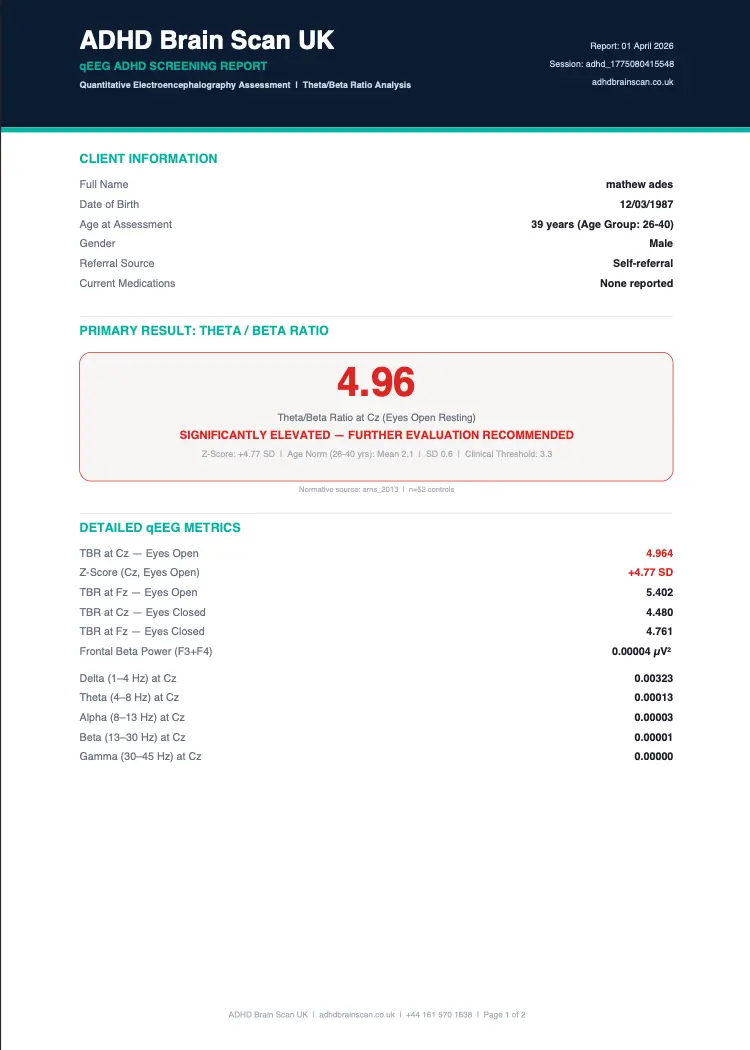
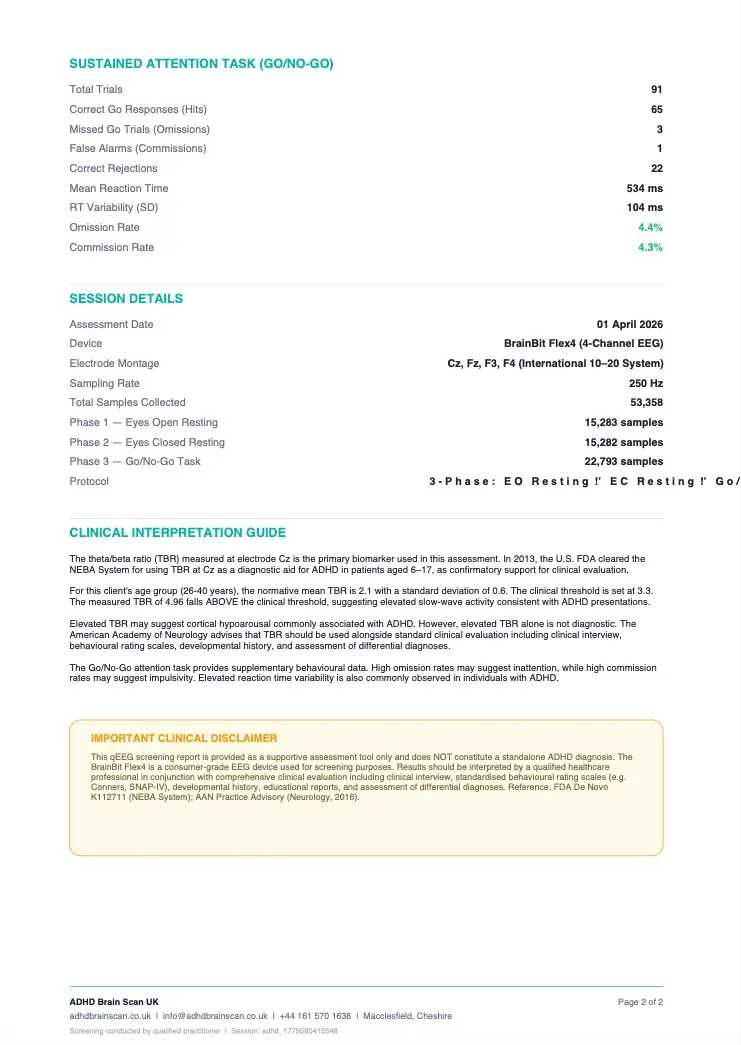
Several assessors have told clients that our reports are among the most detailed screening documents they receive. The z-scores, frequency band analysis, and Go/No-Go attention data provide a neurocognitive profile that complements the clinical interview. The assessment becomes a richer, more informed process.
Objective z-scores and peer-reviewed citations are significantly harder to dismiss than self-reported symptoms. GPs near Milton Keynes respond to evidence.
GPs who include our data in their referral letter give the receiving provider more context, leading to a more focused and efficient assessment.
During the 3–6 month wait, use the report for EHCP applications, Access to Work, and employer reasonable adjustments.
If diagnosed, your baseline data enables a follow-up comparison scan (£345) to objectively track medication response.
Brain screening (£595–£845) + Right to Choose (free) + shared care (NHS). Total: under £850 for a complete diagnostic pathway.
The Right to Choose assessor reviews all evidence. Objective brain data adds a dimension that no other patient typically brings to the assessment.
A third option is fully private assessment (£700–£1,500), which has the shortest wait (2–8 weeks) but you pay the full cost. Many people from Milton Keynes combine approaches: brain screening (£595–£845) + Right to Choose assessment (free) + Access to Work support (free). Total out-of-pocket: the screening only. View all pricing options.
We provide Right to Choose evidence for children aged 6+, teenagers, adults, and women & girls who are systematically underdiagnosed by questionnaire-based assessment.
Each person is compared against age-matched normative data from published research. The clinical letter is tailored for Right to Choose referral submissions, with z-scores, peer-reviewed citations, and specific recommendations your GP can act on immediately.
View packages: standard screening (£595) · comprehensive (£845) · family package (£1,095) · all pricing
After your screening: ADHD support hub · results explained · what to do next · GP appointment guide · medication guide · coping strategies · workplace rights · ADHD in women · parent's guide · relationships guide · sleep guide · exercise & ADHD
Typically 3–6 months from GP referral to assessment. This varies by provider and current demand. Even at the longer end, it is dramatically faster than the 2–5 year Buckinghamshire NHS standard pathway. During the wait, your screening report supports school, work, and other applications.
Yes. The two pathways run in parallel. Stay on the NHS list as backup while pursuing Right to Choose as a faster route. If assessed via Right to Choose first, you can then leave the NHS list. We recommend staying on both.
If ADHD is confirmed, the provider initiates medication (typically stimulant or non-stimulant options) and monitors your titration over 4–12 weeks. They then set up a shared care agreement with your GP for ongoing prescribing. Your GP handles repeat prescriptions at standard NHS cost (£9.90 per item or free with prepayment).
Not required — but strongly recommended. Our clinical letter provides the objective evidence that convinces GPs to refer. Without it, many GPs hesitate. With it, most refer promptly. The comprehensive package (£845) includes the clinical letter specifically formatted for Right to Choose referrals.
The Comprehensive Assessment (£845) — it includes the clinical interpretation letter your GP needs, tailored for Right to Choose referral submissions. The standard Brain Screening (£595) provides the data report but without the formal letter.
This is common. Print the NHS patient choice guidance from nhs.uk and bring it to the appointment. Our clinical letter also explains Right to Choose. Psychiatry-UK has a GP information page your GP can review. In many cases, our letter is the first clear explanation the GP has received.
Right to Choose is England only. Scotland, Wales, and Northern Ireland have separate NHS systems without equivalent patient choice legislation. If you live in those nations, options are standard NHS referral or fully private assessment. Many UK-wide telehealth providers offer video assessments regardless of location.
Yes — and you should. While waiting for Right to Choose assessment, use the report for: EHCP applications, JCQ exam access arrangements, Access to Work evidence, employer reasonable adjustments, and additional GP conversations. One screening supports multiple applications simultaneously.
Request the refusal in writing. Ask for a second opinion from another GP at the same practice. Consider registering with a different practice. Contact PALS (Patient Advice and Liaison Service). Ask Psychiatry-UK to contact the GP directly — they have a process for this. GP refusal after seeing objective brain data is rare but not impossible.
Yes. The assessment is fully NHS-funded — you pay nothing for the assessment itself. The only cost is any supporting evidence you choose to gather beforehand, such as our brain screening (£595–£845). Everything from the Right to Choose referral onwards is free.
Share this page with someone waiting for an ADHD assessment.
Same-day clinical letter. Evidence your GP will act on. From £595.