Right to Choose lets you bypass the Suffolk ADHD waiting list entirely. It is a legal right under the NHS Constitution. Your GP near Ipswich refers you to an approved provider like Psychiatry-UK — and the NHS pays. The missing piece? Evidence that convinces your GP to refer. That is exactly what our brain screening provides.
Source: NHS England ICB commissioning data · ADHD UK postcode tracker
The NHS body responsible for ADHD assessment commissioning around Ipswich is NHS Suffolk and North East Essex ICB. Wait times for the standard pathway vary significantly between trusts inside the same ICB, and published figures often lag reality — which is why we recommend checking current reported waits via ADHD UK before deciding your route.
One development worth knowing: some ICBs have begun triaging or restricting Right to Choose ADHD referrals, and GP practices do not always distinguish between local ICB guidance and your national legal rights. If your GP near Ipswich says 'we cannot do Right to Choose here,' the correct response is to ask whether that is NHS Suffolk and North East Essex ICB policy in writing, and what the approved local pathway is. In most cases the referral can still proceed — it may simply route differently. Our clinical letter names the pathway explicitly, which removes most of this friction.
The Right to Choose pathway has a specific bottleneck that most people near Ipswich do not anticipate: GP willingness. The legal right is clear. The process is straightforward. The funding is available. But the referral requires your GP to submit it — and many GPs have never processed a Right to Choose ADHD referral before.
This unfamiliarity creates friction. Some GPs confuse Right to Choose with 'going private.' Others believe it requires CCG approval (it does not). Some think it only applies to certain conditions. A small number incorrectly believe they can refuse the request entirely.
Our approach solves this. The comprehensive package (£845) includes a clinical interpretation letter that explains Right to Choose, names the recommended provider, and provides the clinical evidence in a format GPs recognise. Several GPs have told us this letter was the first time anyone had clearly explained the Right to Choose process to them. Education plus evidence equals referral.
Three things stop most people near Ipswich from using Right to Choose. First, they do not know it exists — the NHS does not publicise it, and many people only discover it through ADHD communities on social media. Second, their GP has never heard of it — surveys suggest fewer than half of GPs have processed a Right to Choose ADHD referral. Third, the GP is not convinced a referral is warranted — self-reported symptoms alone are often insufficient to overcome clinical caution.
Our service addresses all three barriers. Our clinical letter explains Right to Choose to your GP, provides the evidence that justifies the referral, and names the specific provider to refer to. You walk in with a complete referral package — your GP just needs to submit it through the NHS e-Referral Service (e-RS).
Clients from Ipswich consistently report that having the clinical letter transformed their GP appointment from a frustrating negotiation into a 5-minute administrative process.
The pathway from Ipswich to diagnosis runs through five clear stages. First, evidence gathering: our brain screening provides the objective data, but you should also complete an ASRS-v1.1 (adults) or Conners questionnaire (children), write a functional impairment summary, and gather any historical evidence (school reports, previous assessments).
Second, the GP appointment: book a double slot, present everything in the first minute, and make the Right to Choose request explicitly. Our GP evidence guide has word-for-word scripts. Third, the referral itself: a 5-minute administrative process if the GP has the evidence in front of them. Fourth, the wait: 3–6 months typically, during which you can use the screening report for school, work, and other support. Fifth, the assessment: comprehensive clinical evaluation following NICE NG87, leading to diagnosis and treatment if appropriate.
Most clients near Ipswich complete steps 1–3 within two weeks. The total elapsed time from brain screening to diagnosis is typically 4–8 months — compared to 3–7 years via the standard NHS pathway.
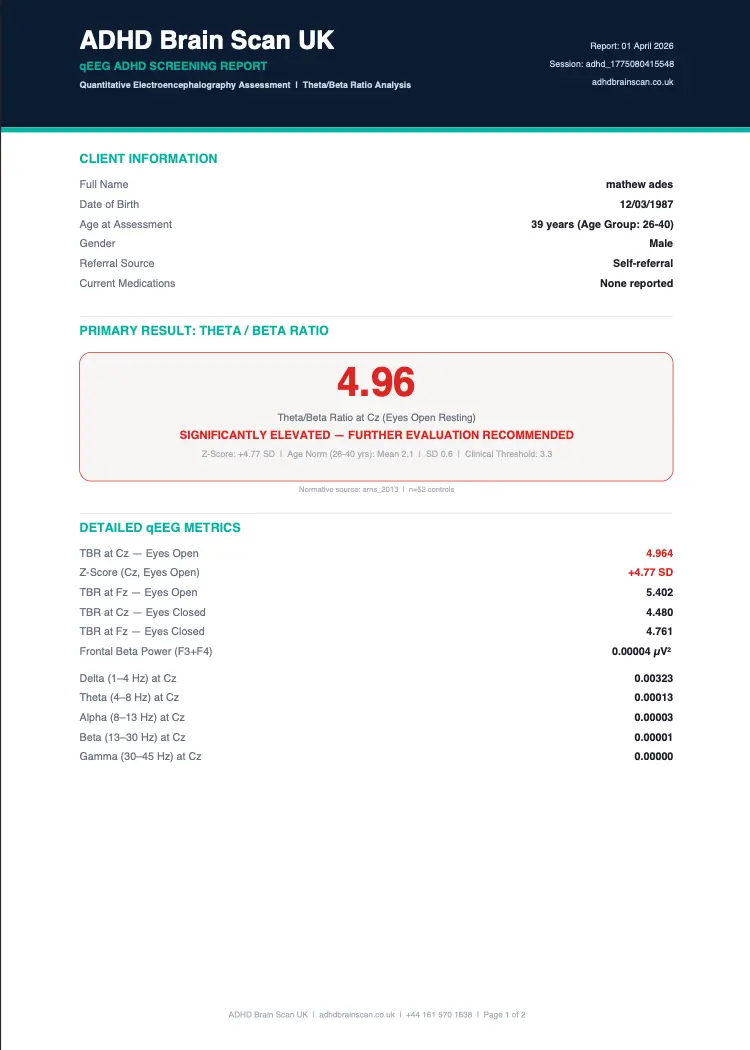
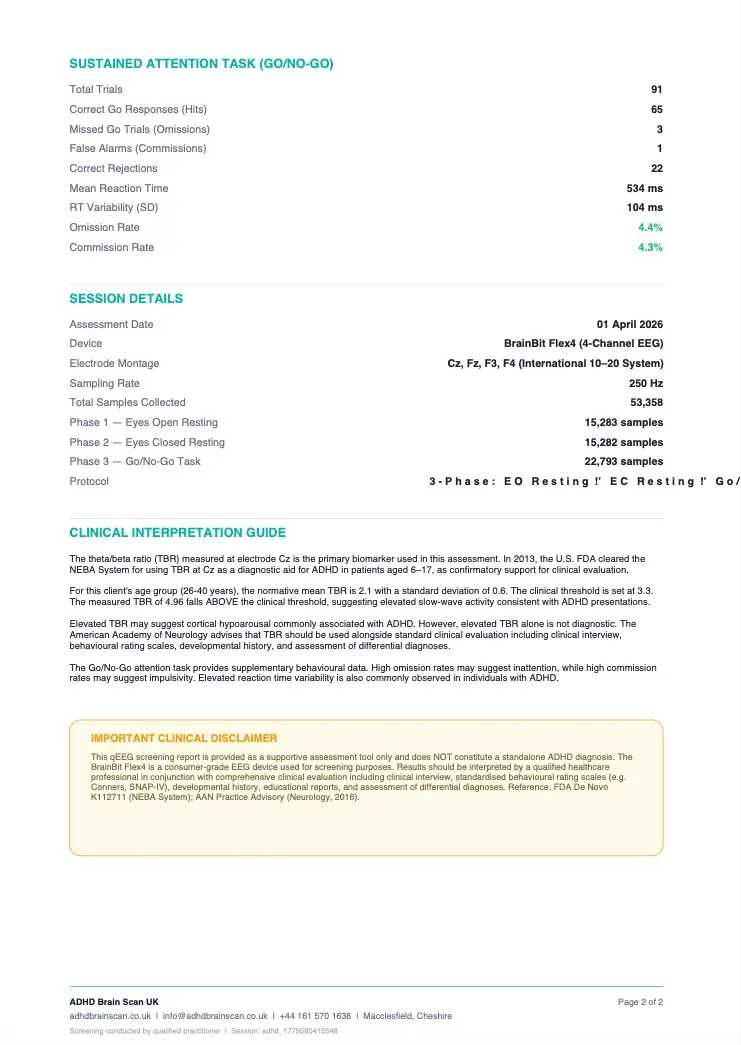
Objective brain data does three things that self-report cannot. First, it removes the bias inherent in questionnaires — particularly important for women who mask, adults who have developed sophisticated coping strategies, and children who behave differently in clinic than in the classroom. Second, it provides a quantified measurement expressed as a z-score — a language every clinician understands instantly. Third, it gives the GP a defensible clinical basis for the referral — something they can point to in the patient record that justifies the decision.
Multiple clients from Ipswich have reported that presenting the clinical letter to their GP resulted in an immediate shift in the conversation. GPs who had previously said 'let's wait and see' or 'try these coping strategies first' moved directly to submitting the Right to Choose referral once they saw the objective neurological data.
Objective z-scores and peer-reviewed citations are significantly harder to dismiss than self-reported symptoms. GPs near Ipswich respond to evidence.
GPs who include our data in their referral letter give the receiving provider more context, leading to a more focused and efficient assessment.
During the 3–6 month wait, use the report for EHCP applications, Access to Work, and employer reasonable adjustments.
If diagnosed, your baseline data enables a follow-up comparison scan (£345) to objectively track medication response.
Brain screening (£595–£845) + Right to Choose (free) + shared care (NHS). Total: under £850 for a complete diagnostic pathway.
The Right to Choose assessor reviews all evidence. Objective brain data adds a dimension that no other patient typically brings to the assessment.
A third option is fully private assessment (£700–£1,500), which has the shortest wait (2–8 weeks) but you pay the full cost. Many people from Ipswich combine approaches: brain screening (£595–£845) + Right to Choose assessment (free) + Access to Work support (free). Total out-of-pocket: the screening only. View all pricing options.
We provide Right to Choose evidence for children aged 6+, teenagers, adults, and women & girls who are systematically underdiagnosed by questionnaire-based assessment.
Each person is compared against age-matched normative data from published research. The clinical letter is tailored for Right to Choose referral submissions, with z-scores, peer-reviewed citations, and specific recommendations your GP can act on immediately.
View packages: standard screening (£595) · comprehensive (£845) · family package (£1,095) · all pricing
After your screening: ADHD support hub · results explained · what to do next · GP appointment guide · medication guide · coping strategies · workplace rights · ADHD in women · parent's guide · relationships guide · sleep guide · exercise & ADHD
GP referrals from Ipswich are commissioned by NHS Suffolk and North East Essex ICB. Right to Choose is national law, but since 2024 several ICBs have introduced triage steps or attempted restrictions on ADHD Right to Choose referrals, and the position changes frequently. Before your GP appointment, check the current position on the ICB's own website and via ADHD UK's local data pages — so you can ask for the correct pathway by name.
Yes — and you should. While waiting for Right to Choose assessment, use the report for: EHCP applications, JCQ exam access arrangements, Access to Work evidence, employer reasonable adjustments, and additional GP conversations. One screening supports multiple applications simultaneously.
Request the refusal in writing. Ask for a second opinion from another GP at the same practice. Consider registering with a different practice. Contact PALS (Patient Advice and Liaison Service). Ask Psychiatry-UK to contact the GP directly — they have a process for this. GP refusal after seeing objective brain data is rare but not impossible.
Yes. The assessment is fully NHS-funded — you pay nothing for the assessment itself. The only cost is any supporting evidence you choose to gather beforehand, such as our brain screening (£595–£845). Everything from the Right to Choose referral onwards is free.
Right to Choose is a legal right under the NHS Constitution — your GP cannot remove the right itself, but they can decline to refer for ADHD if they believe it is not clinically warranted, and some ICBs have added local triage steps that change how referrals route. Objective brain data makes a clinical refusal very difficult to justify. If your GP declines, ask for the reason in writing, ask what the ICB's current approved pathway is, and request a second opinion.
Yes. Right to Choose applies to children and teenagers as well as adults. Parents request the referral through their child's GP. The family package (£1,095) screens two family members for Right to Choose evidence.
Typically 3–6 months from GP referral to assessment. This varies by provider and current demand. Even at the longer end, it is dramatically faster than the 2–5 year Suffolk NHS standard pathway. During the wait, your screening report supports school, work, and other applications.
Yes. The two pathways run in parallel. Stay on the NHS list as backup while pursuing Right to Choose as a faster route. If assessed via Right to Choose first, you can then leave the NHS list. We recommend staying on both.
If ADHD is confirmed, the provider initiates medication (typically stimulant or non-stimulant options) and monitors your titration over 4–12 weeks. They then set up a shared care agreement with your GP for ongoing prescribing. Your GP handles repeat prescriptions at standard NHS cost (£9.90 per item or free with prepayment).
Not required — but strongly recommended. Our clinical letter provides the objective evidence that convinces GPs to refer. Without it, many GPs hesitate. With it, most refer promptly. The comprehensive package (£845) includes the clinical letter specifically formatted for Right to Choose referrals.
The Comprehensive Assessment (£845) — it includes the clinical interpretation letter your GP needs, tailored for Right to Choose referral submissions. The standard Brain Screening (£595) provides the data report but without the formal letter.
Share this page with someone waiting for an ADHD assessment.
Same-day clinical letter. Evidence your GP will act on. From £595.