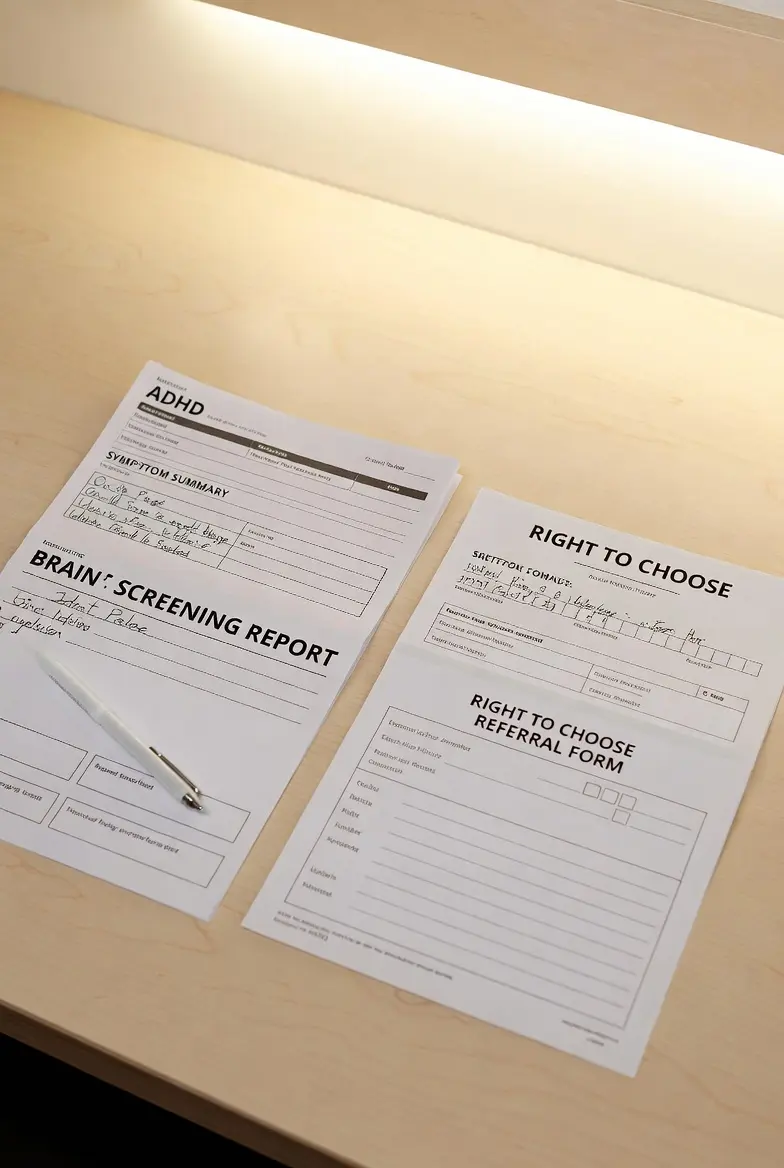
Come prepared and most GPs will refer
Screening report, provider referral form, and the NHS England patient choice guidance. Most Right to Choose referrals are accepted when the GP has objective evidence and a clear, simple process to follow.
You don’t have to wait 3–5 years on the NHS list. Right to Choose lets you be assessed by a private provider — at NHS expense — in months. Your GP just needs a reason to refer. We give them one.
Right to Choose is a legal right enshrined in the NHS Constitution. It allows you to choose which qualified healthcare provider carries out your first outpatient appointment for a condition — including ADHD assessment. In practice, this means your GP can refer you to an approved private provider at NHS expense instead of the standard NHS pathway.
For ADHD, the most commonly used provider is Psychiatry-UK, which has a formal partnership with NHS England for Right to Choose ADHD assessments. Other approved providers include Clinical Partners and some local private clinics. The assessment is clinically identical to an NHS assessment — following NICE NG87 guidelines — it’s just delivered faster by a different provider, paid for by the NHS.
Three reasons. First, most people don’t know it exists. Right to Choose is poorly publicised and many patients only discover it through ADHD communities online. Second, many GPs are unfamiliar with it — some have never processed a Right to Choose referral and may be unsure of the process. Third, GPs still need a clinical reason to refer. Right to Choose doesn’t bypass the need for referral — it changes where the referral goes.
This is where objective evidence becomes critical. A GP who might hesitate to refer based on self-reported symptoms alone is far more likely to refer when presented with a clinical letter showing objective brain data with z-scores against published norms. It gives them the confidence and the clinical justification to submit the referral.
Before approaching your GP, build your evidence pack. The stronger your evidence, the more likely your GP is to refer without pushback. Ideally this includes:
Request a double appointment if possible (20 minutes instead of 10). Tell reception it’s for discussing a specialist referral. See our full guide on how to present ADHD evidence to your GP for exactly what to say.
At the appointment, present your evidence and say clearly: “I’d like to exercise my Right to Choose and be referred to Psychiatry-UK [or another approved provider] for ADHD assessment.”
Key points to make if needed:
The GP submits the referral through the NHS e-Referral Service (e-RS). For Psychiatry-UK specifically, the GP can also use their online referral form. Your screening report and clinical letter should be included with the referral.
The provider contacts you to arrange your assessment. For Psychiatry-UK, this is typically a video consultation lasting 60–90 minutes. They’ll review all evidence (including our brain screening report), conduct a clinical interview, and make a diagnostic decision. If ADHD is confirmed, they can initiate medication and refer back to your GP for shared care.
Some GPs are unfamiliar with Right to Choose or hesitant to refer. Here’s how to handle common pushbacks:
Politely explain: “It’s a legal right under Section 3a of the NHS Constitution. Psychiatry-UK has a formal partnership with NHS England specifically for ADHD assessments. The referral goes through e-RS like any other specialist referral.” Some GPs genuinely haven’t encountered it — they’re not refusing, they’re learning.
This is where objective evidence is essential. Present your clinical letter showing elevated theta/beta ratio with z-scores. “I understand this can overlap with other conditions. The neurological data suggests ADHD patterns. I’d like a specialist to make the clinical determination — that’s what Right to Choose allows.” Read our full GP evidence guide.
Right to Choose is a legal right — it’s not optional for GP practices. If a GP refuses to process the referral, ask them to document their refusal and clinical reasoning in your medical record. You can also request a second opinion from another GP at the practice, contact your local Patient Advice and Liaison Service (PALS), or contact NHS England directly.
Being on the NHS waiting list does not prevent you from exercising Right to Choose. They are separate pathways. You can pursue both simultaneously. Many people keep their NHS referral as a backup while pursuing Right to Choose as a faster route.
A third option is fully private assessment (£700–£1,500), which has the shortest wait (2–8 weeks) but you pay the full cost yourself. Some people combine approaches: brain screening first (£595–£845), then Right to Choose for the formal assessment (free), and Access to Work for workplace support (free). Total out-of-pocket cost: the screening only.
Right to Choose under the NHS (Patient Choice) Regulations 2012 applies only in England. If you’re registered with a GP in Scotland, Wales, or Northern Ireland, you cannot use this pathway.
Scotland’s NHS follows SIGN guidelines rather than NICE. There is no equivalent patient choice mechanism for ADHD. Your options are the standard NHS pathway (via your GP to local ADHD services) or fully private assessment. Our brain screening is available to anyone in Scotland and the report supports GP referrals and private assessments.
Wales follows NICE guidelines but does not have the same patient choice regulations as England. Waiting times vary by health board. Private assessment and our brain screening are both available routes to evidence while waiting.
Northern Ireland has its own NHS structure with no Right to Choose equivalent. ADHD services are accessed through GP referral to local mental health teams. Waiting times are comparable to or longer than England in many areas.
For patients in all four nations, our qEEG brain screening provides objective evidence that supports whichever pathway is available to you — and gives your GP, school, or employer actionable data while the formal process continues.
If your Right to Choose assessment confirms ADHD, the process moves quickly from diagnosis to treatment.
Your assessing provider (typically Psychiatry-UK) will recommend medication if clinically appropriate. They initiate prescribing and manage the titration process — gradually adjusting the dose over 4–12 weeks until the right medication and dose are found. During titration, you’ll have regular review appointments (usually by video call) to monitor effectiveness and side effects. This is all NHS-funded — you pay nothing beyond standard NHS prescription charges (£9.90 per item in England, free in Scotland and Wales).
Once your medication is stable, the provider transfers ongoing prescribing to your GP via a shared care agreement. Your GP takes over repeat prescriptions and routine monitoring, while the specialist provider remains available for annual reviews or if issues arise. Because Right to Choose is NHS-funded from the start, this transfer is built into the pathway — there’s no “private to NHS” hurdle that fully private patients face.
Not every assessment results in an ADHD diagnosis. If ADHD is ruled out, the assessor will typically suggest alternative explanations and may recommend further investigation. Your brain screening data remains useful clinical information — a normal theta/beta ratio alongside attention difficulties suggests other causes worth exploring with your GP.
Objective brain data with z-scores and peer-reviewed citations is significantly harder to dismiss than self-reported symptoms. Multiple clients have had Right to Choose referrals accepted after presenting our clinical letter to GPs who previously refused.
GPs who do refer often include our data in their referral letter. A stronger referral letter means the receiving provider has more context, which can lead to a more focused and efficient assessment.
The Psychiatry-UK (or other provider) assessor will review all available evidence. Having objective neurological data alongside their clinical interview gives them an additional data point that no other patient typically brings.
Even with Right to Choose, there’s a 3–6 month wait. During that time, your screening report can support school EHCP applications, Access to Work claims, and employer reasonable adjustment requests.
If you’re diagnosed and prescribed medication, your baseline brain data becomes invaluable. A follow-up medication comparison scan (£345) shows objective before/after changes to support dosage reviews.
Brain screening (£595–£845) + Right to Choose assessment (free) + Access to Work support (free) = comprehensive ADHD pathway for under £850. A fully private assessment alone costs £700–£1,500 without the brain data.
Yes. The assessment is funded by the NHS, just like any other NHS specialist appointment. The difference is you choose the provider. You don’t pay for the assessment. The only cost is any supporting evidence you choose to gather beforehand (like our screening).
GPs cannot refuse your right to choose a provider. However, they can decline to refer for ADHD specifically if they don’t believe a referral is clinically warranted. That’s why evidence matters — objective brain data gives them the clinical justification. If they still refuse, see our GP evidence guide for next steps including requesting documentation and second opinions.
Yes. Right to Choose applies to children and teenagers as well as adults. Your GP refers your child to an approved provider. The same objective brain data strengthens the referral. Some parents use the family package to screen siblings and refer both via Right to Choose.
Typically 3–6 months from GP referral to assessment. This varies by provider and current demand. Psychiatry-UK has been the most commonly used provider but wait times fluctuate. Even at the longer end, it’s significantly faster than 2–5 years via the standard NHS pathway.
Yes. The two pathways are separate. Many people stay on the NHS list as a backup while pursuing Right to Choose as a faster route. If you’re assessed via Right to Choose first, you can then be removed from the NHS list.
If ADHD is confirmed, the provider can initiate medication (typically stimulants like methylphenidate or lisdexamfetamine). They then set up a shared care agreement with your GP for ongoing prescribing and monitoring. Your GP takes over the repeat prescriptions once the dose is stabilised.
Strictly speaking, no — you need a GP referral. But the brain scan provides the evidence that convinces your GP to refer. Without objective data, many GPs hesitate. With it, most refer promptly. Think of the screening as the key that unlocks the Right to Choose door.
The comprehensive package (£845). It includes the clinical interpretation letter that GPs need, tailored for referral purposes. The standard screening (£595) provides the data but without the formal letter your GP will want to see. View all pricing options.
Yes — the same report serves multiple purposes. While waiting for your Right to Choose assessment, you can use the clinical letter for Access to Work, EHCP applications, and employer reasonable adjustments. One screening, multiple doors opened.
Macclesfield, Cheshire — accessible from Manchester (30 min), Stockport (20 min), Wilmslow (10 min), and the wider North West. Free parking. Same-week appointments usually available. Book now.
No. Right to Choose under the NHS (Patient Choice) Regulations 2012 applies only in England. Scotland, Wales, and Northern Ireland have their own NHS structures without an equivalent mechanism. Patients outside England can use the standard NHS pathway or private assessment. Our brain screening is available across the entire UK.
If ADHD is confirmed, your provider initiates medication and manages titration (dose adjustment) over 4–12 weeks. Once stable, prescribing transfers to your GP via shared care agreement. The entire process is NHS-funded — you pay standard prescription charges only.
No private medication costs. Because Right to Choose is NHS-funded, you pay standard NHS prescription charges (£9.90 per item in England, free in Scotland and Wales with a valid exemption). This is a significant advantage over the fully private route, where medication costs £50–£150/month until shared care is established.
Right to Choose works from anywhere in England. We have created detailed local guides for 30 major cities covering NHS waiting times, GP referral tips, and how brain screening evidence helps.
Get objective brain data your GP can’t ignore. Same-day report. Clinical letter included.