MainHomeHow it worksThe sciencePricingFAQ ServicesADHD Brain ScreeningComprehensive AssessmentFamily PackageMedication Scan Who it's forChildren (6+)AdultsWomen & girlsTeenagers ADHD SupportSupport hubResults explainedWhat to do nextGP appointment guideCoping strategiesMedication guideWorkplace rightsWomen & girlsParent's guide GuidesNHS waiting listEvidence for your GPEHCP evidenceAccess to WorkRight to Choose Book a scan
Southampton, Hampshire

ADHD brain screening in Southampton

Private ADHD brain screening serving Southampton, Hampshire. While the NHS waiting list stretches 2–5 years, our screening gives you objective EEG data this week. Same-day professional PDF report with z-scores, attention task results, and clinical interpretation. Our GP appointment guide includes scripts for presenting your results.

Book your scan today →Learn more
★★★★★ 4.9/5 (199 reviews)
🧠 311+ research subjects
📄 Same-day PDF report
On this page

Why people near Southampton are choosing brain data over questionnaires

You've taken every online ADHD quiz. You relate to every social media post. You're fairly certain you or your child has ADHD. But near Southampton, as across the rest of Hampshire, turning that suspicion into action means navigating a system that wasn't built for speed — or for objectivity.

The NHS pathway is a conversation. Questionnaires. Rating scales. A clinical interview. All valuable — but all subjective. They measure reported behaviour, not brain function. And for anyone who masks their symptoms — which includes most women, most high-functioning adults, and many children who compensate through anxiety-driven effort — the questionnaire scores can look normal even when the underlying neurology is clearly not.

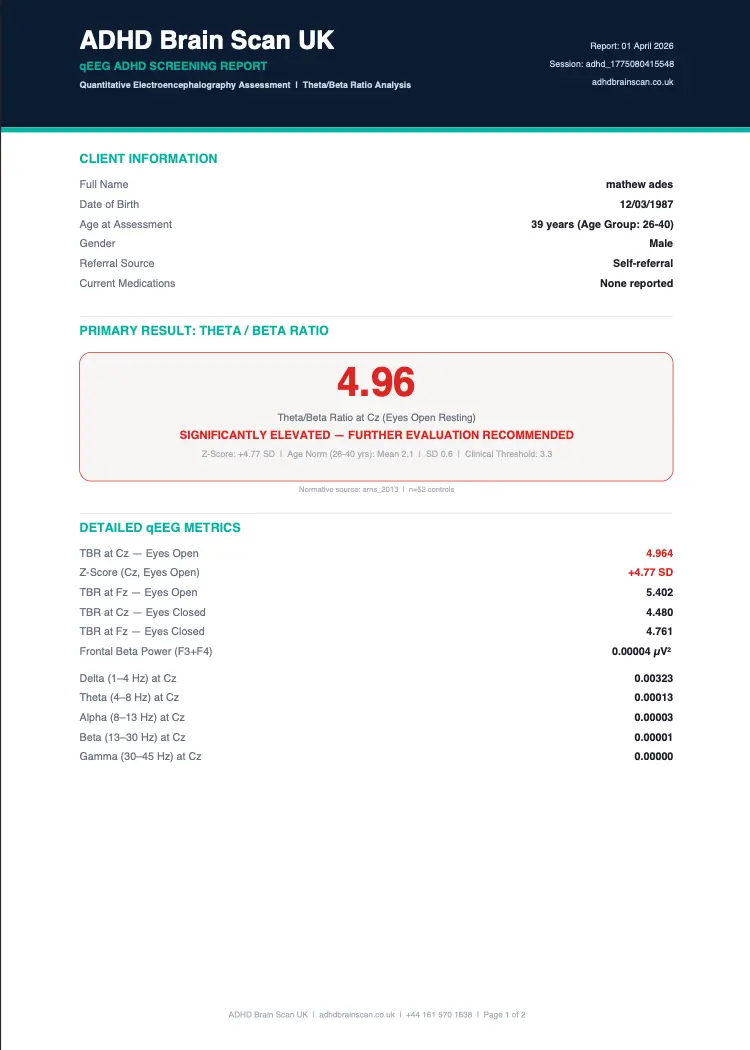
That's why our qEEG screening exists. We measure the brain directly. Four electrodes, 7 minutes of recording, and a comparison against 311+ research subjects. The result: a z-score showing exactly how many standard deviations your theta/beta ratio sits from the age-matched average. Objective. Quantified. Impossible to dismiss. Our next steps guide shows every pathway from screening to diagnosis.

Peer-reviewed science, not pseudoscience

The FDA cleared the NEBA System in 2013 specifically to assist in the evaluation of ADHD in patients aged 6–17. The clearance was based on the theta/beta ratio measured at Cz — the same measurement, at the same electrode site, that we use in our screening. The FDA's decision was supported by a multi-site clinical trial demonstrating that TBR data improved diagnostic accuracy when combined with standard clinical evaluation.

Since then, the evidence base has continued to grow. The International Society for Neurofeedback and Research (ISNR) and the Association for Applied Psychophysiology and Biofeedback (AAPB) both recognise qEEG assessment as a Level 1 (Best Practice) standard for ADHD evaluation.

Our screening applies this evidence in a practical, accessible format: 30 minutes, same-day report, no referral needed. The science is established. We simply make it available to the people who need it.

Read the full breakdown of the research behind our screening on our ADHD brain science page.

30 minutes. Four electrodes. Objective brain data.

The technology we use is a BrainBit Flex4 — a clinical-grade 4-channel EEG system with Web Bluetooth connectivity. Dry spring-loaded electrodes achieve research-quality signal without gel or preparation time. Channel mapping follows established neuroscience protocols for ADHD assessment.

Data processing uses Hanning-windowed Fast Fourier Transform. Band power is computed across every recording phase, then compared against our normative database from six peer-reviewed sources. The result is a precise, quantified measurement — not a subjective impression.

See the full step-by-step process on our how it works page, or visit our FAQ for common questions.

From arrival to report — your appointment step by step

For women coming for screening, we understand the journey is often different. You may have been told for years that it's anxiety, or depression, or just 'being overwhelmed.' The standard questionnaires were designed around hyperactive boys and they've been missing you. Our screening measures the brain directly — the inattentive pattern common in women shows up clearly in theta/beta data even when questionnaires miss it.

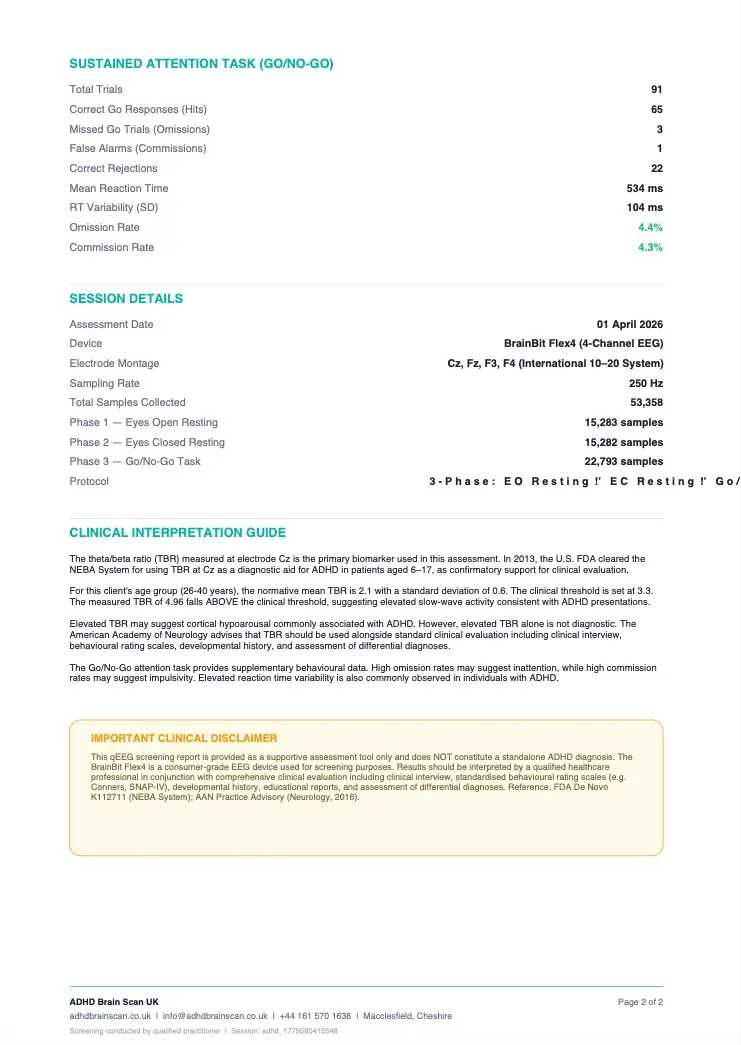
The process takes about 30 minutes. A lightweight cap with four dry electrodes, 7 minutes of recording across three phases (eyes open, eyes closed, Go/No-Go attention task), and a same-day professional report. No clinical interview. No one asking if you fidget. Just your brain data compared against published age-matched norms.

Many women tell us the screening is the first time anyone has taken their concerns seriously with objective evidence. The data doesn't care about gender bias. It shows what your cortex is doing — and that's what matters.

Simple preparation for accurate results

For women coming for screening — many of whom have spent years being told their symptoms are 'just anxiety' — the preparation is the same as everyone else, but the reassurance is different. You do not need to have a dramatic presentation to warrant screening. You do not need to be visibly hyperactive. The inattentive ADHD pattern common in women shows up clearly in theta/beta data even when it's invisible to everyone around you.

Practical prep: clean hair (no heavy products), normal sleep, normal food, moderate caffeine. If you take any medication — ADHD, antidepressants, anxiety meds — let us know when booking so we can advise on timing.

The screening itself takes 30 minutes, is completely painless, and produces a same-day report with your brain data expressed as z-scores against published norms. No one asks you to rate how often you fidget. We just measure your brain.

For more detail on the full process from booking to report, see how it works.

Children, teenagers, and adults from Southampton

We screen children aged 6 and above, teenagers, and adults of all ages from Southampton and across Hampshire. Each person is compared against age-matched normative data from published research — because a 7-year-old's brain is neurologically very different from a 40-year-old's.

For children, the most common scenario is parents who've been told their child "just needs to try harder." For teenagers, it's GCSE or A-level pressure exposing hidden attention difficulties. For adults, it's often a lifetime of wondering — sometimes triggered by a child's diagnosis.

Women and girls are particularly underserved by standard assessment. The inattentive presentation — quiet, dreamy, internally restless — is systematically missed by questionnaires designed around hyperactive boys. Our brain screening measures neurology directly, bypassing the behavioural bias.

Learn more: children 6+ · teenagers · adults · women & girls

View packages: standard screening (£595) · comprehensive (£845) · family package (£1,095) · all pricing

After your screening: ADHD support hub · results explained · what to do next · GP appointment guide · parent's guide

Could it be something other than ADHD?

Burnout and ADHD look remarkably similar in adults near Southampton — exhaustion, brain fog, inability to concentrate, emotional reactivity. Many adults are treated for burnout or chronic fatigue when the underlying issue is undiagnosed ADHD that has finally overwhelmed their coping capacity.

The difference matters because the treatment is completely different. Burnout responds to rest and reduced demands. ADHD responds to stimulant medication, environmental adjustments, and coaching. Treating ADHD as burnout means the person rests, recovers slightly, returns to work, and crashes again — because the underlying neurology hasn't changed.

Our qEEG screening can help distinguish between them. An elevated theta/beta ratio points towards ADHD-pattern cortical hypoarousal. A normal TBR with elevated alpha may suggest anxiety-driven exhaustion. Either way, objective data gives your clinician a clearer starting point than subjective symptom checklists alone.

A calm, comfortable experience for every child

One child is screened while the other waits comfortably with puzzles and activities. The lightweight cap sits gently on the head — no needles, no discomfort. Most children say they barely notice it.
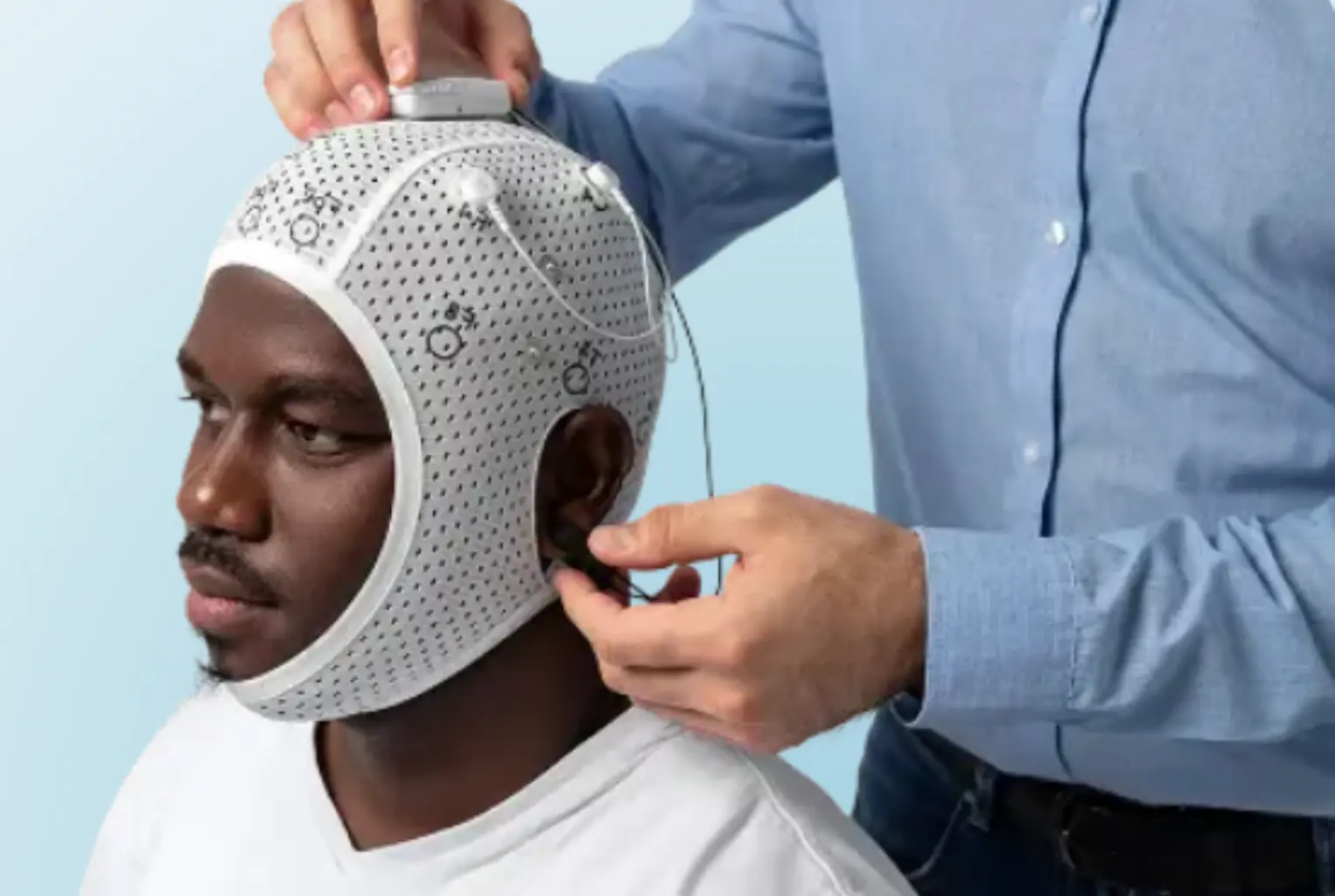
Close-up of lightweight EEG cap with four electrodes during an ADHD brain screening session at ADHD Brain Scan UK
Lightweight EEG cap with four electrodes
Electrodes at Cz, Fz, F3 and F4 — the exact sites used in published ADHD research and the FDA-cleared NEBA System. Completely painless, no electricity enters your body.
Laptop screen showing live EEG brainwave data during ADHD brain screening session with client in background
Real-time brain wave data
Each child's brain activity appears on screen in real time during the seven-minute recording. Results are processed independently using age-specific norms.
Scroll for more →

One screening, multiple doors opened

🩺 GP referral evidence

Objective brain data with z-scores gives your GP the evidence to write a stronger referral or submit a Right to Choose application.

🏫 School & EHCP evidence

SENCOs use our reports for EHCP applications, SEN register placements, and JCQ exam access (extra time, rest breaks).

💼 Workplace support

Adults use the clinical letter for Access to Work applications — government-funded coaching, headphones, assistive technology.

🧑‍⚕️ Private psychiatrist

Brain data gives a private psychiatrist an objective data point they wouldn't otherwise have, making assessment more focused.

📊 Medication tracking

Already on medication? A follow-up medication comparison scan (£345) shows objective before-and-after changes.

⏱ Evidence while you wait

Still on the NHS waiting list? Our report gives you actionable evidence for school, work, and GP support right now.

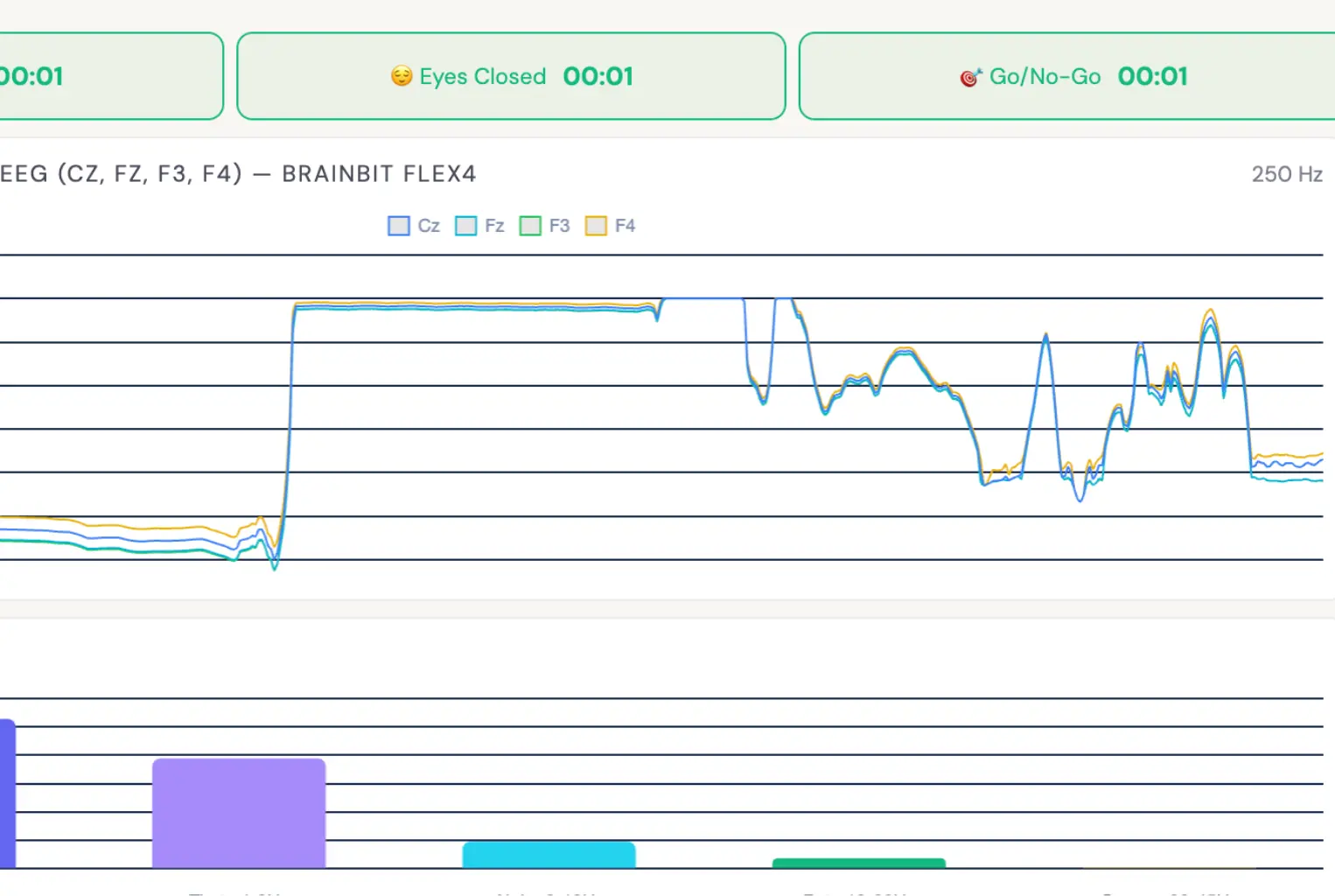
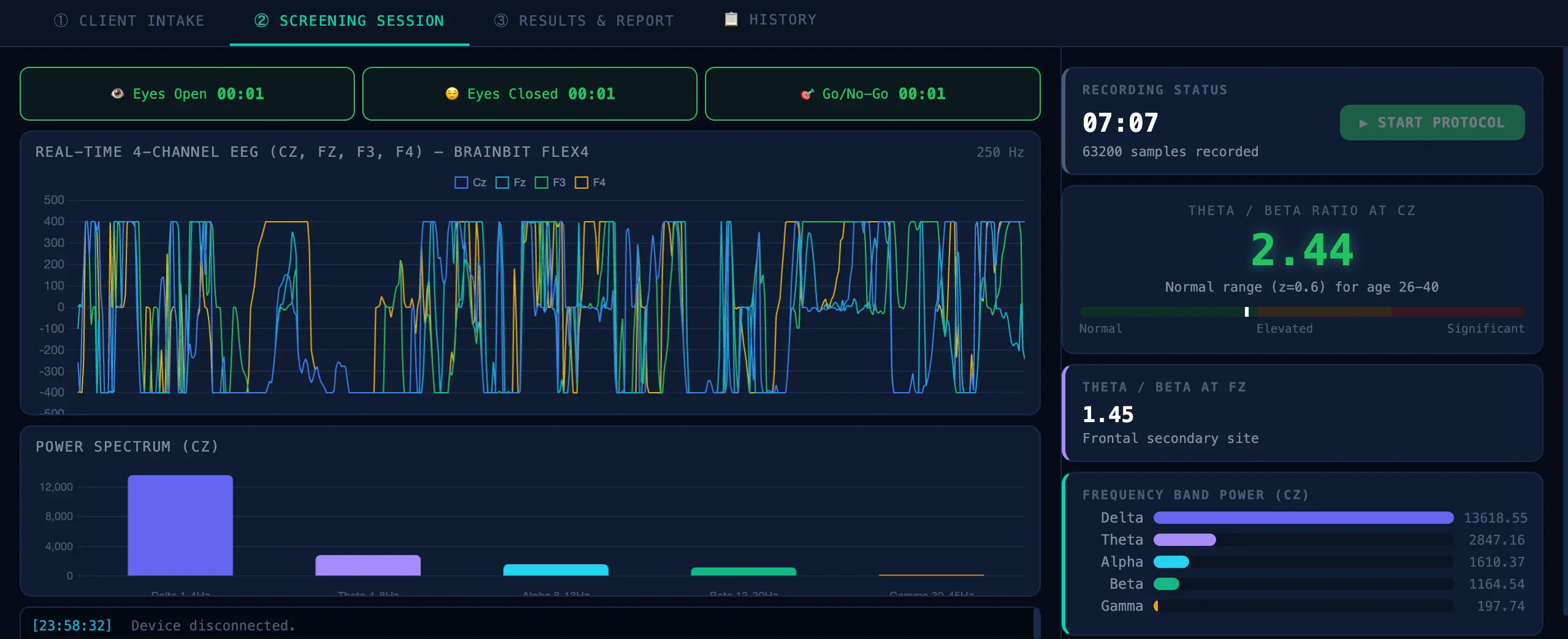
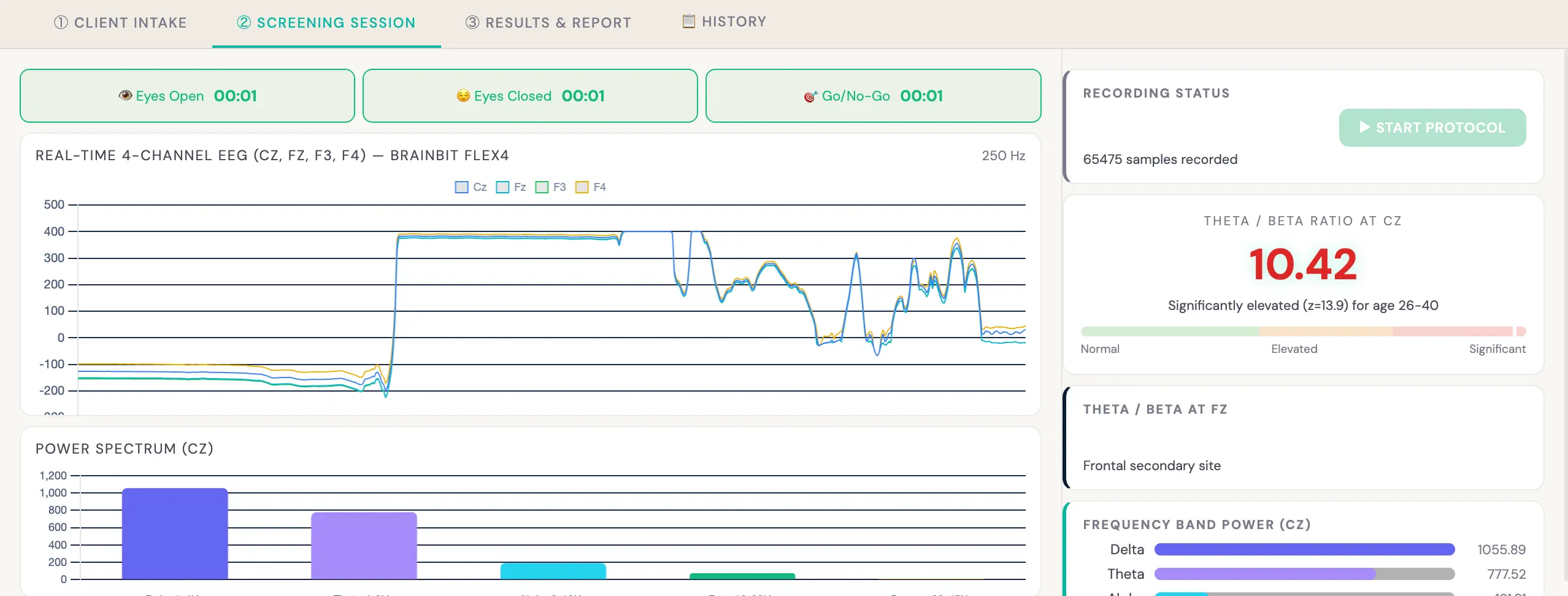
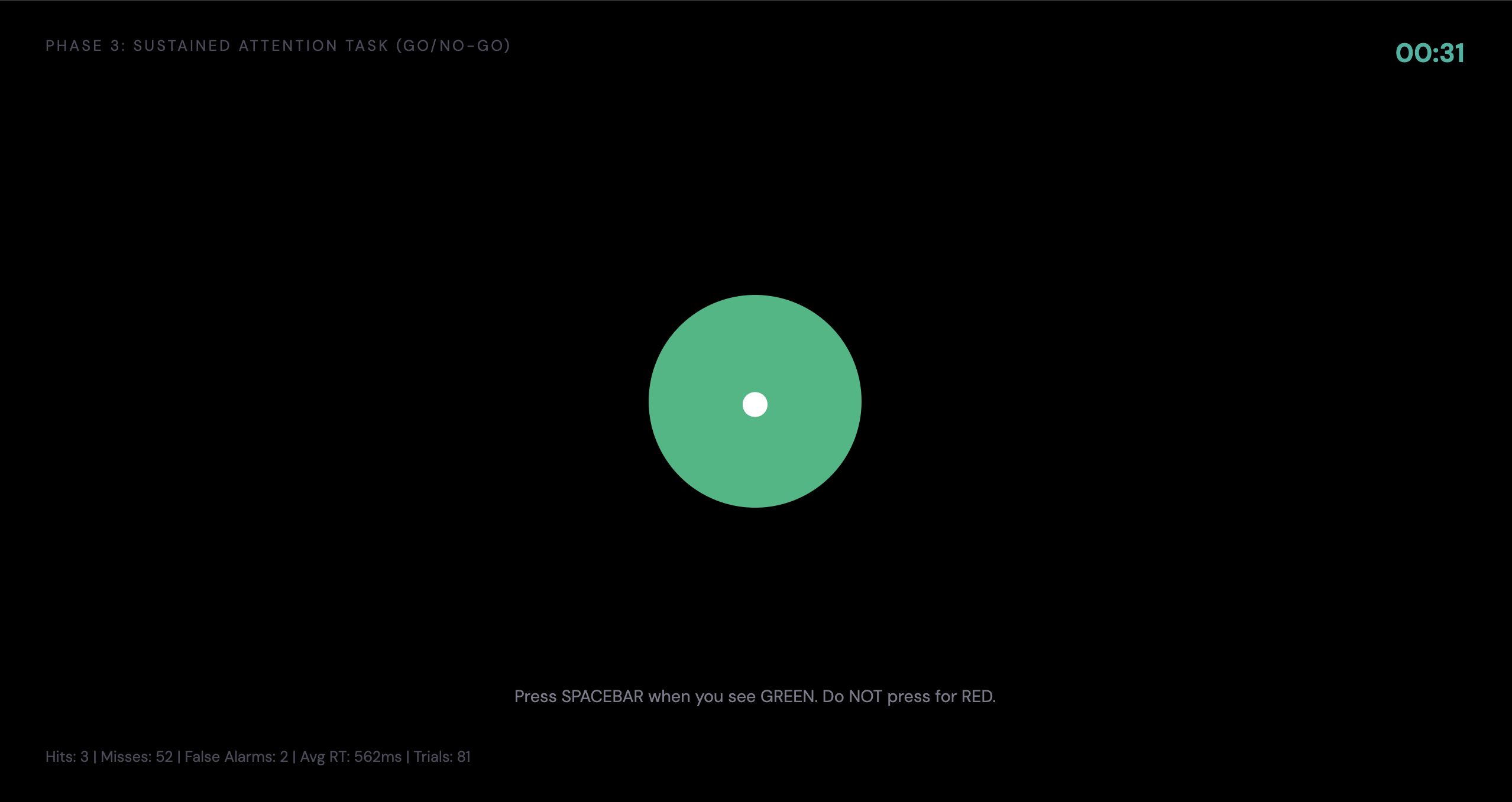
This is how the test looks — real-time brain data

During your screening, you'll see your own brain waves updating in real time on screen. Here's what the testing dashboard looks like during each phase of the 7-minute recording.

Want to understand what each screen means? Our science page explains every frequency band and what elevated theta looks like in real data.

Your results are just the beginning — here's what to do next

Your screening report opens multiple pathways simultaneously — you don't have to pick just one. Most clients from Southampton use the results in two or three ways at once. Immediately: book a GP appointment, bring the clinical letter, and request either an urgent CAMHS referral or a Right to Choose referral to Psychiatry-UK (NHS-funded, typically 3–6 months vs 2–5 years).

At the same time: send the report to your child's school SENCO for SEN register placement, EHCP evidence, or JCQ exam access arrangements (extra time, rest breaks). If you're an adult: begin an Access to Work application for government-funded coaching, assistive technology, and reasonable adjustments.

If the NHS pathway feels too slow even with Right to Choose, you can use the report alongside a private psychiatric assessment (£700–£1,500). The psychiatrist will have objective brain data before they even meet you — making the assessment more focused and potentially faster.

And if you're diagnosed and prescribed medication, your baseline brain data becomes invaluable. A follow-up medication comparison scan (£345) shows objective before-and-after changes in TBR and attention task performance — real evidence that treatment is working.

Transparent pricing, no hidden costs

Brain Screening
£595
qEEG scan + same-day PDF report with z-scores and normative comparison
Book today →
Family Package
£1,095
Two screenings + individual reports. Perfect for siblings or parent + child
Book today →
Medication Scan
£345
Before/after brain data to track medication response objectively
Book today →

NHS waiting list vs getting screened now

NHS pathway from Southampton

  • 2–5 year average wait time
  • No interim support while waiting
  • No evidence for school or work meanwhile
  • Assessment based on questionnaires only
  • No brain measurement included
  • Free (eventually)

Brain screening + stay on list

  • Brain data in your hands this week
  • Evidence for GP to fast-track referral
  • Data for school EHCP and exam access
  • Evidence for Access to Work claims
  • Objective brain data from real EEG
  • From £595 (one-off, same-day report)

We always recommend staying on the NHS waiting list while pursuing our screening. The NHS pathway leads to fully-funded ongoing care. Our screening gives you evidence and support in the meantime — and data that strengthens your case when the NHS appointment finally arrives.

🧠
BrainBit Flex4
Research-grade 4-channel EEG with dry spring-loaded electrodes
📚
6 peer-reviewed sources
Normative database from 311+ subjects across published research
📋
Same-day PDF report
Professional report with z-scores, frequency analysis, and citations
🔒
GDPR compliant
Your data is encrypted, secure, and never shared without consent
4.9
★★★★★
Based on 199 verified reviews
★★★★★☆☆
The clinical letter was key for my GP near Southampton. She read it, said 'this is exactly the kind of evidence I need,' and submitted the Right to Choose referral that same day. The z-scores gave her confidence.
PJ
Priya J.
Adult from Southampton
Verified client
★★★★★☆☆
Travelled from Southampton and it was absolutely worth it. Our son's TBR was clearly elevated — 2.3 standard deviations above the mean. We took the report to our GP and he fast-tracked the CAMHS referral within a week. After 2 years of getting nowhere, one brain scan changed everything.
SM
Sarah M.
Parent from Southampton
Verified client
★★★★★☆☆
My daughter (7) was nervous about the cap but the team were brilliant. They let her hold it first, explained everything as 'listening to her brain,' and she thought seeing her brain waves on screen was cool. Results clearly showed elevated theta. Now pursuing formal assessment.
LW
Laura W.
Parent from Southampton
Verified client
★★★★★☆☆
Three months after the scan I'm formally diagnosed and on medication. Coming from near Southampton, that 30-minute brain scan fast-tracked what would have taken 4+ years on the NHS. Total cost: £845 for comprehensive. Right to Choose was free. Best £845 I've ever spent.
TG
Tom G.
Adult from Southampton
Verified client
★★★★☆
Screened both our daughters with the family package. One showed elevated TBR (the quiet daydreamer). The other came back normal. Having that clarity meant we could focus resources where genuinely needed. Great value.
CP
Claire P.
Parent from Hampshire
Verified client
★★★★★☆☆
My wife got screened after our son was diagnosed. She'd masked ADHD for 38 years near Southampton. Her TBR was even higher than our son's. Decades of 'why can't I just get organised?' finally explained by brain data. She cried in the car park. Happy tears.
DW
David W.
Family from Southampton
Verified client
★★★★★☆☆
I've now received several of these reports from patients across Hampshire. They're well-structured, properly cited with peer-reviewed references, and give me the objective data I need to write strong referral letters. They don't overclaim — they present the data clearly.
DRK
Dr R. Keane
GP in Hampshire
Verified client
★★★★★☆☆
As a SENCO working with families across Hampshire, I now routinely recommend this. The reports give us exactly the objective evidence we need for EHCP applications and JCQ exam access. One student went from zero support to 25%% extra time within a month.
EH
Emma H.
SENCO in Hampshire
Verified client
Scroll for more reviews →

Easy access from Southampton and across Hampshire

From Southampton, our screening venues are easily accessible by car or public transport. We use private rooms at professional venues across Cheshire and the North West — all with free parking and a relaxed, non-medical atmosphere. Exact location is confirmed after booking.

Home visits are also available throughout Hampshire. This option is especially popular with parents of younger children, adults who feel anxious about clinical settings, and anyone who simply prefers the comfort of their own home. Same screening, same report, same day.

Frequently asked questions

No. Book directly without any GP referral. Many clients from Southampton book the screening first, then take the results to their GP as evidence for a formal referral or Right to Choose application.

Anyone aged 6 and above — children, teenagers, and adults. Each person is compared against age-matched normative data from published research, ensuring the comparison is appropriate for their developmental stage.

Our reports include peer-reviewed citations, z-scores against normative data, and clear clinical context. Many GPs across Hampshire have used our reports to support CAMHS referrals and Right to Choose applications.

Completely safe and painless. Electrodes passively listen to natural brain signals. No electricity enters the body. No needles, no radiation, no gel, no side effects. Same technology used safely in children's hospitals worldwide.

Yes. The clinical letter has been accepted by Access to Work assessors as supporting evidence. Clients from Southampton have used it to secure coaching, noise-cancelling headphones, and assistive technology.

Yes. We serve clients from Southampton and across Hampshire. We're based in Macclesfield, Cheshire, with good transport links. Same-week appointments typically available. Home visits also offered (travel fee may apply).

No. Book directly without any GP referral. Many clients from Southampton book the screening first, then take the results to their GP as evidence for a formal referral or Right to Choose application.

Anyone aged 6 and above — children, teenagers, and adults. Each person is compared against age-matched normative data from published research, ensuring the comparison is appropriate for their developmental stage.

Common questions about ADHD brain screening

An elevated theta/beta ratio means your brain produces disproportionately more slow-wave theta activity (associated with unfocused, daydreaming states) relative to fast-wave beta activity (associated with focused concentration). This pattern indicates cortical hypoarousal — the attention networks of your brain are under-powered. It's the neurological signature most consistently associated with ADHD across published research.

When combined with clinical evaluation, EEG-based theta/beta ratio data improves ADHD diagnostic accuracy to 89–94%% (American Academy of Neurology). On its own, TBR has sensitivity around 78–90%% depending on the study and age group. It's significantly more objective than questionnaires alone, which rely on subjective behavioural report. This is especially important for women with inattentive ADHD who score normally on questionnaires despite genuine neurological differences.

Yes. We screen adults of all ages, from 18 to 60+. Adult ADHD is significantly underdiagnosed, particularly in women. Each adult is compared against age-matched normative data from published research. Many adults who come to us have suspected ADHD for years but never had objective evidence to act on. Our coping strategies guide offers techniques you can start immediately.

Standard EEG (used in hospitals) looks at raw brain wave patterns to detect epilepsy, seizures, and structural abnormalities. Quantitative EEG (qEEG) goes further — it analyses the frequency composition of brain activity using mathematical processing (Fast Fourier Transform), then compares the results against normative databases. For ADHD, qEEG reveals the theta/beta ratio imbalance that standard EEG isn't designed to assess.

A qEEG brain scan measures electrical brain activity patterns associated with ADHD — specifically the theta/beta ratio, which is the most-studied EEG biomarker for the condition. It doesn't 'detect' ADHD in the way an X-ray detects a fracture, but it provides objective neurological data that, when combined with clinical evaluation, significantly improves diagnostic accuracy (89–94%% according to the American Academy of Neurology). It's the closest thing to an objective ADHD test that exists. Our results explained guide shows exactly what your report will contain.

An elevated theta/beta ratio means your brain produces disproportionately more slow-wave theta activity (associated with unfocused, daydreaming states) relative to fast-wave beta activity (associated with focused concentration). This pattern indicates cortical hypoarousal — the attention networks of your brain are under-powered. It's the neurological signature most consistently associated with ADHD across published research.

Explore our guides and resources

Know someone who needs this?

Share this page with someone near Southampton who might be waiting for answers.

What happens during a screening

A 60-second look at the ADHD brain screening experience.

From Southampton to clarity — book your ADHD brain screening and get answers, not opinions.

Same-day report. Evidence your GP will take seriously. From £595.

Book your scan today → View pricing