MainHomeHow it worksThe sciencePricingFAQ ServicesADHD Brain ScreeningComprehensive AssessmentFamily PackageMedication Scan Who it's forChildren (6+)AdultsWomen & girlsTeenagers ADHD SupportSupport hubResults explainedWhat to do nextGP appointment guideCoping strategiesMedication guideWorkplace rightsWomen & girlsParent's guide GuidesNHS waiting listEvidence for your GPEHCP evidenceAccess to WorkRight to Choose Book a scan
Oxford, Oxfordshire

ADHD brain screening in Oxford

Fast, private ADHD brain screening for clients from Oxford and Oxfordshire. No GP referral required. Objective neurological data delivered in a same-day professional PDF report. Evidence your GP will take seriously, your school can use for an EHCP, or your employer can use for workplace adjustments.

Book your scan today →Learn more
★★★★★ 4.9/5 (199 reviews)
🧠 311+ research subjects
📄 Same-day PDF report
On this page

Why people near Oxford are choosing brain data over questionnaires

If you're searching for ADHD screening near Oxford, you've probably been through the frustrating cycle: online quizzes that say "likely ADHD," a GP appointment that went nowhere, and an NHS waiting list stretching years into the future. In Oxfordshire, the average CAMHS wait is 2–3 years for children and 3–5 years for adults. Some areas report waits exceeding 5 years.

The private route isn't much better in terms of evidence. A private psychiatric assessment costs £700–£1,500 and is based entirely on conversation: questionnaires, rating scales, and a clinical interview. There is no brain measurement. No objective data. If you're near Oxford and you want something more concrete, something your GP can't dismiss as "everyone struggles with that," you need actual brain data.

That's what we provide. In 30 minutes, we measure the electrical activity of your brain, compare it against published norms from 311+ research subjects, and give you a same-day professional report. Not an opinion. Not a score on a checklist. A direct measurement of what your brain is doing. Our results explained guide helps you understand every data point.

Peer-reviewed science, not pseudoscience

Five frequency bands tell the story of your brain's electrical activity. Delta (1–4 Hz) relates to deep processing and is elevated in drowsy states. Theta (4–8 Hz) is the ADHD-relevant band — elevated theta indicates an under-aroused cortex that struggles to maintain focused attention. Alpha (8–12 Hz) reflects relaxed awareness and is often elevated in anxiety. Beta (12–30 Hz) indicates active concentration and engagement. Gamma (30–45 Hz) relates to higher cognitive processing.

We measure all five bands at four cortical sites simultaneously: Cz (vertex — the FDA-standard TBR measurement point), Fz (frontal midline — secondary TBR site), F3 (left prefrontal — executive function), and F4 (right prefrontal — attention regulation). This four-channel configuration captures the cortical regions most relevant to ADHD neuroscience.

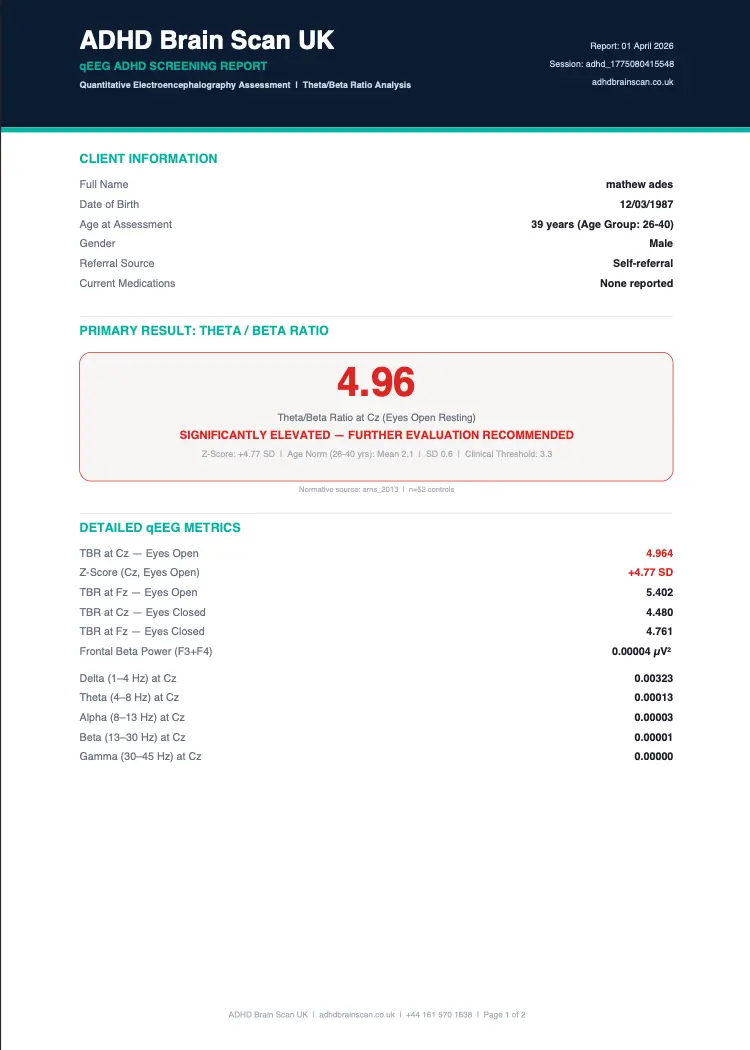
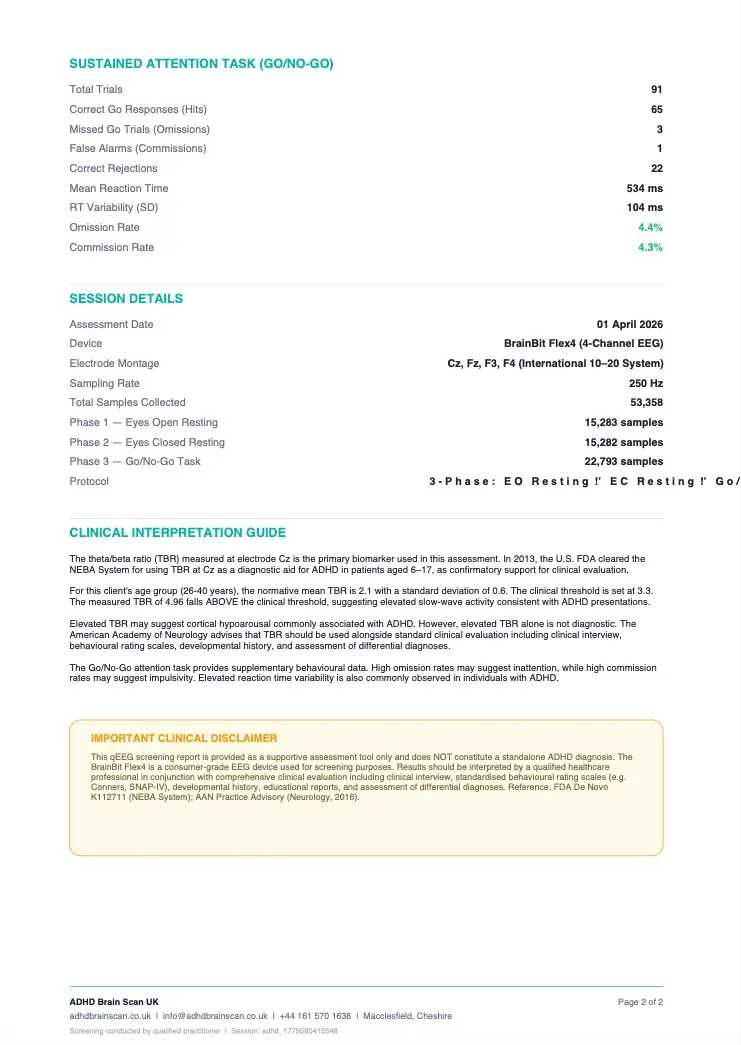
Your report shows the absolute and relative power in each band at each site, the TBR at Cz and Fz, and z-scores comparing each measurement against published age-matched norms. The full picture, not just a single number.

Read the full breakdown of the research behind our screening on our ADHD brain science page.

30 minutes. Four electrodes. Objective brain data.

Everything starts with a 5-minute setup: cap on, electrode check, clear explanation. The brain recording takes 7 minutes. We measure at four cortical sites: Cz (primary TBR site), Fz (secondary TBR site), F3 (left prefrontal — executive function), and F4 (right prefrontal — attention regulation). Data is processed using Fast Fourier Transform into five frequency bands: delta, theta, alpha, beta, and gamma.

The key measurement is the theta/beta ratio at Cz — an elevated TBR indicates cortical hypoarousal, the pattern most consistently associated with ADHD. Your result is expressed as a z-score against age-matched norms.

See the full step-by-step process on our how it works page, or visit our FAQ for common questions.

From arrival to report — your appointment step by step

Nervous about the appointment? Most people are — especially if they've had difficult medical experiences before, or if they're anxious about what the results might show. Here's what to expect: a calm, friendly environment where every step is explained before it happens. No surprises. No pressure. No judgment.

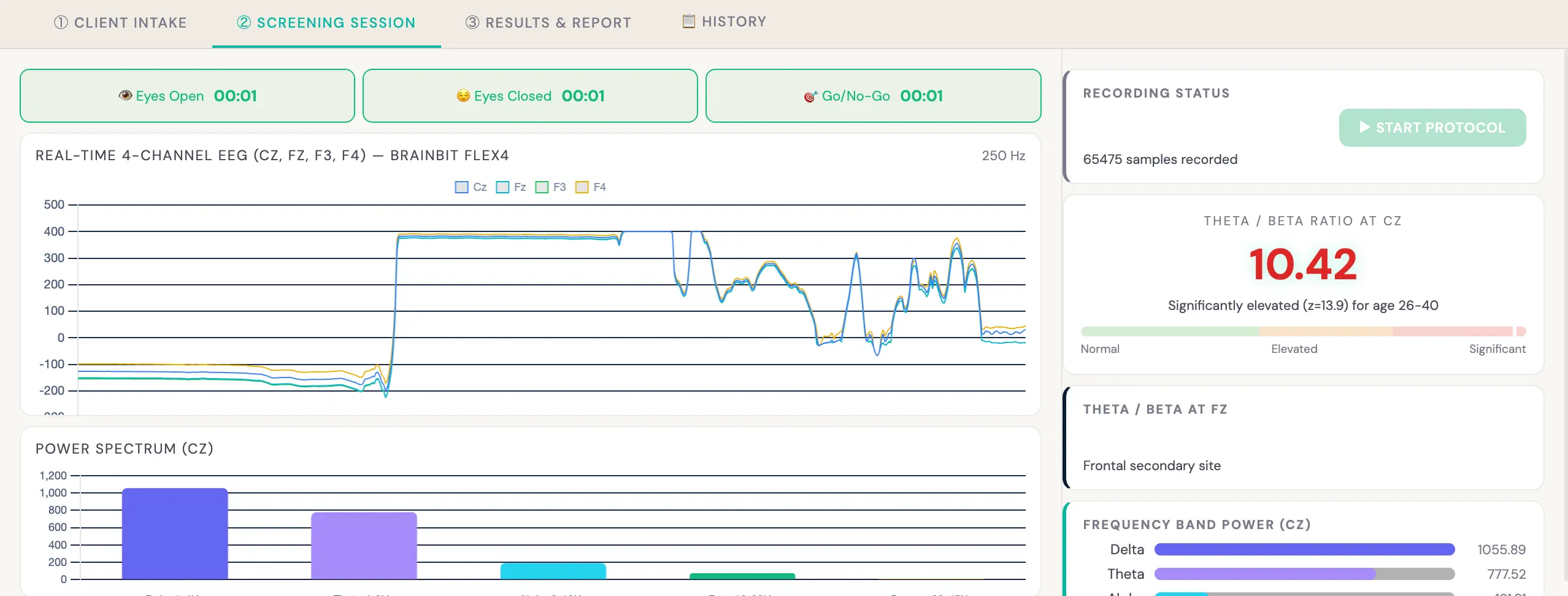
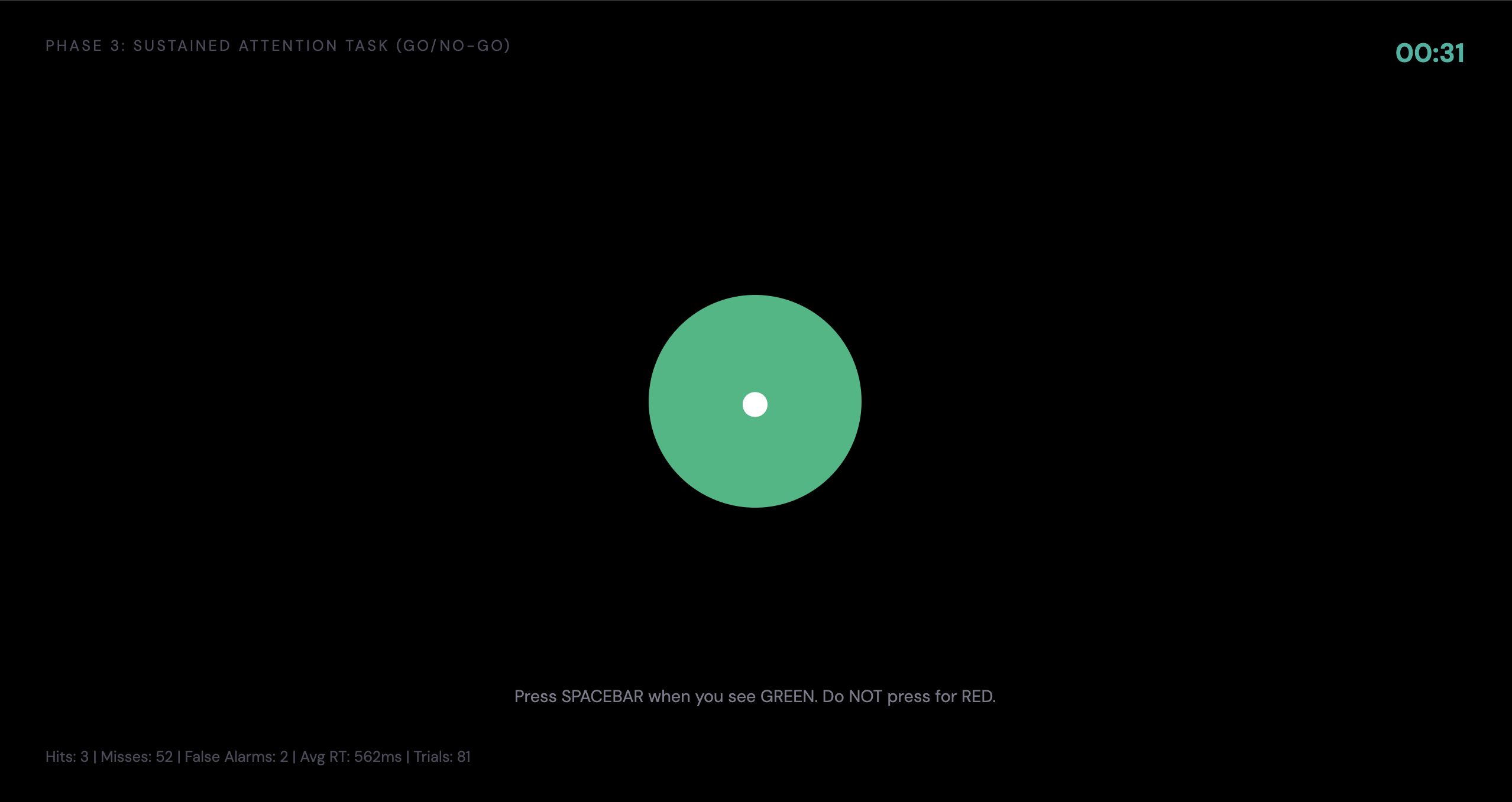
The screening takes 30 minutes total. The brain recording itself is just 7 minutes: 2 minutes eyes open, 2 minutes eyes closed, 3 minutes doing a simple press-the-button task. The cap is lightweight, dry (no gel), and most people forget it's there within a minute. You'll see your own brain waves on screen in real time — most people find this fascinating rather than stressful.

After recording, your data is processed and your report generated the same day. If you've booked the comprehensive package, we spend 20 minutes walking through every finding with you. Either way, our ADHD support hub is available afterwards with guides on understanding your results, next steps, coping strategies and more.

Simple preparation for accurate results

There's very little preparation needed — that's part of the appeal. The main things to remember: clean hair (no heavy products or gel), normal sleep, normal food, and moderate caffeine. Arrive 5 minutes early so we can start on time, but there's no paperwork or questionnaires to complete beforehand.

If you're bringing a child, explain the process in simple, positive terms: 'we're going to listen to your brain waves with a special hat — it doesn't hurt at all and you'll be able to see your brain working on a screen.' Most children are curious rather than anxious when it's framed this way. Our parent's guide has more advice on preparing children.

If you're an adult who takes ADHD medication, let us know when booking. For a baseline screening, we typically recommend taking the test unmedicated (skip your morning dose). For a medication comparison scan, we need one session off medication and one on medication. We'll advise on the best approach for your situation.

For more detail on the full process from booking to report, see how it works.

Children, teenagers, and adults from Oxford

We screen children aged 6 and above, teenagers, and adults of all ages from Oxford and across Oxfordshire. Each person is compared against age-matched normative data from published research — because a 7-year-old's brain is neurologically very different from a 40-year-old's.

For children, the most common scenario is parents who've been told their child "just needs to try harder." For teenagers, it's GCSE or A-level pressure exposing hidden attention difficulties. For adults, it's often a lifetime of wondering — sometimes triggered by a child's diagnosis.

Women and girls are particularly underserved by standard assessment. The inattentive presentation — quiet, dreamy, internally restless — is systematically missed by questionnaires designed around hyperactive boys. Our brain screening measures neurology directly, bypassing the behavioural bias.

Learn more: children 6+ · teenagers · adults · women & girls

View packages: standard screening (£595) · comprehensive (£845) · family package (£1,095) · all pricing

After your screening: ADHD support hub · results explained · what to do next · GP appointment guide · parent's guide

Could it be something other than ADHD?

ADHD symptoms overlap with anxiety (restlessness, poor focus), depression (low motivation, forgetfulness), autism (sensory sensitivity, social difficulty), sleep disorders (daytime inattention, irritability), and even giftedness (boredom, underperformance). This overlap is precisely why so many people are misdiagnosed — or dismissed entirely.

Women are particularly affected by misdiagnosis. The inattentive presentation of ADHD — internal restlessness, difficulty organising thoughts, emotional overwhelm — is frequently labelled as anxiety or depression. Many women near Oxford come to us after years on SSRIs that never fully resolved their symptoms, because the underlying ADHD was never identified.

Our brain screening adds objective neurological data to the clinical picture. An elevated TBR at Cz is specific to the cortical hypoarousal pattern seen in ADHD — it doesn't appear in anxiety, depression, or sleep disorders in the same way. This helps your clinician differentiate between conditions that questionnaires cannot distinguish.

A calm, comfortable experience for every child

One child is screened while the other waits comfortably with puzzles and activities. The lightweight cap sits gently on the head — no needles, no discomfort. Most children say they barely notice it.
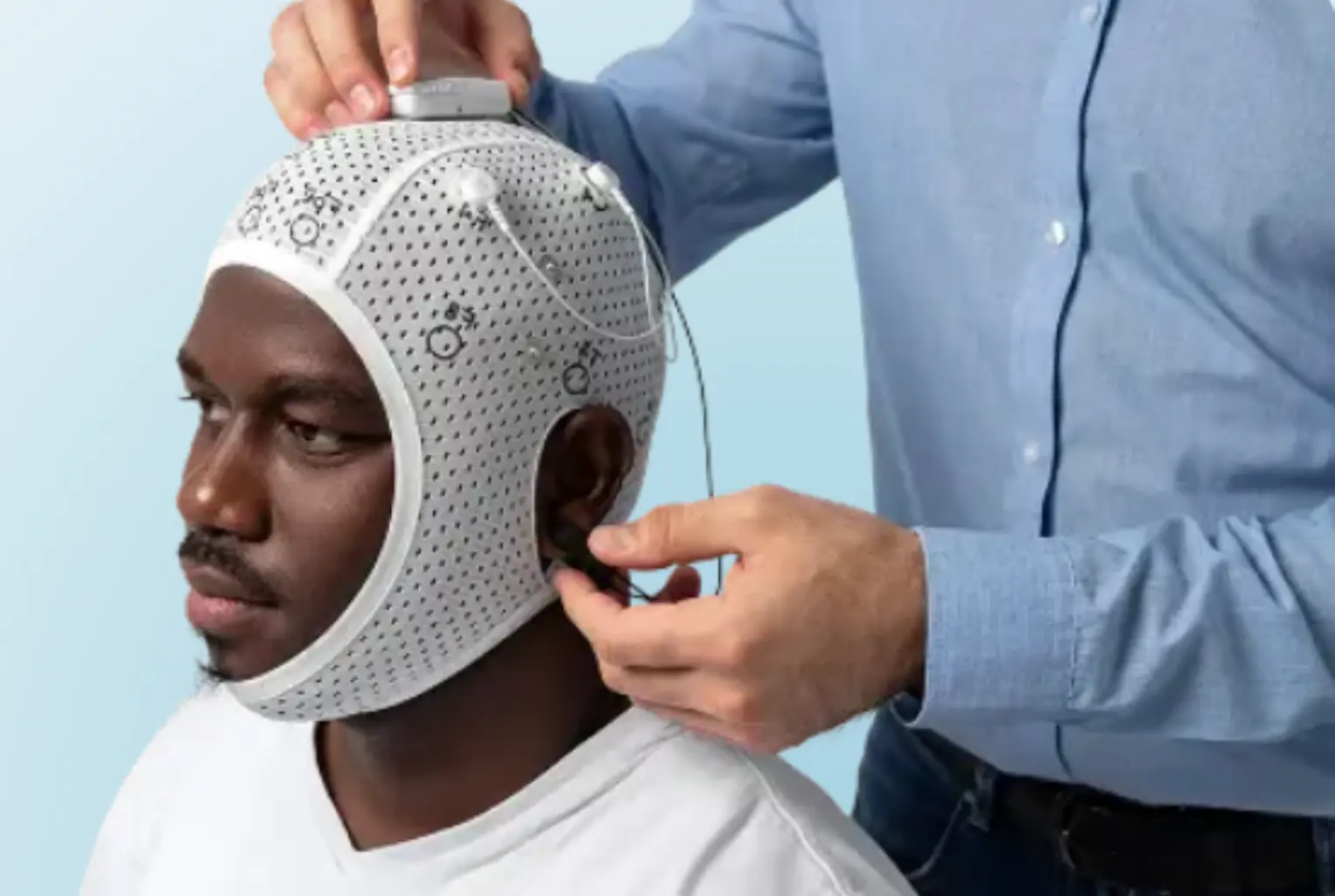
Close-up of lightweight EEG cap with four electrodes during an ADHD brain screening session at ADHD Brain Scan UK
Lightweight EEG cap with four electrodes
Electrodes at Cz, Fz, F3 and F4 — the exact sites used in published ADHD research and the FDA-cleared NEBA System. Completely painless, no electricity enters your body.
Laptop screen showing live EEG brainwave data during ADHD brain screening session with client in background
Real-time brain wave data
Each child's brain activity appears on screen in real time during the seven-minute recording. Results are processed independently using age-specific norms.
Scroll for more →

One screening, multiple doors opened

🩺 GP referral evidence

Objective brain data with z-scores gives your GP the evidence to write a stronger referral or submit a Right to Choose application.

🏫 School & EHCP evidence

SENCOs use our reports for EHCP applications, SEN register placements, and JCQ exam access (extra time, rest breaks).

💼 Workplace support

Adults use the clinical letter for Access to Work applications — government-funded coaching, headphones, assistive technology.

🧑‍⚕️ Private psychiatrist

Brain data gives a private psychiatrist an objective data point they wouldn't otherwise have, making assessment more focused.

📊 Medication tracking

Already on medication? A follow-up medication comparison scan (£345) shows objective before-and-after changes.

⏱ Evidence while you wait

Still on the NHS waiting list? Our report gives you actionable evidence for school, work, and GP support right now.

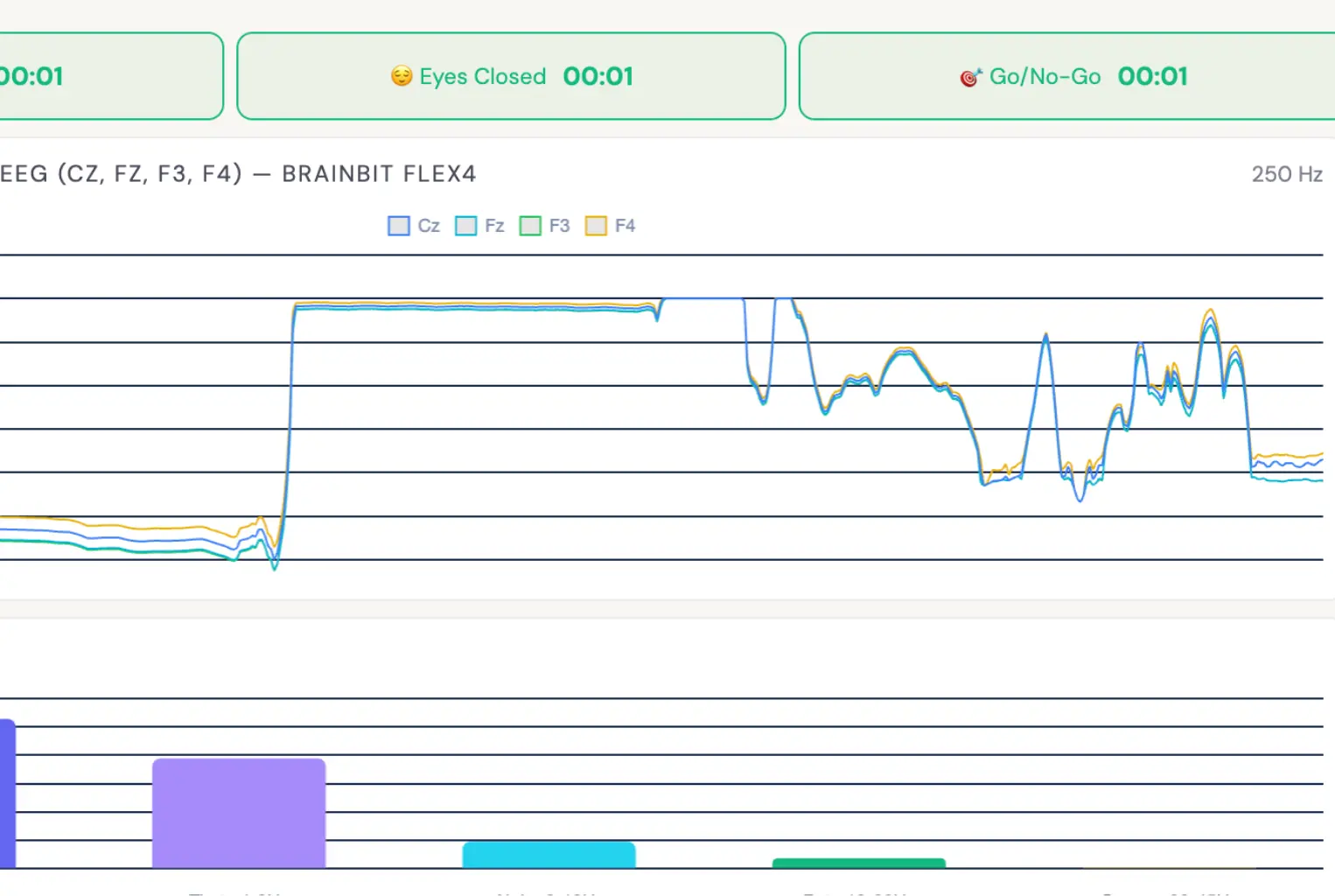
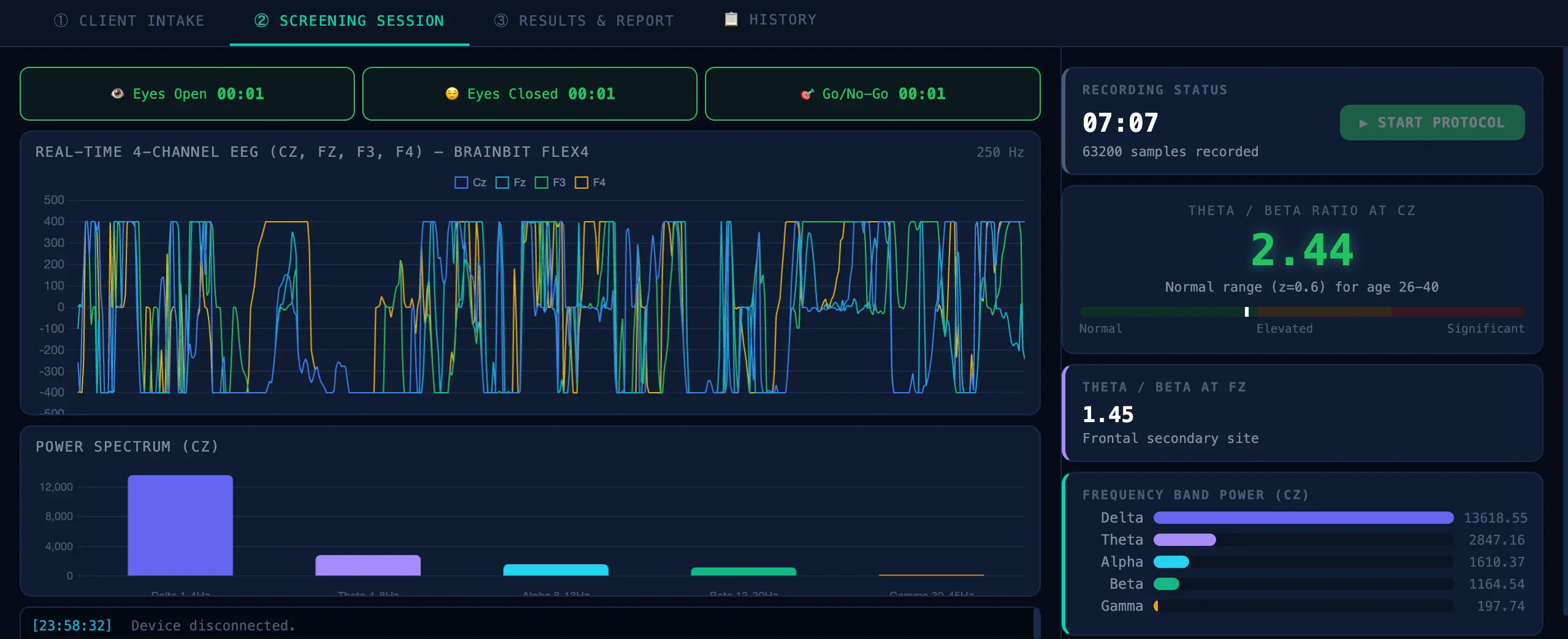
This is how the test looks — real-time brain data

During your screening, you'll see your own brain waves updating in real time on screen. Here's what the testing dashboard looks like during each phase of the 7-minute recording.

Want to understand what each screen means? Our science page explains every frequency band and what elevated theta looks like in real data.

Your results are just the beginning — here's what to do next

Your screening report opens multiple pathways simultaneously — you don't have to pick just one. Most clients from Oxford use the results in two or three ways at once. Immediately: book a GP appointment, bring the clinical letter, and request either an urgent CAMHS referral or a Right to Choose referral to Psychiatry-UK (NHS-funded, typically 3–6 months vs 2–5 years).

At the same time: send the report to your child's school SENCO for SEN register placement, EHCP evidence, or JCQ exam access arrangements (extra time, rest breaks). If you're an adult: begin an Access to Work application for government-funded coaching, assistive technology, and reasonable adjustments.

If the NHS pathway feels too slow even with Right to Choose, you can use the report alongside a private psychiatric assessment (£700–£1,500). The psychiatrist will have objective brain data before they even meet you — making the assessment more focused and potentially faster.

And if you're diagnosed and prescribed medication, your baseline brain data becomes invaluable. A follow-up medication comparison scan (£345) shows objective before-and-after changes in TBR and attention task performance — real evidence that treatment is working.

Transparent pricing, no hidden costs

Brain Screening
£595
qEEG scan + same-day PDF report with z-scores and normative comparison
Book today →
Family Package
£1,095
Two screenings + individual reports. Perfect for siblings or parent + child
Book today →
Medication Scan
£345
Before/after brain data to track medication response objectively
Book today →

NHS waiting list vs getting screened now

NHS pathway from Oxford

  • 2–5 year average wait time
  • No interim support while waiting
  • No evidence for school or work meanwhile
  • Assessment based on questionnaires only
  • No brain measurement included
  • Free (eventually)

Brain screening + stay on list

  • Brain data in your hands this week
  • Evidence for GP to fast-track referral
  • Data for school EHCP and exam access
  • Evidence for Access to Work claims
  • Objective brain data from real EEG
  • From £595 (one-off, same-day report)

We always recommend staying on the NHS waiting list while pursuing our screening. The NHS pathway leads to fully-funded ongoing care. Our screening gives you evidence and support in the meantime — and data that strengthens your case when the NHS appointment finally arrives.

🧠
BrainBit Flex4
Research-grade 4-channel EEG with dry spring-loaded electrodes
📚
6 peer-reviewed sources
Normative database from 311+ subjects across published research
📋
Same-day PDF report
Professional report with z-scores, frequency analysis, and citations
🔒
GDPR compliant
Your data is encrypted, secure, and never shared without consent
4.9
★★★★★
Based on 199 verified reviews
★★★★★☆☆
Used the clinical letter for my Access to Work application from Oxford. Having objective neurological data rather than just a questionnaire made all the difference. Approved for 20 sessions of ADHD coaching plus noise-cancelling headphones.
SC
Sophie C.
Adult from Oxford
Verified client
★★★★★☆☆
My daughter is the quiet daydreamer type — nobody in Oxfordshire had flagged it despite years of underperformance. The scan showed elevated theta. Inattentive ADHD, exactly as I'd suspected. Validation at last.
RA
Rachel A.
Parent from Oxfordshire
Verified client
★★★★★☆☆
As an adult near Oxford who's suspected ADHD for 15 years, seeing the actual brain data was incredibly validating. My TBR was significantly elevated. The comprehensive clinical letter got my Right to Choose referral accepted first time. Now diagnosed and on Elvanse. Life-changing.
JT
James T.
Adult from Oxford
Verified client
★★★★★☆☆
My GP near Oxford had dismissed ADHD twice because I 'didn't seem hyperactive.' I'm a 44-year-old woman who's spent her life masking. The brain scan showed elevated TBR at both sites. Took it back to the GP — Right to Choose referral submitted that week.
NR
Nicola R.
Adult from Oxfordshire
Verified client
★★★★★☆☆
Our son's GCSEs were 6 months away and he was drowning with zero support. The brain scan confirmed elevated TBR. His school's SENCO in Oxfordshire used the clinical letter to get JCQ exam access approved in 3 weeks — 25%% extra time plus rest breaks.
MD
Mark D.
Parent from Oxfordshire
Verified client
★★★★★☆☆
The clinical letter was key for my GP near Oxford. She read it, said 'this is exactly the kind of evidence I need,' and submitted the Right to Choose referral that same day. The z-scores gave her confidence.
PJ
Priya J.
Adult from Oxford
Verified client
★★★★★☆☆
Travelled from Oxford and it was absolutely worth it. Our son's TBR was clearly elevated — 2.3 standard deviations above the mean. We took the report to our GP and he fast-tracked the CAMHS referral within a week. After 2 years of getting nowhere, one brain scan changed everything.
SM
Sarah M.
Parent from Oxford
Verified client
★★★★★☆☆
My daughter (7) was nervous about the cap but the team were brilliant. They let her hold it first, explained everything as 'listening to her brain,' and she thought seeing her brain waves on screen was cool. Results clearly showed elevated theta. Now pursuing formal assessment.
LW
Laura W.
Parent from Oxford
Verified client
Scroll for more reviews →

Easy access from Oxford and across Oxfordshire

Getting screened from Oxford is straightforward. We use private venues across Cheshire and Greater Manchester — all with free parking, easy access, and a calm, non-clinical atmosphere. When you book, we confirm the nearest available venue to Oxford and send you full directions.

If you'd prefer not to travel at all, our home visit service covers Oxfordshire and beyond. A tester brings all equipment to your home and conducts the full screening in a quiet room. Same 7-minute recording, same same-day report. Ideal for nervous children or anyone who values complete privacy.

Frequently asked questions

Right to Choose lets you be assessed by a private provider at NHS expense. Your GP submits the referral. Our clinical letter provides objective evidence that helps GPs feel confident making that referral.

ADHD Brain Screening is £595 (scan + same-day PDF report). Comprehensive Assessment is £845 (scan + consultation + clinical letter). Family Package is £1,095 (two screenings). Medication Comparison Scan is £345.

No. This is an objective brain screening providing quantitative neurological data to support clinical evaluation. ADHD diagnosis requires a qualified clinician. Our report provides powerful supporting evidence.

About 30 minutes from arrival to departure. The brain recording itself is 7 minutes. Setup takes about 5 minutes. Your report is delivered the same day by email.

Yes. SENCOs across Oxfordshire use our reports for EHCP panel submissions and JCQ exam access (extra time, rest breaks, separate room). The comprehensive clinical letter is designed for educational contexts.

We understand — difficulty sitting still is often why you're here. Recording is only 7 minutes with breaks available. If a phase is too noisy, we redo it free. If your child can't tolerate the cap, we offer a free retry.

Right to Choose lets you be assessed by a private provider at NHS expense. Your GP submits the referral. Our clinical letter provides objective evidence that helps GPs feel confident making that referral.

ADHD Brain Screening is £595 (scan + same-day PDF report). Comprehensive Assessment is £845 (scan + consultation + clinical letter). Family Package is £1,095 (two screenings). Medication Comparison Scan is £345.

Common questions about ADHD brain screening

Our reports include peer-reviewed citations, z-scores against published normative data, and formal clinical interpretation letters. Many GPs across the UK have used our reports to support CAMHS referrals, Right to Choose applications to Psychiatry-UK, and urgent assessment requests. The report is designed to be credible and actionable within the NHS system. Our GP appointment guide includes scripts for presenting your results.

No GP referral is needed. You can book directly online or by phone. Many clients book the screening first, then take the objective results to their GP as evidence to support a formal referral. Having brain data in hand often makes the GP conversation significantly more productive — our GP appointment guide shows you exactly what to say.

Yes. The theta/beta ratio has been studied for over 30 years, replicated across hundreds of independent studies, and was referenced in the FDA's 2013 clearance of the NEBA System for ADHD evaluation. The International Society for Neurofeedback and Research (ISNR) rates qEEG assessment as Level 1 (Best Practice) for ADHD. It's well-established science, not experimental. Our ADHD brain guide explains the neuroscience in plain English.

No. Screening provides objective data; diagnosis requires comprehensive clinical assessment by a qualified professional. Our screening gives you neurological evidence to support the diagnostic process — it doesn't replace it. Think of it as providing the brain data that questionnaires and interviews cannot capture, making the eventual diagnosis more accurate and evidence-based. Our next steps guide explains every pathway from screening to formal diagnosis.

If you're currently waiting years on the NHS list with no support, paying £595–£845 for same-day objective data that can unlock GP referrals, school support, workplace accommodations, and Right to Choose applications is highly cost-effective. Many clients tell us the screening paid for itself within weeks through the support it unlocked.

Our reports include peer-reviewed citations, z-scores against published normative data, and formal clinical interpretation letters. Many GPs across the UK have used our reports to support CAMHS referrals, Right to Choose applications to Psychiatry-UK, and urgent assessment requests. The report is designed to be credible and actionable within the NHS system. Our GP appointment guide includes scripts for presenting your results.

Explore our guides and resources

Know someone who needs this?

Share this page with someone near Oxford who might be waiting for answers.

What happens during a screening

A 60-second look at the ADHD brain screening experience.

The Oxfordshire waiting list won't move. Your screening can happen this week.

Same-day report. Evidence your GP will take seriously. From £595.

Book your scan today → View pricing