Available for clients from Leicester. A 30-minute brain scan that provides what no ADHD questionnaire can: a direct measurement of cortical electrical activity, expressed as z-scores against published age-matched norms. The data speaks for itself. Our next steps guide shows you what to do with it.
The reality for anyone near Leicester seeking an ADHD assessment is bleak. NHS waiting times across Leicestershire are measured in years, not months. Private psychiatric assessments are expensive and still based entirely on conversation — no brain measurement, no objective data.
For parents, this gap is devastating. Your child's teacher says they can't focus. The school suggests assessment. Your GP puts you on a CAMHS list that stretches past your child's GCSEs. Meanwhile, your child falls further behind, starts believing they're "just stupid," and develops anxiety on top of the undiagnosed ADHD. Our parent's guide covers school support, EHCP and exam access you can pursue right now.
For adults near Leicester, the picture is equally frustrating. You've suspected ADHD for years. The coping strategies that got you through school are crumbling under adult responsibilities. You've been prescribed SSRIs for "anxiety" that never fully resolved. And the NHS adult ADHD pathway has a 3–5 year wait.
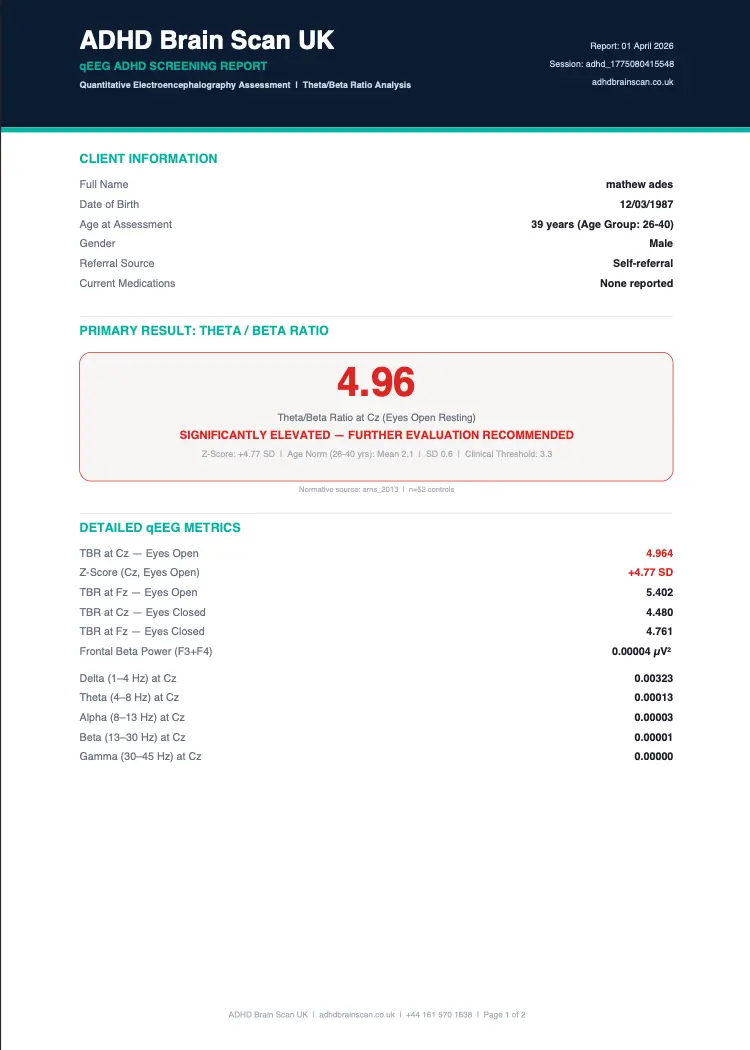
Z-scores are the language of clinical neuroscience. A z-score tells you how many standard deviations a measurement sits from the average for a reference population. A z-score of 0 means you're exactly average. A z-score of 1.5 means you're 1.5 standard deviations above average. A z-score of 2.0 or above is generally considered clinically significant.
In our reports, every TBR measurement is expressed as a z-score against the age-matched mean from published research. This means your GP doesn't need to know what a 'normal' TBR is — they just need to see whether your z-score is elevated. It's the same statistical framework used in blood tests, IQ scores, and every other clinical measurement.
This precision is what separates our screening from questionnaires. A questionnaire gives you a score on an arbitrary scale with arbitrary cutoffs. Our z-scores reference published, peer-reviewed normative data with known statistical properties. That's why GPs take them seriously.
Read the full breakdown of the research behind our screening on our ADHD brain science page.
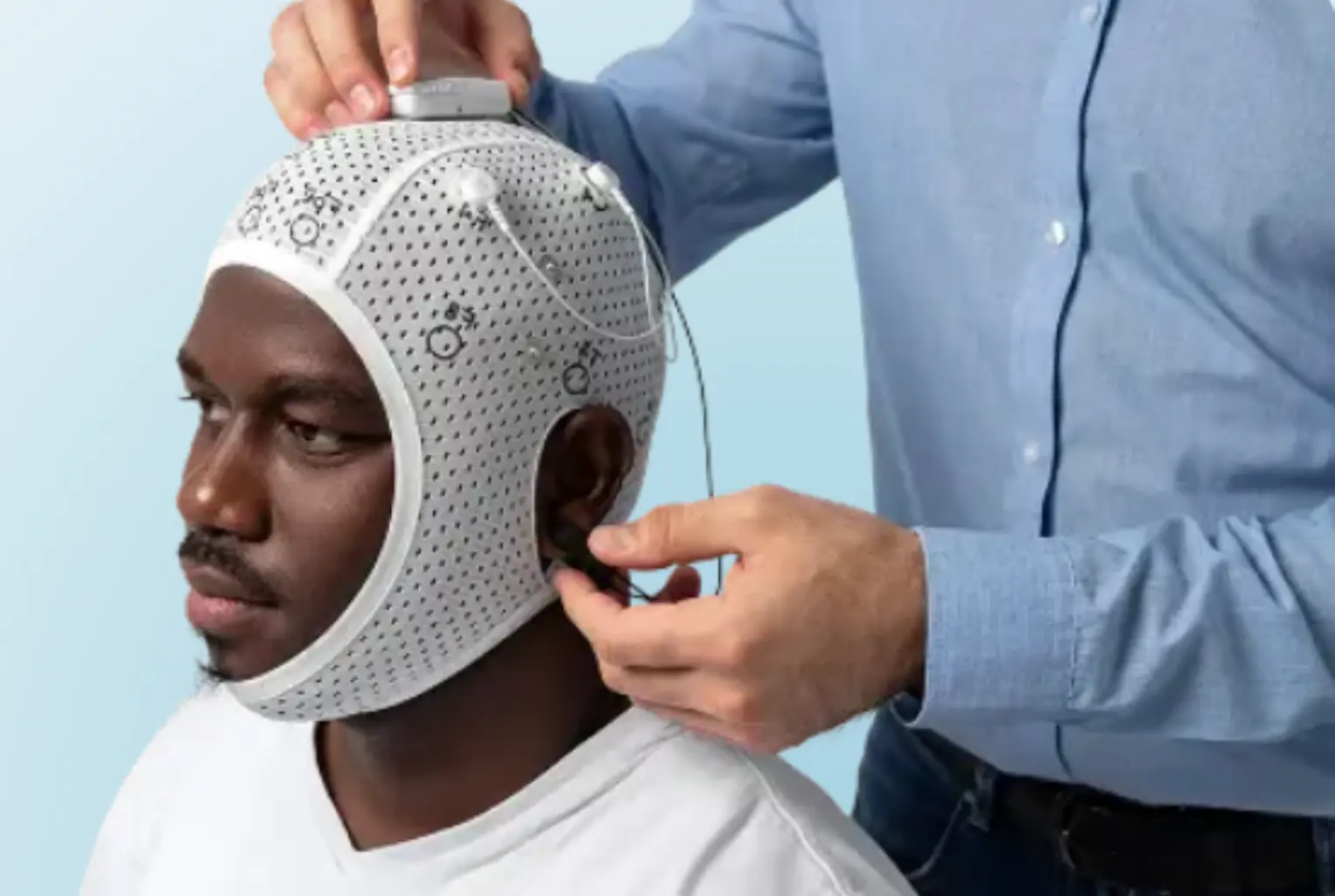
The process is designed to be quick, comfortable, and anxiety-free. No medical gowns. No clinical waiting rooms. You arrive, we explain the process, place the cap, record for 7 minutes, and you're done.
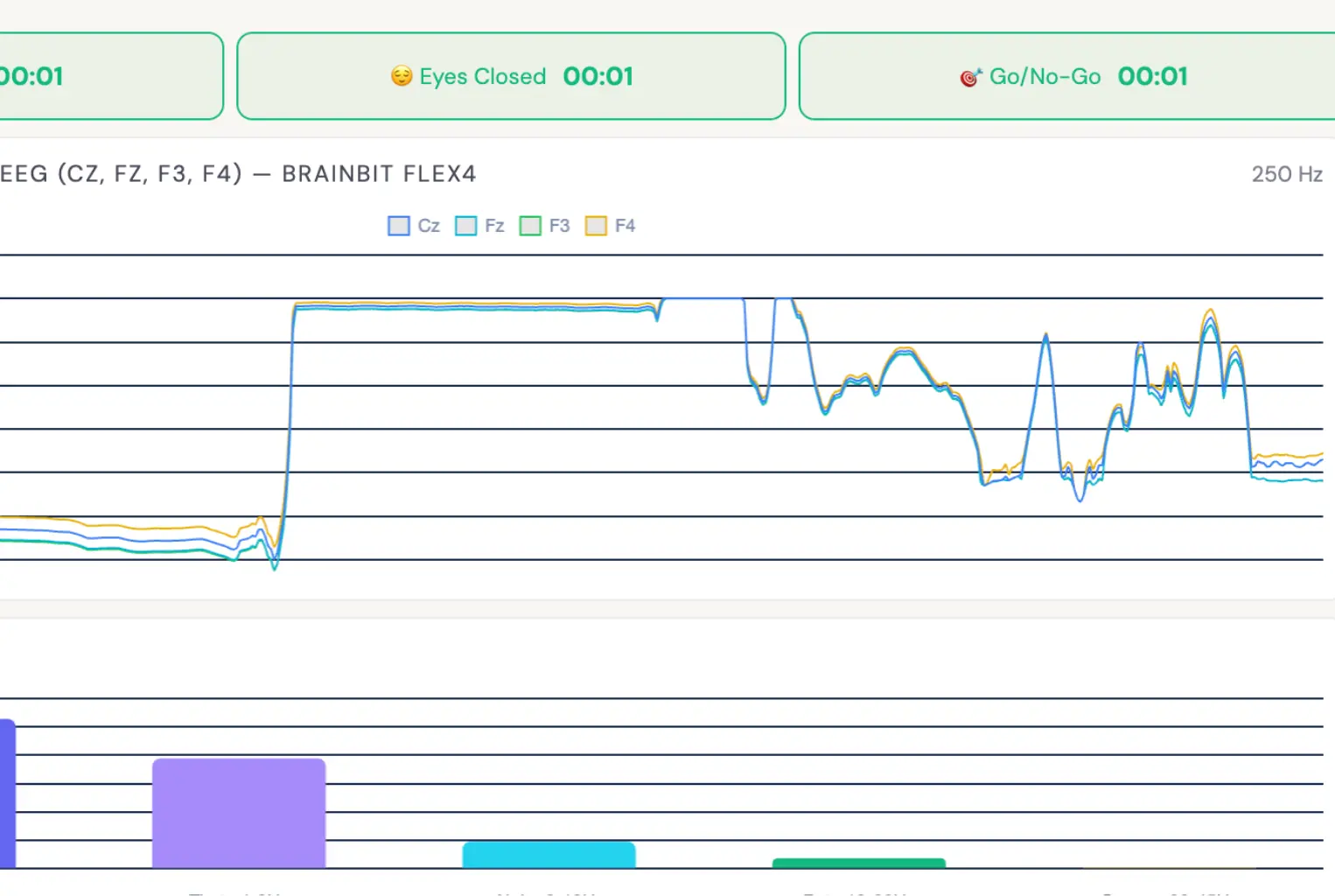
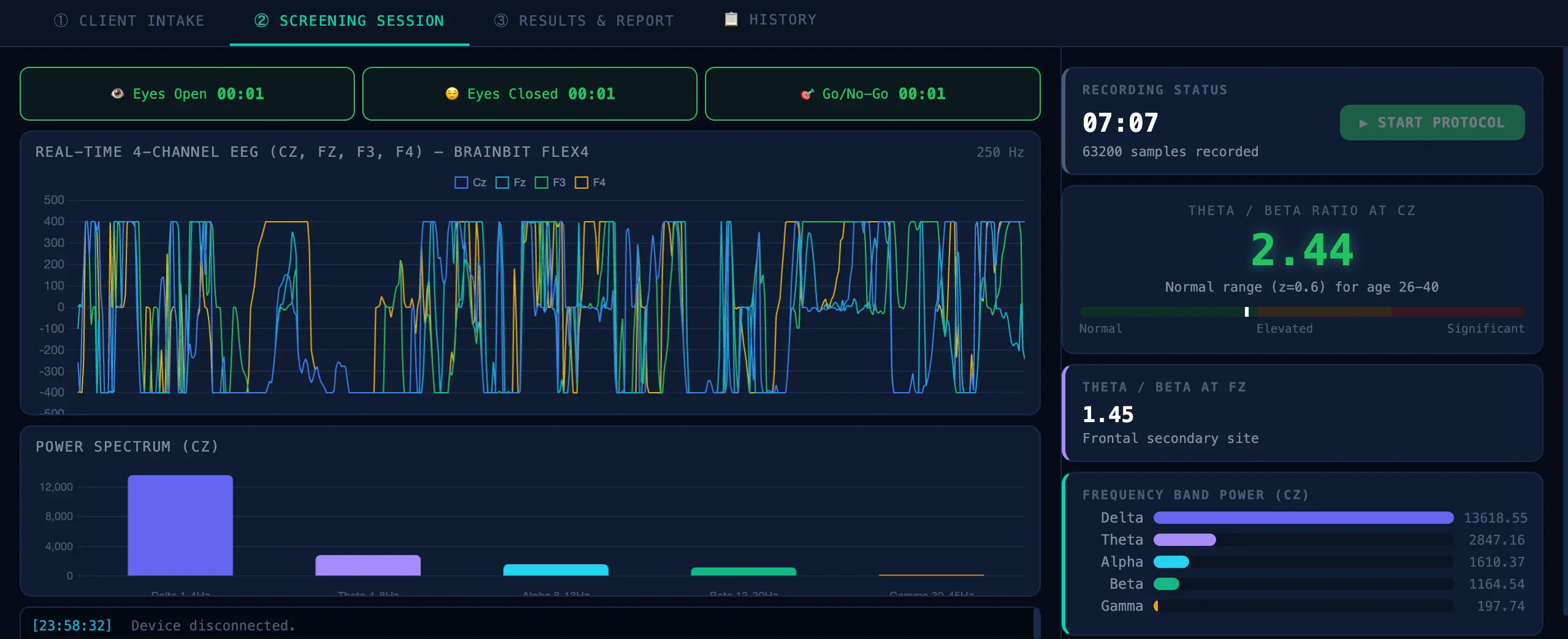
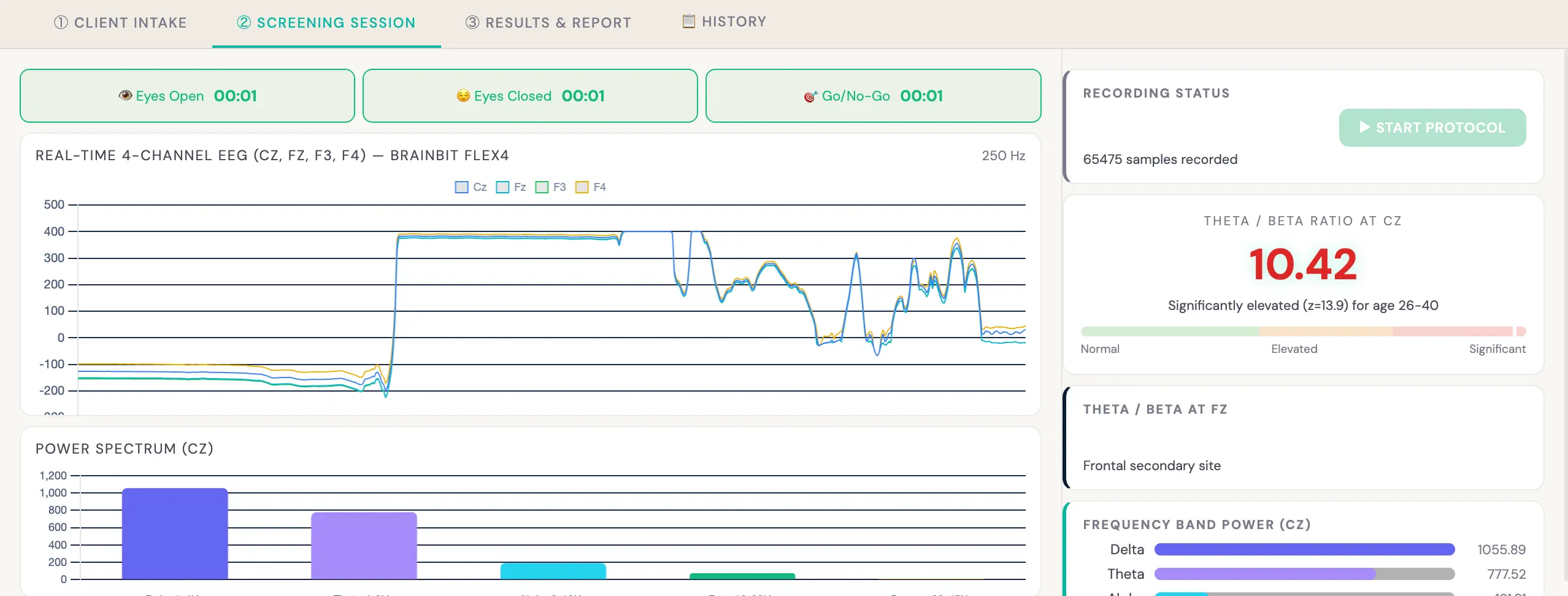
During recording, the screen shows a live visualisation of your brain waves — most people find this fascinating. You can see theta activity rise when your mind wanders and beta activity increase when you concentrate. It makes the abstract concept of "brain differences" immediately tangible.
Standard screening reports (£595) are emailed the same day. The comprehensive package (£845) includes a consultation plus a clinical letter for your GP.
See the full step-by-step process on our how it works page, or visit our FAQ for common questions.
When you arrive for your screening, we'll welcome you into a comfortable, quiet room — no clinical waiting areas, no hospital atmosphere. We'll explain every step before we begin, answer any questions, and make sure you or your child feels completely at ease before the cap goes on.
The cap is a lightweight textile headband with four small, dry, spring-loaded electrodes. It sits on the head like a beanie — no gel, no paste, no needles. Two small clip electrodes attach to the earlobes for reference. Most people forget the cap is there after 60 seconds. Children can hold it first and see the electrodes before we put it on.
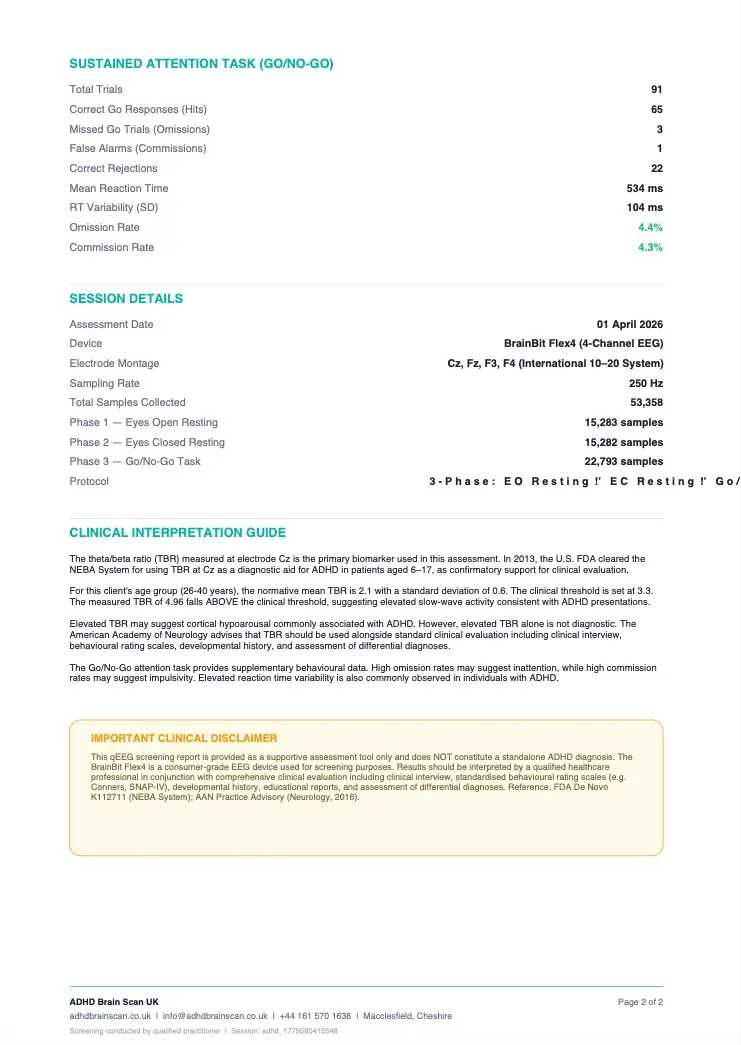
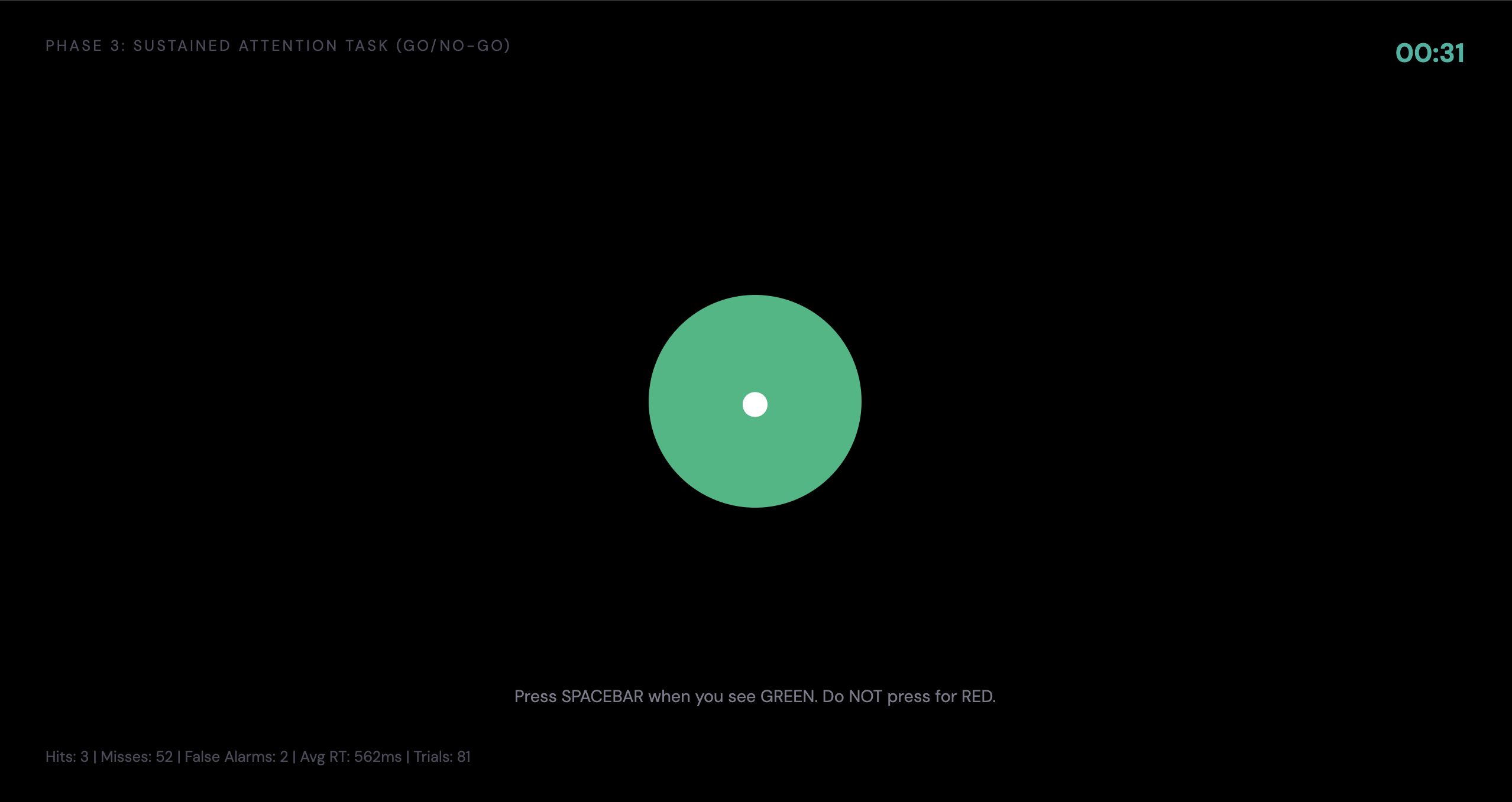
During the 7-minute recording, you'll sit in a comfortable chair facing a screen. Phase 1 (2 min): look at a fixation cross with eyes open. Phase 2 (2 min): close your eyes and relax. Phase 3 (3 min): the Go/No-Go task appears on screen — press for green circles, don't press for red squares. You can see your own brain waves updating in real time throughout.
After recording, we remove the cap (takes 10 seconds), process the data, and generate your report. Standard screening (£595): same-day PDF by email. Comprehensive (£845): 20-minute face-to-face consultation explaining every finding, plus a formal clinical letter. Our results explained guide walks you through every metric in your report.
Preparation checklist: wash hair day-of (no gel/wax/heavy products), sleep normally, eat normally, moderate caffeine, arrive 5 minutes early. That's it. If screening a child, explain the 'brain listening hat' in positive terms and bring a favourite small toy or book for the waiting period.
Wear something comfortable — you'll be sitting in a chair for about 30 minutes. The cap sits on the forehead and crown, so avoid bulky headbands or hair clips that would interfere with electrode placement.
There are no medications to stop, no blood tests to fast for, no preparations that take days. One of the reasons our screening is so accessible is that it requires almost nothing from you except showing up. After your screening, our ADHD support hub guides you through every next step.
For more detail on the full process from booking to report, see how it works.
We screen children aged 6 and above, teenagers, and adults of all ages from Leicester and across Leicestershire. Each person is compared against age-matched normative data from published research — because a 7-year-old's brain is neurologically very different from a 40-year-old's.
For children, the most common scenario is parents who've been told their child "just needs to try harder." For teenagers, it's GCSE or A-level pressure exposing hidden attention difficulties. For adults, it's often a lifetime of wondering — sometimes triggered by a child's diagnosis.
Women and girls are particularly underserved by standard assessment. The inattentive presentation — quiet, dreamy, internally restless — is systematically missed by questionnaires designed around hyperactive boys. Our brain screening measures neurology directly, bypassing the behavioural bias.
Learn more: children 6+ · teenagers · adults · women & girls
View packages: standard screening (£595) · comprehensive (£845) · family package (£1,095) · all pricing
After your screening: ADHD support hub · results explained · what to do next · GP appointment guide · parent's guide
ADHD symptoms overlap with anxiety (restlessness, poor focus), depression (low motivation, forgetfulness), autism (sensory sensitivity, social difficulty), sleep disorders (daytime inattention, irritability), and even giftedness (boredom, underperformance). This overlap is precisely why so many people are misdiagnosed — or dismissed entirely.
Women are particularly affected by misdiagnosis. The inattentive presentation of ADHD — internal restlessness, difficulty organising thoughts, emotional overwhelm — is frequently labelled as anxiety or depression. Many women near Leicester come to us after years on SSRIs that never fully resolved their symptoms, because the underlying ADHD was never identified.
Our brain screening adds objective neurological data to the clinical picture. An elevated TBR at Cz is specific to the cortical hypoarousal pattern seen in ADHD — it doesn't appear in anxiety, depression, or sleep disorders in the same way. This helps your clinician differentiate between conditions that questionnaires cannot distinguish.
Every screening produces a detailed same-day report with theta/beta ratios, z-scores, frequency band analysis, and Go/No-Go attention task results — all compared against published age-matched norms.


This is the standard report included with our ADHD Brain Screening (£595). The Comprehensive Assessment (£845) adds a clinical interpretation letter addressed to your GP, school, or employer.
Objective brain data with z-scores gives your GP the evidence to write a stronger referral or submit a Right to Choose application.
SENCOs use our reports for EHCP applications, SEN register placements, and JCQ exam access (extra time, rest breaks).
Adults use the clinical letter for Access to Work applications — government-funded coaching, headphones, assistive technology.
Brain data gives a private psychiatrist an objective data point they wouldn't otherwise have, making assessment more focused.
Already on medication? A follow-up medication comparison scan (£345) shows objective before-and-after changes.
Still on the NHS waiting list? Our report gives you actionable evidence for school, work, and GP support right now.
During your screening, you'll see your own brain waves updating in real time on screen. Here's what the testing dashboard looks like during each phase of the 7-minute recording.


Want to understand what each screen means? Our science page explains every frequency band and what elevated theta looks like in real data.
Your screening report opens multiple pathways simultaneously — you don't have to pick just one. Most clients from Leicester use the results in two or three ways at once. Immediately: book a GP appointment, bring the clinical letter, and request either an urgent CAMHS referral or a Right to Choose referral to Psychiatry-UK (NHS-funded, typically 3–6 months vs 2–5 years).
At the same time: send the report to your child's school SENCO for SEN register placement, EHCP evidence, or JCQ exam access arrangements (extra time, rest breaks). If you're an adult: begin an Access to Work application for government-funded coaching, assistive technology, and reasonable adjustments.
If the NHS pathway feels too slow even with Right to Choose, you can use the report alongside a private psychiatric assessment (£700–£1,500). The psychiatrist will have objective brain data before they even meet you — making the assessment more focused and potentially faster.
And if you're diagnosed and prescribed medication, your baseline brain data becomes invaluable. A follow-up medication comparison scan (£345) shows objective before-and-after changes in TBR and attention task performance — real evidence that treatment is working.
We always recommend staying on the NHS waiting list while pursuing our screening. The NHS pathway leads to fully-funded ongoing care. Our screening gives you evidence and support in the meantime — and data that strengthens your case when the NHS appointment finally arrives.
Getting screened from Leicester is straightforward. We use private venues across Cheshire and Greater Manchester — all with free parking, easy access, and a calm, non-clinical atmosphere. When you book, we confirm the nearest available venue to Leicester and send you full directions.
If you'd prefer not to travel at all, our home visit service covers Leicestershire and beyond. A tester brings all equipment to your home and conducts the full screening in a quiet room. Same 7-minute recording, same same-day report. Ideal for nervous children or anyone who values complete privacy.
Completely safe and painless. Electrodes passively listen to natural brain signals. No electricity enters the body. No needles, no radiation, no gel, no side effects. Same technology used safely in children's hospitals worldwide.
Yes. The clinical letter has been accepted by Access to Work assessors as supporting evidence. Clients from Leicester have used it to secure coaching, noise-cancelling headphones, and assistive technology.
Yes. We serve clients from Leicester and across Leicestershire. We're based in Macclesfield, Cheshire, with good transport links. Same-week appointments typically available. Home visits also offered (travel fee may apply).
No. Book directly without any GP referral. Many clients from Leicester book the screening first, then take the results to their GP as evidence for a formal referral or Right to Choose application.
Anyone aged 6 and above — children, teenagers, and adults. Each person is compared against age-matched normative data from published research, ensuring the comparison is appropriate for their developmental stage.
Our reports include peer-reviewed citations, z-scores against normative data, and clear clinical context. Many GPs across Leicestershire have used our reports to support CAMHS referrals and Right to Choose applications.
Completely safe and painless. Electrodes passively listen to natural brain signals. No electricity enters the body. No needles, no radiation, no gel, no side effects. Same technology used safely in children's hospitals worldwide.
Yes. The clinical letter has been accepted by Access to Work assessors as supporting evidence. Clients from Leicester have used it to secure coaching, noise-cancelling headphones, and assistive technology.
Standard EEG (used in hospitals) looks at raw brain wave patterns to detect epilepsy, seizures, and structural abnormalities. Quantitative EEG (qEEG) goes further — it analyses the frequency composition of brain activity using mathematical processing (Fast Fourier Transform), then compares the results against normative databases. For ADHD, qEEG reveals the theta/beta ratio imbalance that standard EEG isn't designed to assess.
A qEEG brain scan measures electrical brain activity patterns associated with ADHD — specifically the theta/beta ratio, which is the most-studied EEG biomarker for the condition. It doesn't 'detect' ADHD in the way an X-ray detects a fracture, but it provides objective neurological data that, when combined with clinical evaluation, significantly improves diagnostic accuracy (89–94%% according to the American Academy of Neurology). It's the closest thing to an objective ADHD test that exists. Our results explained guide shows exactly what your report will contain.
An elevated theta/beta ratio means your brain produces disproportionately more slow-wave theta activity (associated with unfocused, daydreaming states) relative to fast-wave beta activity (associated with focused concentration). This pattern indicates cortical hypoarousal — the attention networks of your brain are under-powered. It's the neurological signature most consistently associated with ADHD across published research.
When combined with clinical evaluation, EEG-based theta/beta ratio data improves ADHD diagnostic accuracy to 89–94%% (American Academy of Neurology). On its own, TBR has sensitivity around 78–90%% depending on the study and age group. It's significantly more objective than questionnaires alone, which rely on subjective behavioural report. This is especially important for women with inattentive ADHD who score normally on questionnaires despite genuine neurological differences.
Yes. We screen adults of all ages, from 18 to 60+. Adult ADHD is significantly underdiagnosed, particularly in women. Each adult is compared against age-matched normative data from published research. Many adults who come to us have suspected ADHD for years but never had objective evidence to act on. Our coping strategies guide offers techniques you can start immediately.
Standard EEG (used in hospitals) looks at raw brain wave patterns to detect epilepsy, seizures, and structural abnormalities. Quantitative EEG (qEEG) goes further — it analyses the frequency composition of brain activity using mathematical processing (Fast Fourier Transform), then compares the results against normative databases. For ADHD, qEEG reveals the theta/beta ratio imbalance that standard EEG isn't designed to assess.
Signs, age norms, school evidence, what parents need to know
Decades of masking, late diagnosis, workplace impact
Inattentive type, misdiagnosis as anxiety, hormonal triggers
GCSE/A-level pressure, exam access, university prep
NHS-funded private assessment in months, not years
4 things you can do while you wait
What to say, what to bring, how to get referred
School applications, exam access, SENCO guidance
Free coaching, tech, and adjustments for employed adults
Share this page with someone near Leicester who might be waiting for answers.
A 60-second look at the ADHD brain screening experience.
Same-day report. Evidence your GP will take seriously. From £595.