ADHD screening near Guildford using quantitative electroencephalography — the same technology used in research hospitals worldwide. We measure what matters: theta/beta ratio, attention task performance, and full frequency analysis. Same-day report. From £595. Book a follow-up scan later to track medication response.
Parents across Surrey tell us the same story: their child is struggling at school, the teacher says they need to "try harder," and the GP has put them on a CAMHS waiting list that stretches years ahead. If you're near Guildford and this sounds familiar, you're not alone.
Over 177,000 children and young people are on ADHD and autism waiting lists in England. The system is overwhelmed. And while you wait, nothing happens. No support. No accommodations. No medication. No answers.
What if you could get objective evidence this week? Not a diagnosis — that requires a clinical assessment — but neurological data showing whether your brain's theta/beta ratio is elevated compared to published norms. Data your GP can use to justify an urgent referral. Data that moves the conversation from "we suspect" to "the brain data shows." Our GP appointment guide includes word-for-word scripts for that conversation.
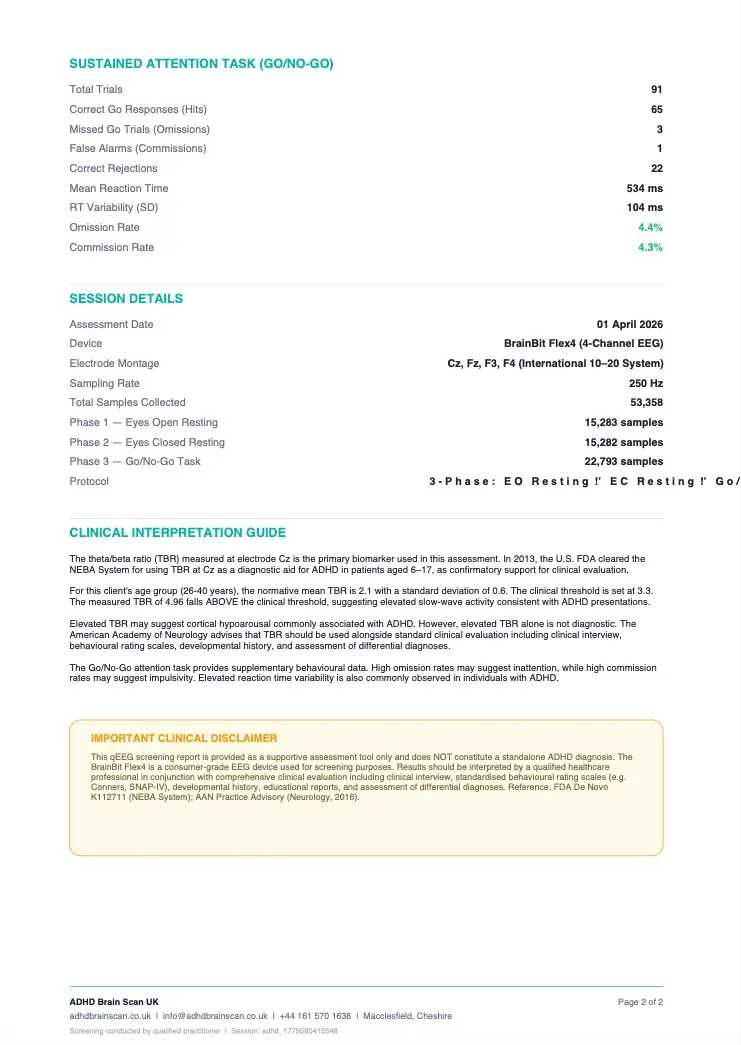
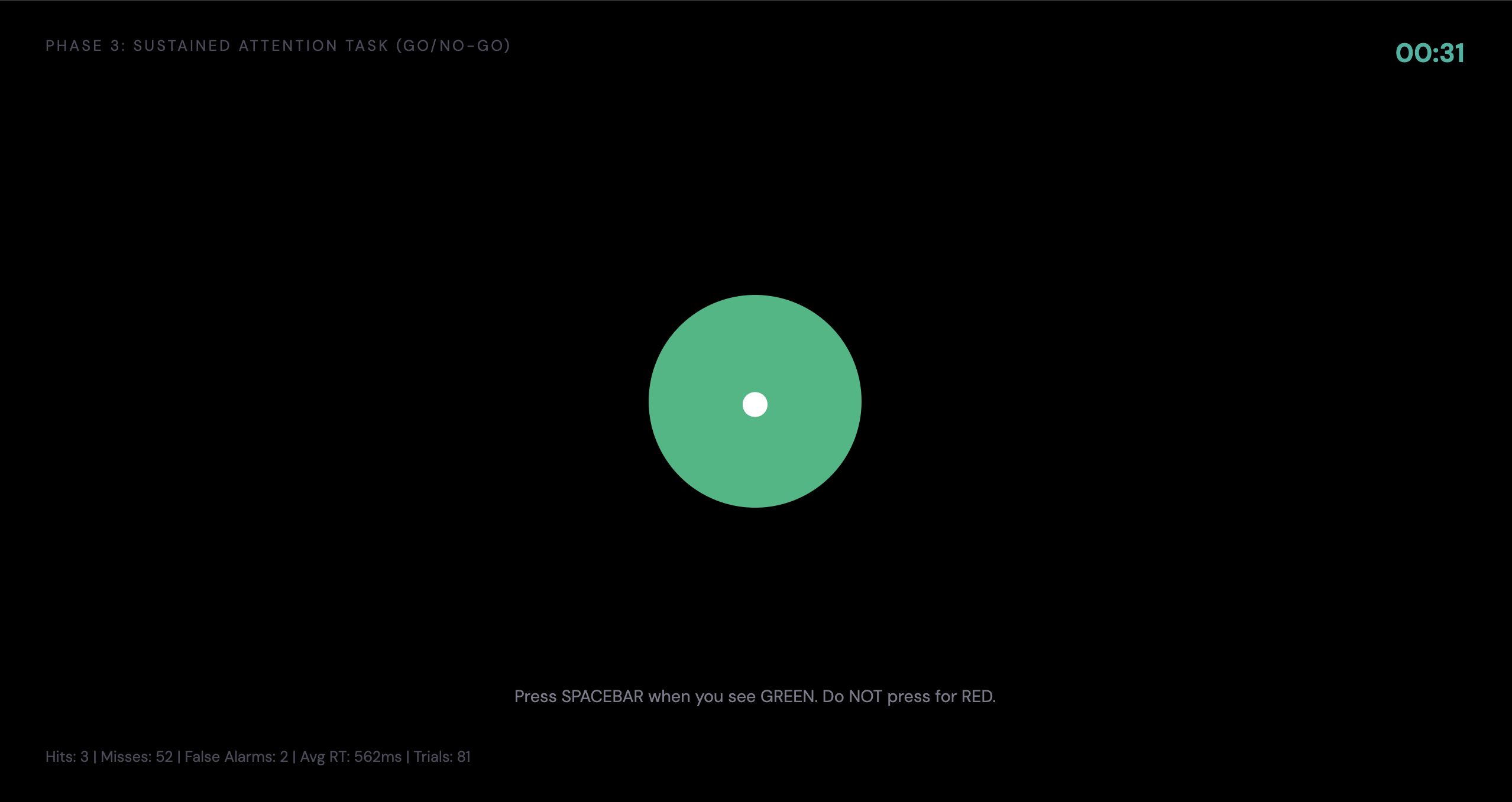
The Go/No-Go task isn't just a 'game' — it's a well-established neuropsychological paradigm used in ADHD research worldwide. The task presents a rapid series of stimuli (green circles and red squares) and requires you to press for one and withhold for the other. It directly measures the cognitive functions most affected by ADHD.
Hit rate measures sustained attention: can you consistently detect and respond to targets over 3 minutes? Miss rate reveals attention lapses: how often does your focus drop? False alarm rate measures impulse control: can you stop yourself pressing when you shouldn't? Reaction time variability measures consistency: ADHD is characterised not by slow responses but by highly variable response times.
These four metrics, combined with the resting-state TBR data, provide a comprehensive picture of neurocognitive function that no questionnaire can replicate. The data is quantified, comparable, and clinically meaningful.
Read the full breakdown of the research behind our screening on our ADHD brain science page.
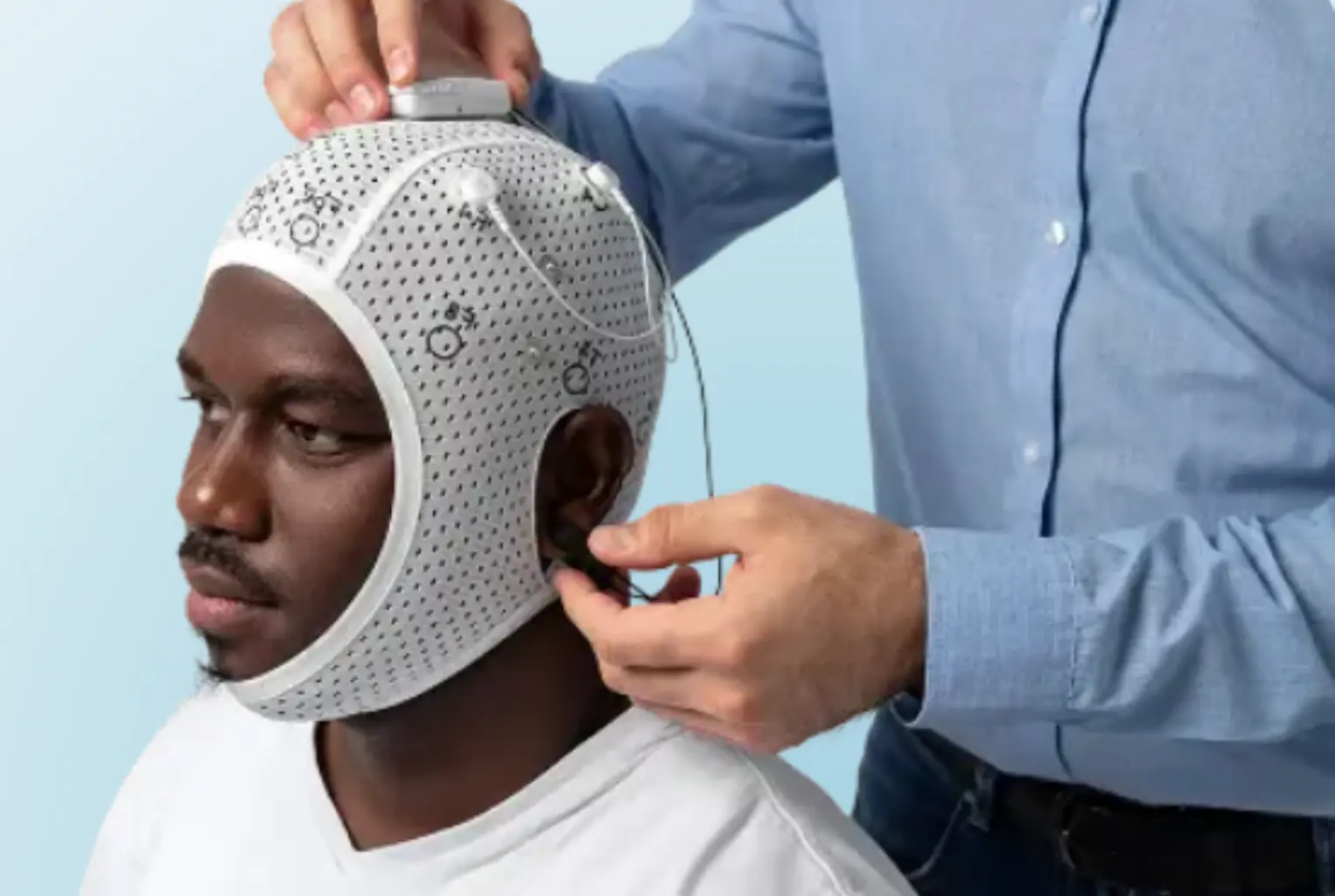
Setup takes about 5 minutes. The electrodes use dry spring-loaded contacts through the hair — no gel, no shaving. Phase 1 is 2 minutes eyes-open (baseline cortical arousal). Phase 2 is 2 minutes eyes-closed (alpha reactivity assessment). Phase 3 is the 3-minute Go/No-Go attention task: green circle means press, red square means don't.
The complete session is about 30 minutes. For children, we allow extra time for explanation and breaks. We never rush a recording and we never force a child to continue if they're uncomfortable.
See the full step-by-step process on our how it works page, or visit our FAQ for common questions.
Your appointment from arrival to departure takes about 30 minutes. The actual brain recording is just 7 minutes. Here's the typical timeline: minutes 0–5, setup and explanation. Minutes 5–12, the three recording phases. Minutes 12–15, cap removal and data check. Minutes 15–30, initial results discussion (comprehensive package) or wrap-up (standard).
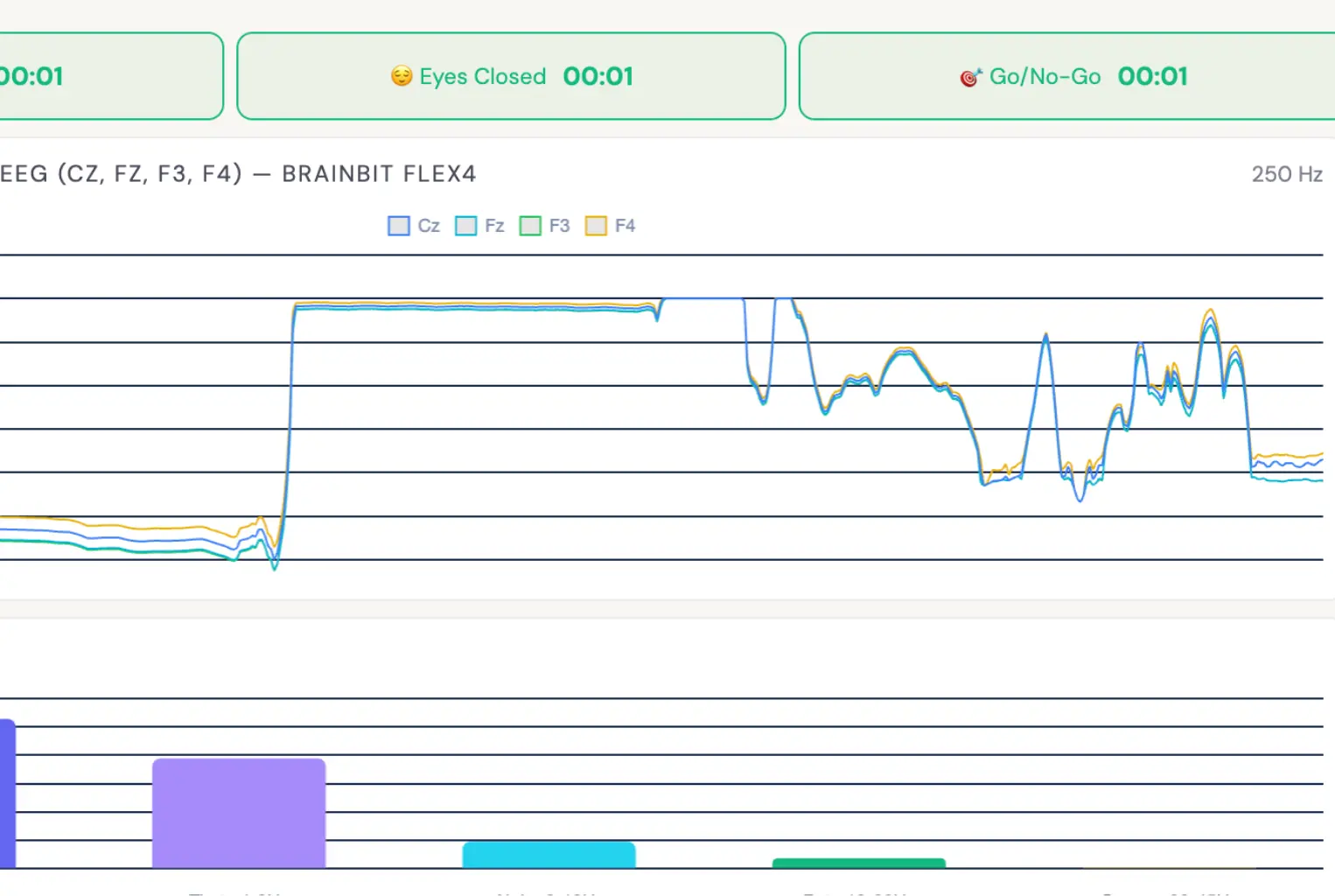
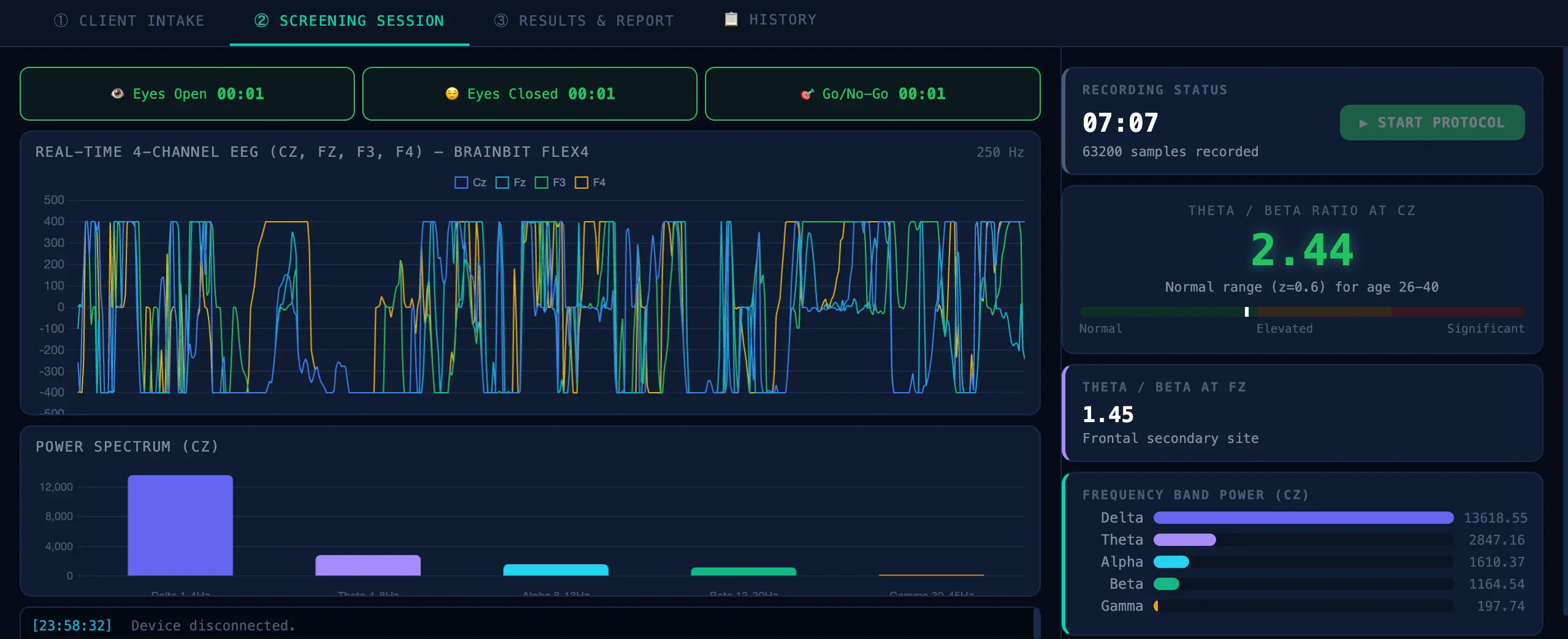
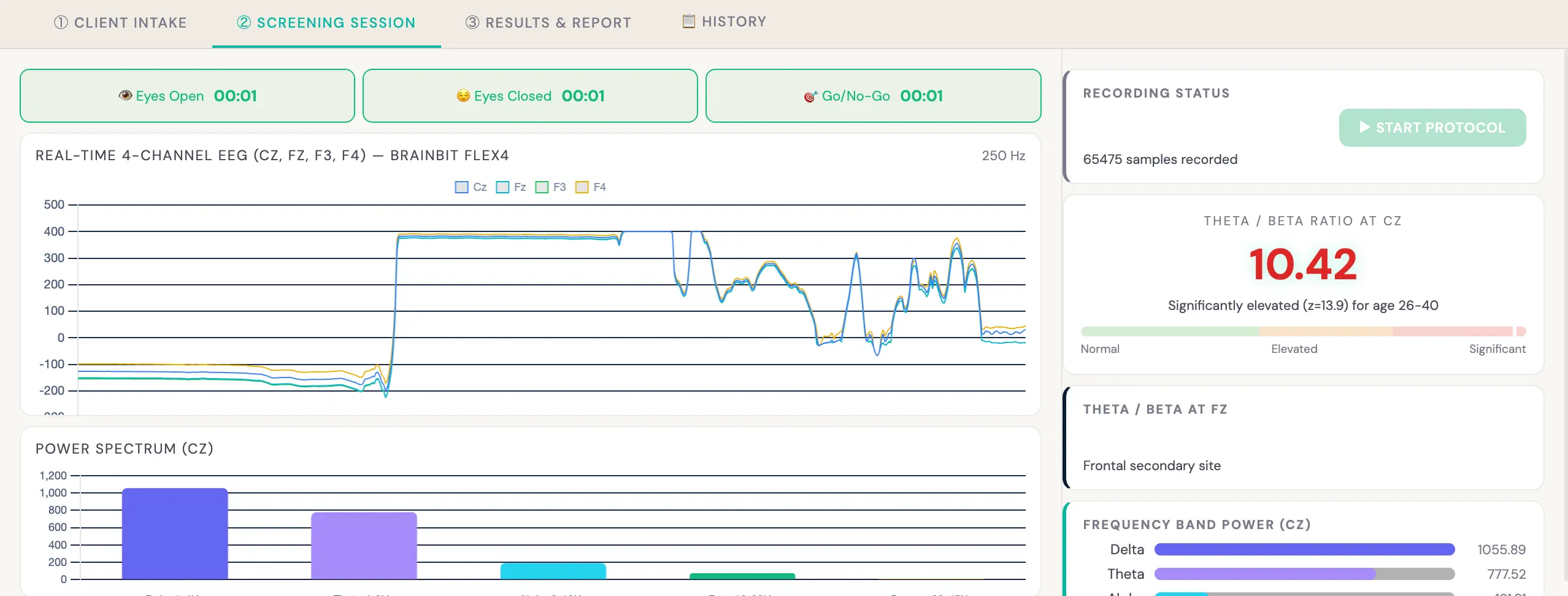
You'll see your brain waves on screen in real time as they're recorded. Most clients find this genuinely fascinating — you can watch theta waves increase when your mind drifts and beta waves spike when you concentrate. Our guide to the ADHD brain explains what each frequency band means. For teenagers, this visual feedback often makes the experience more engaging than expected.
The environment is calm and private. We understand that many people coming for ADHD screening are anxious about the process or uncertain about what they'll find. We create a space where questions are welcome, where there's no rush, and where you're treated as a person, not a patient number.
The night before your screening, the most important thing you can do is sleep. ADHD and sleep problems go hand in hand — up to 80%% of adults with ADHD have significant sleep difficulties. If you slept badly, that's okay. We're measuring your normal brain, not your best brain. Just don't deliberately stay up late or pull an all-nighter.
On the morning: wash your hair with normal shampoo (no gel, wax, heavy conditioners or leave-in products). Eat breakfast — low blood sugar affects concentration and brain wave patterns. Have your usual tea or coffee, but don't overdo the caffeine — stick to your normal intake rather than loading up.
If you take ADHD medication, contact us when you book and we'll advise whether to take it or skip it on the morning of the scan. For a first baseline screening, we usually recommend coming unmedicated. For a medication comparison scan, take your medication as normal.
For more detail on the full process from booking to report, see how it works.
We screen children aged 6 and above, teenagers, and adults of all ages from Guildford and across Surrey. Each person is compared against age-matched normative data from published research — because a 7-year-old's brain is neurologically very different from a 40-year-old's.
For children, the most common scenario is parents who've been told their child "just needs to try harder." For teenagers, it's GCSE or A-level pressure exposing hidden attention difficulties. For adults, it's often a lifetime of wondering — sometimes triggered by a child's diagnosis.
Women and girls are particularly underserved by standard assessment. The inattentive presentation — quiet, dreamy, internally restless — is systematically missed by questionnaires designed around hyperactive boys. Our brain screening measures neurology directly, bypassing the behavioural bias.
Learn more: children 6+ · teenagers · adults · women & girls
View packages: standard screening (£595) · comprehensive (£845) · family package (£1,095) · all pricing
After your screening: ADHD support hub · results explained · what to do next · GP appointment guide · parent's guide
Sleep disorders are one of the most common ADHD mimics — and one of the most overlooked. A child with obstructive sleep apnoea who snores and wakes frequently will be inattentive, irritable, and hyperactive during the day. An adult with delayed sleep phase disorder who never falls asleep before 2am will struggle with morning concentration and appear to have ADHD.
The NHS rarely investigates sleep before diagnosing ADHD, and vice versa. For families near Guildford, this creates diagnostic confusion. Our qEEG screening provides a data point that helps clarify: if the theta/beta ratio is within normal range but the person shows classic ADHD symptoms, a sleep disorder investigation may be more appropriate. If TBR is elevated alongside sleep problems, both issues likely need addressing — our ADHD sleep guide explains why 80%% of ADHD adults have sleep difficulties and what to do about it.
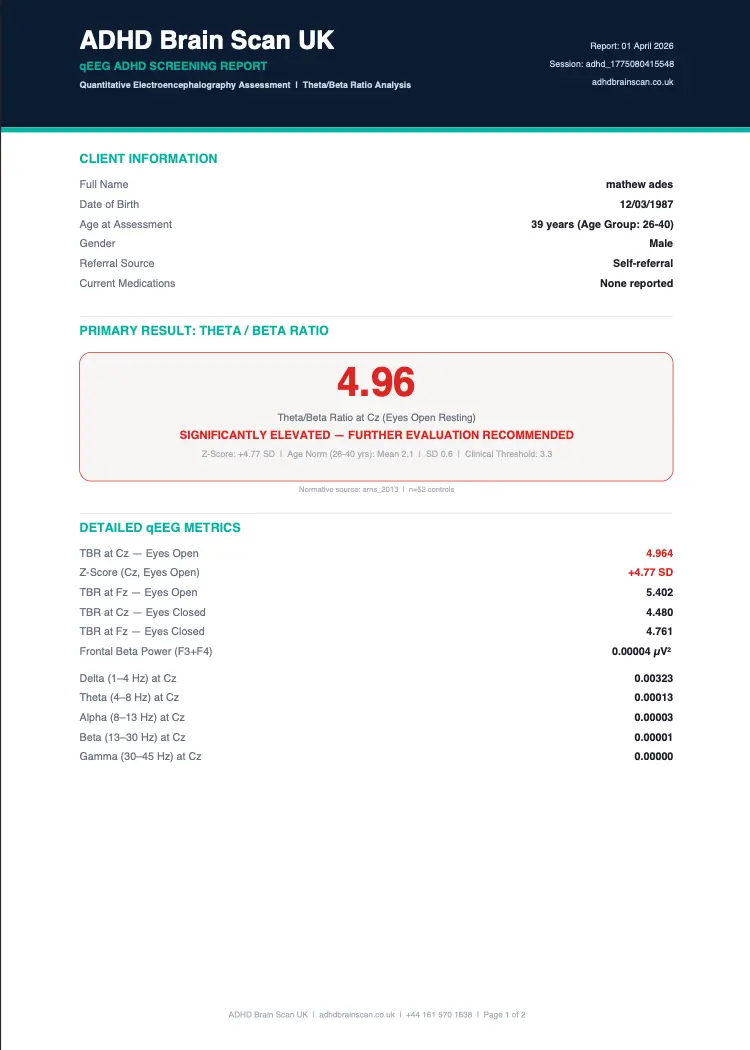
Every screening produces a detailed same-day report with theta/beta ratios, z-scores, frequency band analysis, and Go/No-Go attention task results — all compared against published age-matched norms.


This is the standard report included with our ADHD Brain Screening (£595). The Comprehensive Assessment (£845) adds a clinical interpretation letter addressed to your GP, school, or employer.
Objective brain data with z-scores gives your GP the evidence to write a stronger referral or submit a Right to Choose application.
SENCOs use our reports for EHCP applications, SEN register placements, and JCQ exam access (extra time, rest breaks).
Adults use the clinical letter for Access to Work applications — government-funded coaching, headphones, assistive technology.
Brain data gives a private psychiatrist an objective data point they wouldn't otherwise have, making assessment more focused.
Already on medication? A follow-up medication comparison scan (£345) shows objective before-and-after changes.
Still on the NHS waiting list? Our report gives you actionable evidence for school, work, and GP support right now.
During your screening, you'll see your own brain waves updating in real time on screen. Here's what the testing dashboard looks like during each phase of the 7-minute recording.


Want to understand what each screen means? Our science page explains every frequency band and what elevated theta looks like in real data.
After your screening, you have a same-day report in your hands. Here's the recommended action plan: Week 1 — book a GP appointment (request a double appointment, 20 minutes). Bring the clinical letter and report. Ask for a Right to Choose referral to Psychiatry-UK or an urgent CAMHS referral. Week 1–2 — email the report to your child's school SENCO. Request a meeting to discuss SEN register, exam access, and EHCP evidence. Week 2–4 — if you're an adult in work, start an Access to Work application online. Attach the clinical letter as supporting evidence.
While you wait for formal assessment (3–6 months via Right to Choose, 2–5 years via NHS): use the report for any immediate support needs — workplace adjustments, school accommodations, private therapy, or family understanding. The report doesn't expire. It's your evidence for as long as you need it.
We always recommend staying on the NHS waiting list while pursuing our screening. The NHS pathway leads to fully-funded ongoing care. Our screening gives you evidence and support in the meantime — and data that strengthens your case when the NHS appointment finally arrives.
We screen at private venues — not hospitals, not surgeries, not shared waiting rooms. Just a quiet, comfortable space where you can focus on the screening without distractions. From Guildford, we confirm the most convenient venue when you book. All have free parking and step-free access.
If Guildford is where you'd rather stay, our home visit service means you don't have to go anywhere. A qualified tester brings the full setup to your home, conducts the screening in a room of your choice, and you have your report by the end of the day. It's the same clinical-grade screening — just on your sofa instead of ours.
We understand — difficulty sitting still is often why you're here. Recording is only 7 minutes with breaks available. If a phase is too noisy, we redo it free. If your child can't tolerate the cap, we offer a free retry.
Right to Choose lets you be assessed by a private provider at NHS expense. Your GP submits the referral. Our clinical letter provides objective evidence that helps GPs feel confident making that referral.
ADHD Brain Screening is £595 (scan + same-day PDF report). Comprehensive Assessment is £845 (scan + consultation + clinical letter). Family Package is £1,095 (two screenings). Medication Comparison Scan is £345.
No. This is an objective brain screening providing quantitative neurological data to support clinical evaluation. ADHD diagnosis requires a qualified clinician. Our report provides powerful supporting evidence.
About 30 minutes from arrival to departure. The brain recording itself is 7 minutes. Setup takes about 5 minutes. Your report is delivered the same day by email.
Yes. SENCOs across Surrey use our reports for EHCP panel submissions and JCQ exam access (extra time, rest breaks, separate room). The comprehensive clinical letter is designed for educational contexts.
We understand — difficulty sitting still is often why you're here. Recording is only 7 minutes with breaks available. If a phase is too noisy, we redo it free. If your child can't tolerate the cap, we offer a free retry.
Right to Choose lets you be assessed by a private provider at NHS expense. Your GP submits the referral. Our clinical letter provides objective evidence that helps GPs feel confident making that referral.
No GP referral is needed. You can book directly online or by phone. Many clients book the screening first, then take the objective results to their GP as evidence to support a formal referral. Having brain data in hand often makes the GP conversation significantly more productive — our GP appointment guide shows you exactly what to say.
Yes. The theta/beta ratio has been studied for over 30 years, replicated across hundreds of independent studies, and was referenced in the FDA's 2013 clearance of the NEBA System for ADHD evaluation. The International Society for Neurofeedback and Research (ISNR) rates qEEG assessment as Level 1 (Best Practice) for ADHD. It's well-established science, not experimental. Our ADHD brain guide explains the neuroscience in plain English.
No. Screening provides objective data; diagnosis requires comprehensive clinical assessment by a qualified professional. Our screening gives you neurological evidence to support the diagnostic process — it doesn't replace it. Think of it as providing the brain data that questionnaires and interviews cannot capture, making the eventual diagnosis more accurate and evidence-based. Our next steps guide explains every pathway from screening to formal diagnosis.
If you're currently waiting years on the NHS list with no support, paying £595–£845 for same-day objective data that can unlock GP referrals, school support, workplace accommodations, and Right to Choose applications is highly cost-effective. Many clients tell us the screening paid for itself within weeks through the support it unlocked.
Our reports include peer-reviewed citations, z-scores against published normative data, and formal clinical interpretation letters. Many GPs across the UK have used our reports to support CAMHS referrals, Right to Choose applications to Psychiatry-UK, and urgent assessment requests. The report is designed to be credible and actionable within the NHS system. Our GP appointment guide includes scripts for presenting your results.
No GP referral is needed. You can book directly online or by phone. Many clients book the screening first, then take the objective results to their GP as evidence to support a formal referral. Having brain data in hand often makes the GP conversation significantly more productive — our GP appointment guide shows you exactly what to say.
Signs, age norms, school evidence, what parents need to know
Decades of masking, late diagnosis, workplace impact
Inattentive type, misdiagnosis as anxiety, hormonal triggers
GCSE/A-level pressure, exam access, university prep
NHS-funded private assessment in months, not years
4 things you can do while you wait
What to say, what to bring, how to get referred
School applications, exam access, SENCO guidance
Free coaching, tech, and adjustments for employed adults
Share this page with someone near Guildford who might be waiting for answers.
A 60-second look at the ADHD brain screening experience.
Same-day report. Evidence your GP will take seriously. From £595.