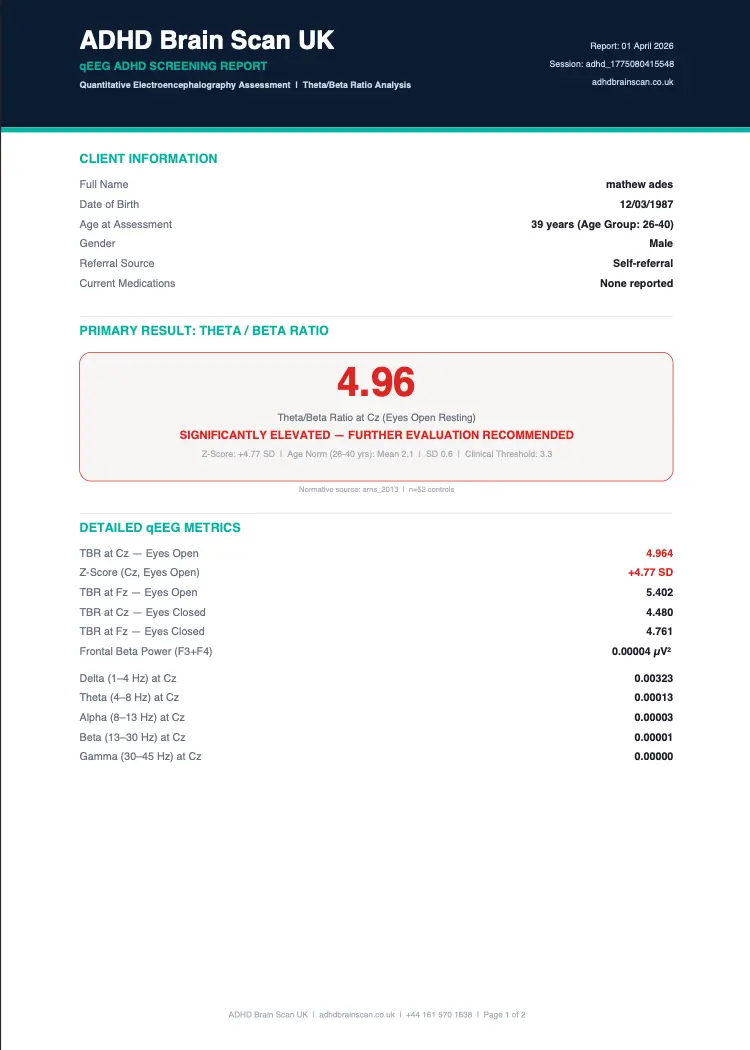
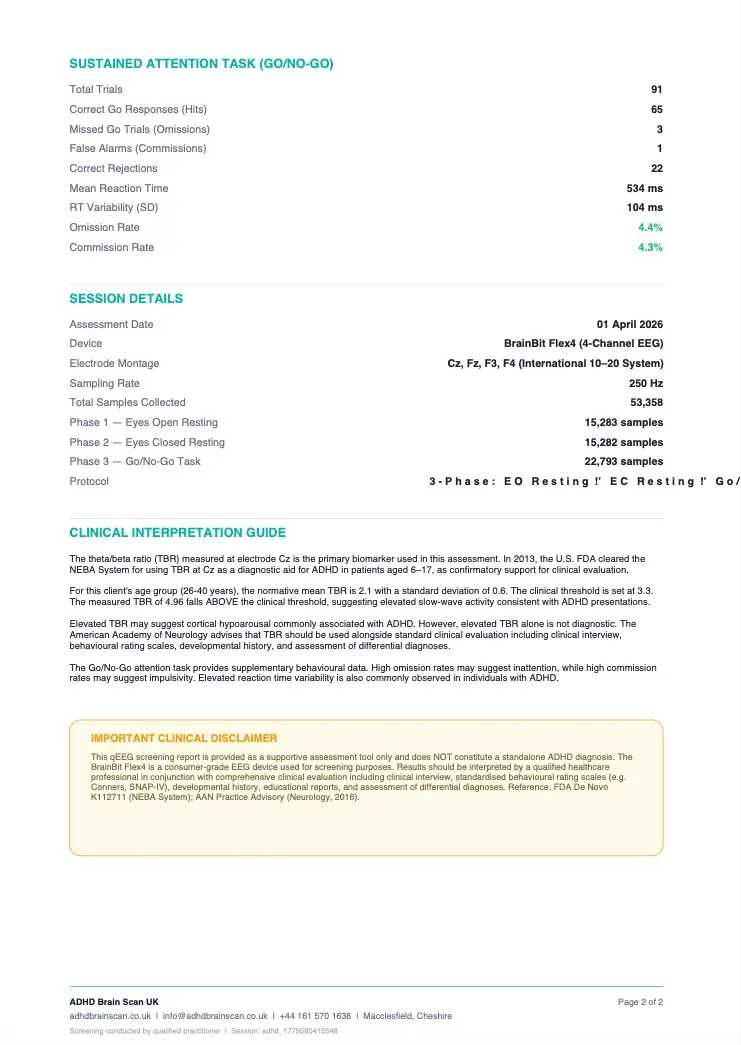
Most people near Leeds do not know Right to Choose exists. Fewer still know that a 30-minute brain screening can be the difference between a GP who hesitates and a GP who refers. We provide the objective neurological data — theta/beta ratio z-scores against published norms — that turns a conversation into a referral.
If you have already been on the West Yorkshire NHS waiting list for over a year, Right to Choose does not require you to leave it. The two pathways run in parallel. You stay on the NHS list as a backup while pursuing Right to Choose as a faster route. If you are assessed via Right to Choose first, you can then be removed from the NHS list — but the choice is yours.
This parallel approach is what we recommend to every client near Leeds. It costs nothing extra (Right to Choose is NHS-funded), maintains your position in the standard queue, and gives you a realistic chance of assessment within months rather than years. Our screening report supports both pathways simultaneously.
Many clients also use the screening report for immediate practical benefits while waiting: EHCP applications, exam access arrangements, workplace reasonable adjustments, and Access to Work claims. One screening, multiple doors opened, while the formal assessment pathway progresses.
A question we hear frequently from clients near Leeds: 'If Right to Choose is free, why would I pay £595–£845 for a brain scan?' The answer is that Right to Choose is free once your GP refers. The brain scan is what gets your GP to refer.
Without objective evidence, many GPs hesitate. With it, most refer promptly. The screening is not the assessment — it is the key that unlocks the assessment. Think of it as an investment that activates a free pathway worth £700–£1,500 (the equivalent private assessment cost). And unlike a private assessment, the Right to Choose assessment leads directly to NHS shared care for ongoing medication — no arguing with your GP about accepting a private diagnosis.
Clients who have been through the full pathway consistently describe the screening as the single most impactful step: the moment the conversation with their GP changed from speculative to evidence-based.
For adults near Leeds who have never been assessed, the preparation focuses on demonstrating lifelong symptoms. ADHD is a developmental condition — NICE guidelines require evidence that symptoms were present before age 12. Gather: old school reports (comments like 'easily distracted' or 'does not fulfil potential'), a written childhood history from a parent or family member, examples of current functional impairment across work, relationships, and daily life.
Our brain screening report adds the neurological dimension that no other evidence provides. While self-report and history tell the story of your lived experience, the theta/beta ratio tells the story of your brain's electrical activity — and the two stories should align if ADHD is present. GPs near Leeds respond to this combination of subjective narrative and objective measurement.
After referral, expect a DIVA-5 structured interview (a standardised diagnostic tool for adult ADHD), questionnaires, and a comprehensive clinical formulation. If diagnosed, medication options include stimulants (methylphenidate, lisdexamfetamine) and non-stimulants (atomoxetine, guanfacine).
Objective brain data does three things that self-report cannot. First, it removes the bias inherent in questionnaires — particularly important for women who mask, adults who have developed sophisticated coping strategies, and children who behave differently in clinic than in the classroom. Second, it provides a quantified measurement expressed as a z-score — a language every clinician understands instantly. Third, it gives the GP a defensible clinical basis for the referral — something they can point to in the patient record that justifies the decision.
Multiple clients from Leeds have reported that presenting the clinical letter to their GP resulted in an immediate shift in the conversation. GPs who had previously said 'let's wait and see' or 'try these coping strategies first' moved directly to submitting the Right to Choose referral once they saw the objective neurological data.
Objective z-scores and peer-reviewed citations are significantly harder to dismiss than self-reported symptoms. GPs near Leeds respond to evidence.
GPs who include our data in their referral letter give the receiving provider more context, leading to a more focused and efficient assessment.
During the 3–6 month wait, use the report for EHCP applications, Access to Work, and employer reasonable adjustments.
If diagnosed, your baseline data enables a follow-up comparison scan (£345) to objectively track medication response.
Brain screening (£595–£845) + Right to Choose (free) + shared care (NHS). Total: under £850 for a complete diagnostic pathway.
The Right to Choose assessor reviews all evidence. Objective brain data adds a dimension that no other patient typically brings to the assessment.
A third option is fully private assessment (£700–£1,500), which has the shortest wait (2–8 weeks) but you pay the full cost. Many people from Leeds combine approaches: brain screening (£595–£845) + Right to Choose assessment (free) + Access to Work support (free). Total out-of-pocket: the screening only. View all pricing options.
We provide Right to Choose evidence for children aged 6+, teenagers, adults, and women & girls who are systematically underdiagnosed by questionnaire-based assessment.
Each person is compared against age-matched normative data from published research. The clinical letter is tailored for Right to Choose referral submissions, with z-scores, peer-reviewed citations, and specific recommendations your GP can act on immediately.
View packages: standard screening (£595) · comprehensive (£845) · family package (£1,095) · all pricing
After your screening: ADHD support hub · results explained · what to do next · GP appointment guide · medication guide · coping strategies · workplace rights · ADHD in women · parent's guide · relationships guide · sleep guide · exercise & ADHD
Yes. The two pathways run in parallel. Stay on the NHS list as backup while pursuing Right to Choose as a faster route. If assessed via Right to Choose first, you can then leave the NHS list. We recommend staying on both.
If ADHD is confirmed, the provider initiates medication (typically stimulant or non-stimulant options) and monitors your titration over 4–12 weeks. They then set up a shared care agreement with your GP for ongoing prescribing. Your GP handles repeat prescriptions at standard NHS cost (£9.90 per item or free with prepayment).
Not required — but strongly recommended. Our clinical letter provides the objective evidence that convinces GPs to refer. Without it, many GPs hesitate. With it, most refer promptly. The comprehensive package (£845) includes the clinical letter specifically formatted for Right to Choose referrals.
The Comprehensive Assessment (£845) — it includes the clinical interpretation letter your GP needs, tailored for Right to Choose referral submissions. The standard Brain Screening (£595) provides the data report but without the formal letter.
This is common. Print the NHS patient choice guidance from nhs.uk and bring it to the appointment. Our clinical letter also explains Right to Choose. Psychiatry-UK has a GP information page your GP can review. In many cases, our letter is the first clear explanation the GP has received.
Right to Choose is England only. Scotland, Wales, and Northern Ireland have separate NHS systems without equivalent patient choice legislation. If you live in those nations, options are standard NHS referral or fully private assessment. Many UK-wide telehealth providers offer video assessments regardless of location.
Yes — and you should. While waiting for Right to Choose assessment, use the report for: EHCP applications, JCQ exam access arrangements, Access to Work evidence, employer reasonable adjustments, and additional GP conversations. One screening supports multiple applications simultaneously.
Request the refusal in writing. Ask for a second opinion from another GP at the same practice. Consider registering with a different practice. Contact PALS (Patient Advice and Liaison Service). Ask Psychiatry-UK to contact the GP directly — they have a process for this. GP refusal after seeing objective brain data is rare but not impossible.
Yes. The assessment is fully NHS-funded — you pay nothing for the assessment itself. The only cost is any supporting evidence you choose to gather beforehand, such as our brain screening (£595–£845). Everything from the Right to Choose referral onwards is free.
No. Right to Choose is a legal right under Section 3a of the NHS Constitution. Your GP cannot refuse the right itself — they can only decline to refer for ADHD if they believe it is not clinically warranted. Objective brain data makes that position very difficult to justify. If they refuse, ask for the refusal in writing and request a second opinion.
Share this page with someone waiting for an ADHD assessment.
Same-day clinical letter. Evidence your GP will act on. From £595.