GCSEs are looming. A-levels are approaching. University applications are due. Your teenager is struggling and the NHS waiting list stretches years into the future. Objective brain data can change the trajectory — in 30 minutes.
Primary school is relatively structured. A supportive teacher can scaffold a child with ADHD through the day. But secondary school changes everything. Multiple teachers, multiple classrooms, homework from six different subjects, long-term project deadlines, independent study expectations. The safety net disappears — and undiagnosed ADHD becomes impossible to hide.
For many teenagers, this is where things fall apart. Grades drop. Homework doesn’t get handed in. Motivation evaporates. Parents and teachers assume it’s “laziness” or “not caring.” The teenager — who IS trying — starts to believe them. Self-esteem crumbles. Anxiety builds. Sometimes depression follows.
Year 9–11
The critical window. GCSE coursework, mock exams, and options choices happen during the years when undiagnosed ADHD causes the most academic damage. Getting evidence NOW means support can be in place before it’s too late.
Their GCSEs won’t wait for the NHS
If your teen is in Year 9, GCSE finals are ~24 months away. The NHS waiting list takes longer. Brain screening + JCQ access arrangements is the only realistic path.
Meanwhile, the NHS CAMHS waiting list is 2–5 years. Your teenager doesn’t have 2–5 years. Their GCSEs are in months, not years. They need evidence now — evidence that can unlock exam access arrangements, school support, and a clinical pathway.
That’s what our qEEG brain screening provides: objective neurological data, compared against age-matched norms for their exact age group, delivered the same day in a professional report your GP and school will take seriously.
Recognise the pattern?
How ADHD shows up in teenagers
Teenage ADHD looks different from childhood ADHD. The hyperactivity often goes internal. The coping strategies start failing. And new pressures expose what was previously hidden.
Academic free-fall
Capable but underperforming. Can ace a topic that interests them, can’t start an essay that doesn’t. Homework mysteriously vanishes between completion and submission. Reports say “not meeting potential.”
Phone addiction (dopamine seeking)
Glued to their phone, gaming, or social media for hours — but can’t sustain 20 minutes on homework. This isn’t laziness. It’s a brain seeking dopamine from the only source that delivers it instantly.
Sleep chaos
Can’t fall asleep because their mind won’t switch off. Can’t wake up because they finally fell asleep at 2am. Chronic sleep deprivation compounds every other ADHD symptom. A vicious cycle.
Emotional volatility
Bigger reactions than peers to setbacks. Quick to anger, quick to tears. Perceived rejection hits harder. Friendship drama feels like the end of the world. Parents walk on eggshells.
Executive function collapse
Can’t plan ahead. Can’t break large tasks into steps. Starts revision the night before. Loses PE kit weekly. Forgets deadlines that were written in the planner they also lost.
The quiet struggler
Not all teen ADHD is visible. Girls especially may mask with people-pleasing, perfectionism, and anxiety. They get adequate grades through extraordinary hidden effort — then burn out.
If several of these patterns match your teenager, a brain screening can provide the objective data to move from suspicion to action. Our screening measures the theta/beta ratio — the brain’s balance between unfocused and focused activity — and compares it against published norms for their specific age group.
Teen-friendly process
How the screening works for teenagers
Teenagers are often more open to a “brain scan” than a psychiatric appointment. It feels scientific, not clinical. It takes 30 minutes, not an hour of questions about their childhood. And the Go/No-Go attention task feels more like a game than a test.
What happens
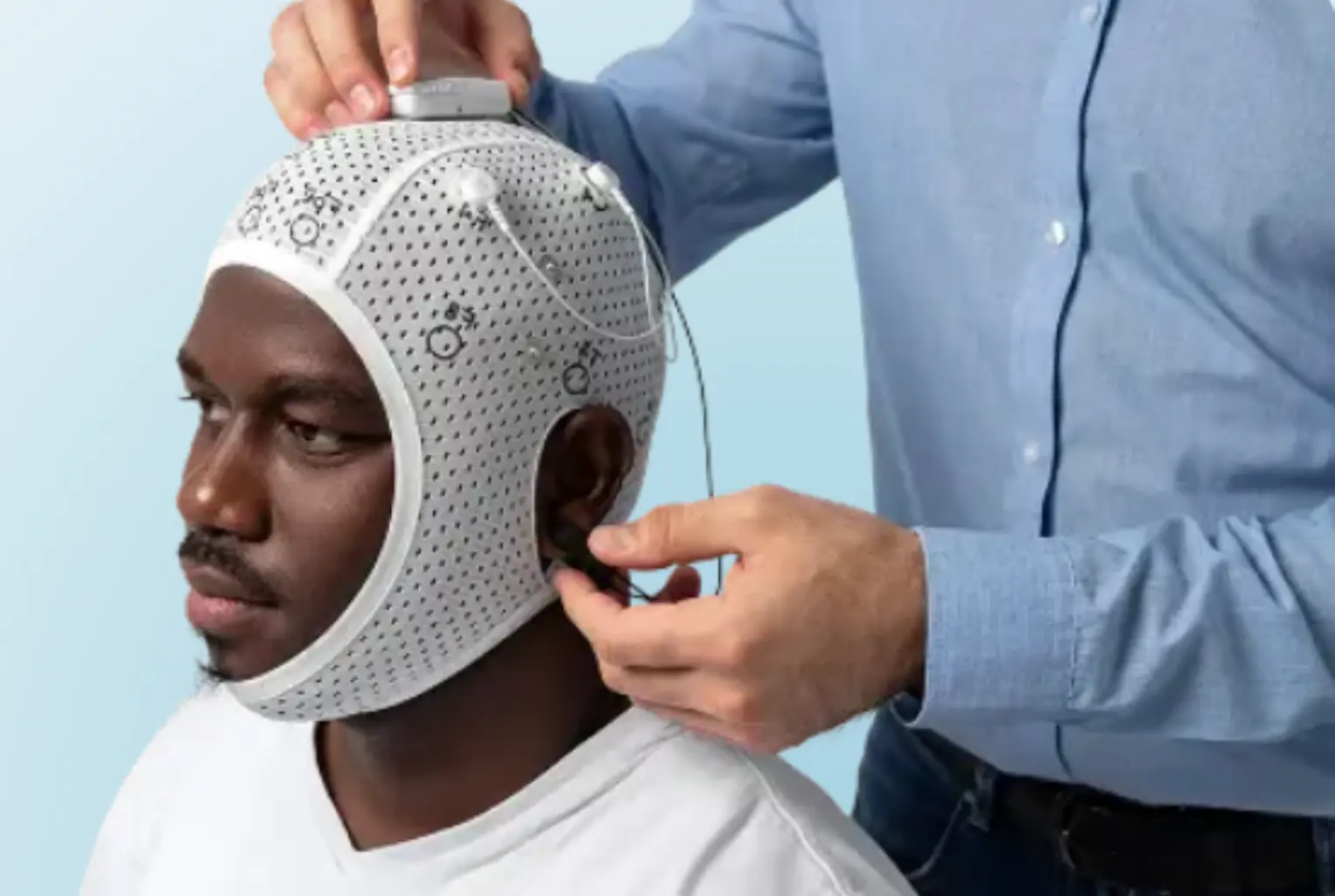
We place a lightweight cap with four dry electrodes. No gel, no needles, no discomfort. The recording takes 7 minutes: 2 minutes eyes-open, 2 minutes eyes-closed, and a 3-minute attention task. Most teenagers complete it without any difficulty. A parent or guardian stays in the room for under-18s.
Teenagers who don’t want to be there
We get it. Some teens arrive reluctantly, dragged by worried parents. We explain the process directly to them — not over their head to mum and dad. We show them the live brain waves on screen (most teens find this genuinely cool). And we make it clear: this isn’t about proving something is “wrong” with them. It’s about understanding how their brain works so they can get the right support.
Age-matched norms
A 14-year-old’s brain is very different from a 7-year-old’s or a 30-year-old’s. We compare against specific norms for age groups 12–13, 14–15, and 16–17 — all from published peer-reviewed research including Arns et al. (2013). As the brain matures through adolescence, the theta/beta ratio naturally decreases, so the clinical thresholds are different for each group.
Seven minutes that can change their trajectory
The lightweight cap measures theta and beta brain waves at four electrode sites. Completely painless, no needles, and most teenagers find it genuinely interesting to watch their own brain activity on screen in real time.
What the data unlocks
Why screening now can change your teenager’s trajectory
A professional screening report with objective brain data opens doors that “we think our child has ADHD” cannot:
Exam access arrangements
Extra time, rest breaks, separate room, word processor access. Schools and exam boards require evidence of need for these accommodations. A comprehensive assessment with clinical letter provides exactly that. Our reports have been used to support JCQ access arrangement applications across multiple schools.
School SEN support & EHCP
SENCOs need objective evidence for EHCP applications and SEN register placements. Our reports provide citable neurological data that sits alongside educational psychology assessments and teacher observations.
If your teenager is heading to university, having a screening (or diagnosis) before they go means they can access Disabled Students’ Allowance (DSA), exam accommodations, mentoring, and assistive technology from day one — rather than struggling for a year and then seeking help.
Self-understanding
Perhaps the most important outcome: your teenager stops blaming themselves. Seeing objective data that shows their brain works differently — not deficiently, differently — can be profoundly validating for a teenager who’s been told they’re lazy for years.
Schools and SENCOs need defensible evidence to apply for JCQ access arrangements. Self-report alone rarely cuts it. Here’s what realistically gets approved.
Evidence for extra time, rest breaks, and exam support
Your teenager’s report supports JCQ exam access arrangements, EHCP applications, and SEN register placement — giving them the support they need before GCSEs and A-levels, not years after.
What parents of teenagers say
4.9
★★★★★
Based on 199 verified reviews
★★★★★
Our son’s GCSEs were approaching and he was drowning. The brain scan confirmed what we suspected — elevated TBR. His school has now put exam accommodations in place. We only wish we’d done this sooner.
MD
Mark & Helen Davies
Parents of boy (15) · March 2026
Verified client
★★★★★
Got screened at 17 before starting uni. Knowing I have ADHD before freshers week means I can access disability support from day one rather than struggling for a year first. Smart move by my parents.
TG
Tom Gallagher
Age 17 · March 2026
Verified client
★★★★★
As a SENCO I refer teenagers here regularly. The reports provide exactly the objective evidence we need for JCQ exam access arrangement applications. It’s changed how we support students with suspected ADHD.
EH
Emma Hughes
SENCO · February 2026
Education professional
★★★★★
My 14-year-old daughter was reluctant but the team were great with her. She actually thought seeing her brain waves on screen was cool. Results showed elevated theta — the quiet inattentive type. Now getting proper support at school.
LW
Laura Whitfield
Parent of girl (14) · January 2026
Verified client
★★★★☆
Good service. My 16-year-old found the eyes-closed phase boring (his words) but completed everything fine. Results were clear and the school SENCO said the report was exactly what she needed for his access arrangements.
PH
Peter Hartley
Parent of boy (16) · February 2026
Verified client
★★★★★
We’d been waiting 3 years on CAMHS. Our daughter sat her mock GCSEs with zero support. This scan gave us the evidence to get 25% extra time for her real exams. The difference has been enormous.
SF
Sarah & James Foster
Parents of girl (16) · March 2026
Verified client
★★★★★
My son went from predicted 3s and 4s to getting 6s and 7s in his GCSEs after diagnosis and medication. This brain scan was the first domino. Without the objective data, our GP wouldn’t have referred him.
RB
Richard Bradley
Parent of boy (16) · March 2026
Verified client
★★★★★
My teenager was completely against seeing a psychiatrist but agreed to a “brain scan.” The framing made all the difference. Now he has his diagnosis, his medication, and his A-level predictions have jumped two grades.
JK
Julie Knowles
Parent of boy (17) · February 2026
Verified client
★★★★★
The comprehensive package was worth it for the clinical letter. Our daughter’s sixth form used it to apply for JCQ access arrangements and she now has 25% extra time plus rest breaks. Game changer for A-levels.
MT
Maria Thompson
Parent of girl (17) · March 2026
Verified client
★★★★★
Drove from Warrington with both our teens. Different profiles — one combined type, one inattentive. Individual reports for each. The family package saved us nearly £100 and the comparative overview was really useful.
KM
Karen McBride
Parent of 2 teens · March 2026
Verified client
★★★★★
Did the medication comparison scan after our son started Concerta. His TBR dropped significantly and his Go/No-Go scores improved dramatically. The before/after data convinced his school he wasn’t just “trying harder.”
AW
Andrew Walsh
Parent of boy (14) · February 2026
Verified client
★★★★★
I’m a child psychologist specialising in adolescents. This service fills a crucial gap. Teenagers resist traditional assessment but engage with the technology. The data quality is excellent and the reports are clinically useful.
EW
Dr Emily Watson
Child psychologist · February 2026
Healthcare professional
★★★★★
My daughter is heading to Manchester Uni in September. Having the screening done now means she can apply for DSA and exam adjustments before she even starts. Proactive rather than reactive. Highly recommend.
CB
Catherine Barnes
Parent of girl (18) · March 2026
Verified client
Scroll for more reviews →
Questions from parents of teens
Everything parents ask about teenage ADHD screening
We screen teenagers from 13 upwards with specific normative data for age groups 12–13, 14–15, and 16–17. We also screen younger children from age 6 and adults of all ages. Each person is compared against their own age group.
Many teens who resist psychiatric appointments are open to a “brain scan.” It feels scientific rather than clinical. The process is quick (30 minutes), the Go/No-Go task feels like a game, and seeing their own brain waves on screen is genuinely fascinating for most teens. We talk to them directly, not over their head to parents.
Yes. Our reports provide objective neurological evidence that schools can use when applying for JCQ exam access arrangements (extra time, rest breaks, separate room, word processor). The comprehensive package includes a clinical letter specifically designed for educational contexts. Read our guide on EHCP and exam evidence.
Ideal timing. A screening before university means your teen can apply for Disabled Students’ Allowance (DSA), register with the university’s disability service, access exam accommodations, mentoring, and assistive technology from day one — rather than struggling for a year and then seeking help when it’s already affected their grades.
Under-18s require a parent or legal guardian to provide informed consent and be present during the screening. We also explain the process to the teenager directly and ensure they’re willing to participate. We never force a recording. 18-year-olds can consent independently and attend alone. Full details in our terms of service.
Our reports include peer-reviewed citations, z-scores against age-matched norms, and clear clinical context. Many GPs have used our teenage reports to support CAMHS referrals and Right to Choose applications. The comprehensive package clinical letter is particularly effective. See our GP evidence guide.
Absolutely. The inattentive presentation is significantly underdiagnosed in girls and women. Daydreaming, slow processing, difficulty following instructions, and quiet disengagement are all ADHD — just not the stereotypical kind. Our screening measures brain activity, not behaviour, so it detects the cortical pattern regardless of outward presentation.
Yes — our Family Package (£1,095) covers two children or teenagers with individual reports and a comparative overview, saving £95 vs separate bookings. For three or more, contact us for a custom quote.
For an initial baseline scan, most clinicians prefer unmedicated. For a medication comparison scan (£345), take medication as normal. Discuss timing with your prescribing clinician — we can accommodate either approach.
A normal theta/beta ratio doesn’t rule out ADHD — it means this specific biomarker isn’t elevated. ADHD is complex with multiple presentations. A normal result still helps narrow the diagnostic picture and may redirect investigation toward other possibilities. Learn more about what TBR can and can’t tell you.
Macclesfield, Cheshire — accessible from Manchester (30 min), Stockport (20 min), Wilmslow (10 min), Warrington (35 min), and the wider North West. Free parking. Same-week appointments usually available.
Their exams won’t wait. Neither should you.
Get objective brain data before the next exam season. Same-day report. Evidence that opens doors.