Main Home How it works The science Pricing FAQ Contact Us Blog Services ADHD Brain Screening Comprehensive Assessment Family Package Medication Scan Who it's for Children (6+) Adults Women & girls Teenagers Guides NHS waiting list Evidence for your GP EHCP evidence Access to Work Right to Choose Psychiatric assessment ADHD diagnosis guide Book a scan
Home How it works
Simple, non-invasive, painless

How your ADHD brain scan works

From the moment you walk in to the moment you receive your report, here's exactly what happens. No surprises, no discomfort, and no needles — just science. Suitable for children (6+), teenagers, and adults.

Your screening journey
01

Book your appointment online

Choose your package — ADHD Brain Screening (£595), Comprehensive (£845), or Family Package (£1,095). Pay securely via Stripe and choose your preferred date. We'll confirm within 24 hours. See full pricing details.

Before your appointment, you'll complete a short intake form online covering basic details, presenting concerns, current medications, and relevant history. This helps us prepare and saves time on the day.
02

Arrive and get comfortable

When you arrive, we'll explain the entire process, answer any questions, and make sure you (or your child) feel relaxed. The environment is calm and clinical but not intimidating — no hospital vibes.

For children: We're experienced with young clients. We explain the process in age-appropriate language and let them see the equipment before we start. Parents stay in the room throughout. We also screen teenagers and adults.
03

Cap and electrode placement

We place a lightweight textile EEG cap on your head and position four dry, gold-plated spring-loaded electrodes at specific locations on the 10-20 international system. Two small clips attach to your earlobes as reference points.

Electrode positions: Cz (top centre — the FDA-standard TBR measurement site), Fz (forehead midline), F3 (left frontal), F4 (right frontal). Ear clips serve as reference and ground. Setup takes approximately 5 minutes. No gel, no paste, no mess.
04

Phase 1 — Eyes-open resting EEG (2 minutes)

You sit still and focus on a cross displayed on screen. Your brain activity is recorded across all four channels in real time. This captures your baseline brain state — the pattern your brain produces when it's alert but not actively processing a task.

What we're measuring: Resting theta/beta ratio at Cz — the primary FDA-referenced biomarker. An elevated ratio in this condition may indicate cortical hypoarousal, which is commonly associated with ADHD.
05

Phase 2 — Eyes-closed resting EEG (2 minutes)

You close your eyes and relax. We record the same four channels. The brain produces different patterns with eyes closed versus open — the difference between these conditions reveals important information about cortical reactivity.

What changes: Alpha waves (8-13 Hz) typically increase with eyes closed — this is called the "alpha blocking" response. Comparing eyes-open and eyes-closed TBR gives us a more complete picture than either condition alone.
06

Phase 3 — Go/No-Go sustained attention task (3 minutes)

A computerised task appears on screen. Green circles = press the spacebar. Red squares = don't press. It runs for 3 minutes at varying speeds, measuring your ability to sustain attention and inhibit impulses.

What we capture: Reaction time, reaction time variability, omission errors (missed Go trials = inattention marker), commission errors (pressing on No-Go trials = impulsivity marker). All compared against age-matched norms. Standard 70/30 Go/No-Go ratio as used in published research.
07

Real-time analysis

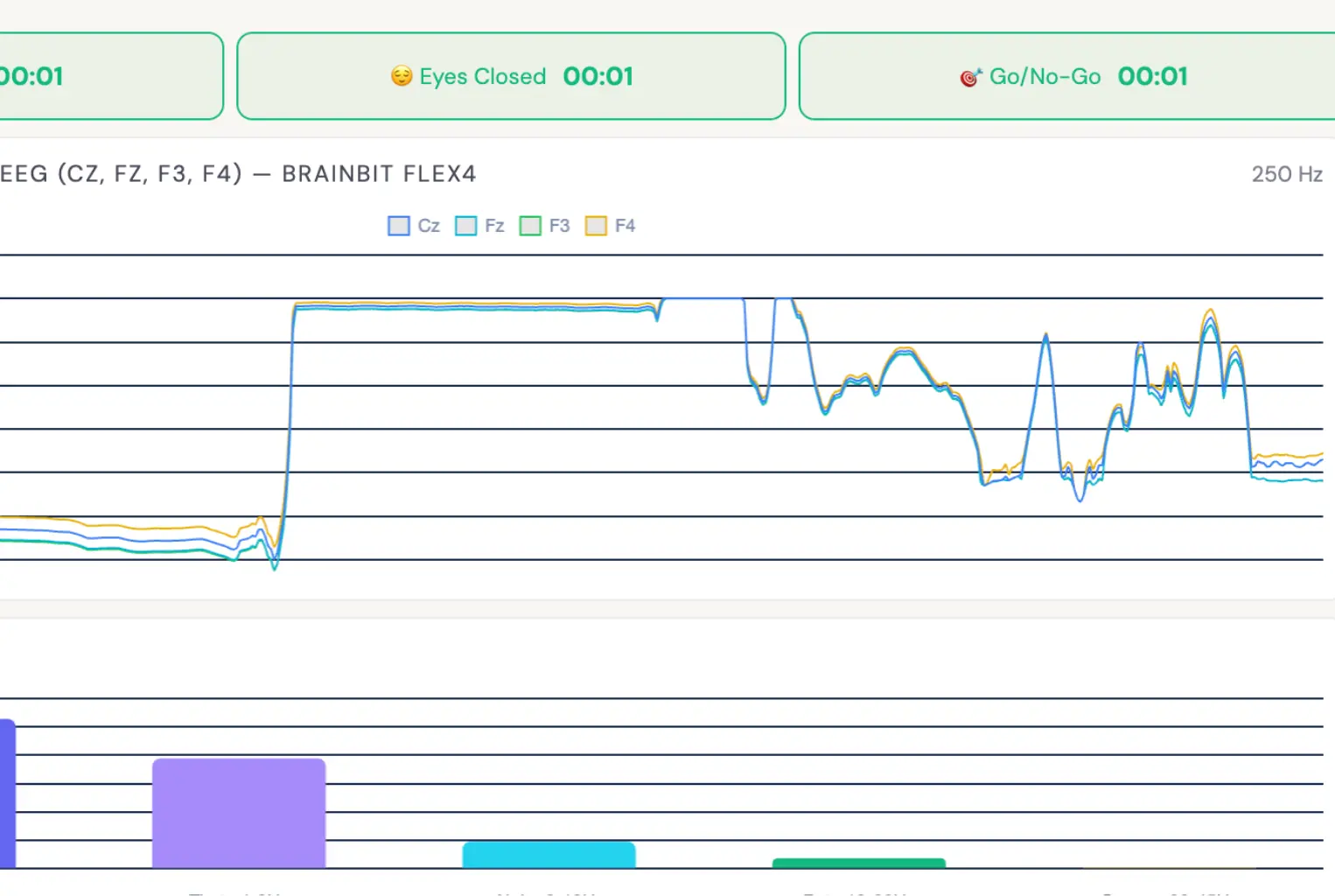
Throughout the recording, our software performs Fast Fourier Transform (FFT) spectral analysis on all four channels, computing frequency band powers (delta, theta, alpha, beta, gamma) and the theta/beta ratio approximately five times per second.

You can watch it happen: The live EEG waveforms and frequency spectrum are displayed on screen in real time during your recording. You'll see your own brain waves flowing across the monitor — most clients find this fascinating.
08

Receive your professional report

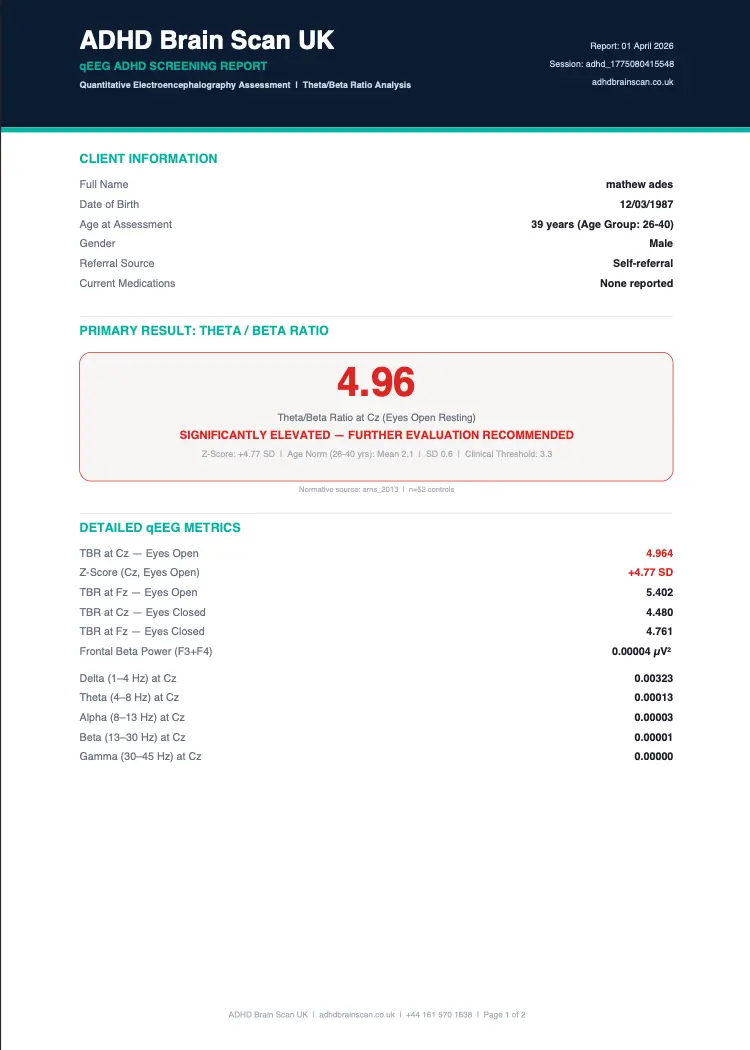
Your results are automatically compiled into a comprehensive PDF report including your theta/beta ratio with z-score, all frequency band powers, Go/No-Go performance metrics, age-matched normative comparison, and clinical interpretation guidance. Emailed to you the same day. Use it as evidence for your GP, for a Right to Choose referral, EHCP application, or Access to Work claim.

Normative data: Your results are compared against published norms from 311+ research subjects across 6 peer-reviewed sources including Arns et al. (2013), Monastra et al. (1999), and the Mendeley open-access EEG dataset. Every comparison is citable.

A calm, comfortable experience for every one

One child is screened while the other waits comfortably with puzzles and activities. The lightweight cap sits gently on the head — no needles, no discomfort. Most children say they barely notice it.
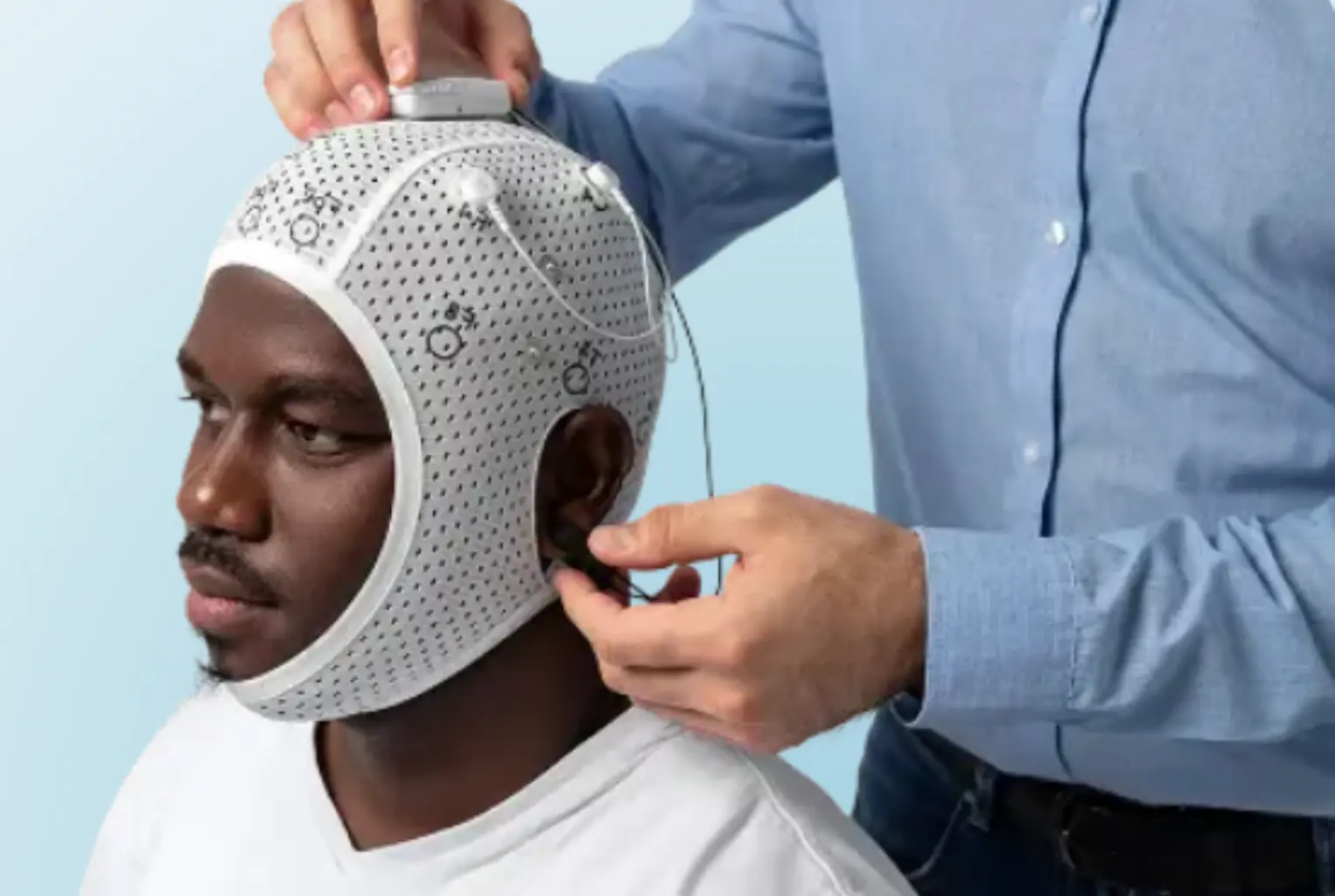
Close-up of lightweight EEG cap with four electrodes during an ADHD brain screening session at ADHD Brain Scan UK
Lightweight EEG cap with four electrodes
Electrodes at Cz, Fz, F3 and F4 — the exact sites used in published ADHD research and the FDA-cleared NEBA System. Completely painless, no electricity enters your body.
Laptop screen showing live EEG brainwave data during ADHD brain screening session with client in background
Real-time brain wave data
Each child's brain activity appears on screen in real time during the seven-minute recording. Results are processed independently using age-specific norms.
Scroll for more →
7 minutes that reveal how your brain works
👁️

Eyes open resting

2:00

Baseline cortical activity. Focus on fixation cross. Captures resting theta/beta ratio — the primary ADHD biomarker.

😌

Eyes closed resting

2:00

Relaxed with eyes closed. Measures alpha reactivity and compares TBR across conditions for a fuller picture.

🎯

Go/No-Go task

3:00

Computerised attention and impulse control test. Green = press. Red = don't. Measures RT, omissions, commissions.

What you'll receive on the same day
A professional PDF report designed to be presented to your GP, psychiatrist, school, or employer. Suitable for Right to Choose referrals and EHCP evidence.

📊 Theta/Beta Ratio

Your TBR at Cz and Fz, the FDA-referenced biomarker, with a z-score showing how many standard deviations you fall from the healthy age-matched average.

📈 Frequency band analysis

Complete power spectrum across delta, theta, alpha, beta, and gamma bands for both eyes-open and eyes-closed conditions.

🎯 Attention task performance

Reaction time, RT variability, omission rate, commission rate, and total accuracy — all compared against age-specific norms.

📋 Normative comparison

Every metric compared against published norms from 311+ research subjects with full peer-reviewed citations. Includes percentile ranking.

🧠 Frontal beta power

Average beta power across F3 and F4 electrodes. Low frontal beta may indicate cortical hypoarousal — a pattern commonly associated with ADHD.

📄 Clinical interpretation guide

Plain-English explanation of what your results mean, the clinical significance of each metric, and guidance on next steps. References FDA and AAN guidelines. Designed to support psychiatric assessments and help navigate the NHS ADHD pathway.

Real brain data from real screening sessions

Every client receives a professional report with clear visualisations of their brain activity. Here is what the screening process and results look like.
ADHD Brain Scan UK professional PDF report showing theta beta ratio z-scores and normative comparison for ADHD screening
Professional screening report
Your same-day PDF report includes theta/beta ratio z-scores, normative comparisons against 311+ research subjects, and full frequency band analysis. Designed for GPs and psychiatrists.
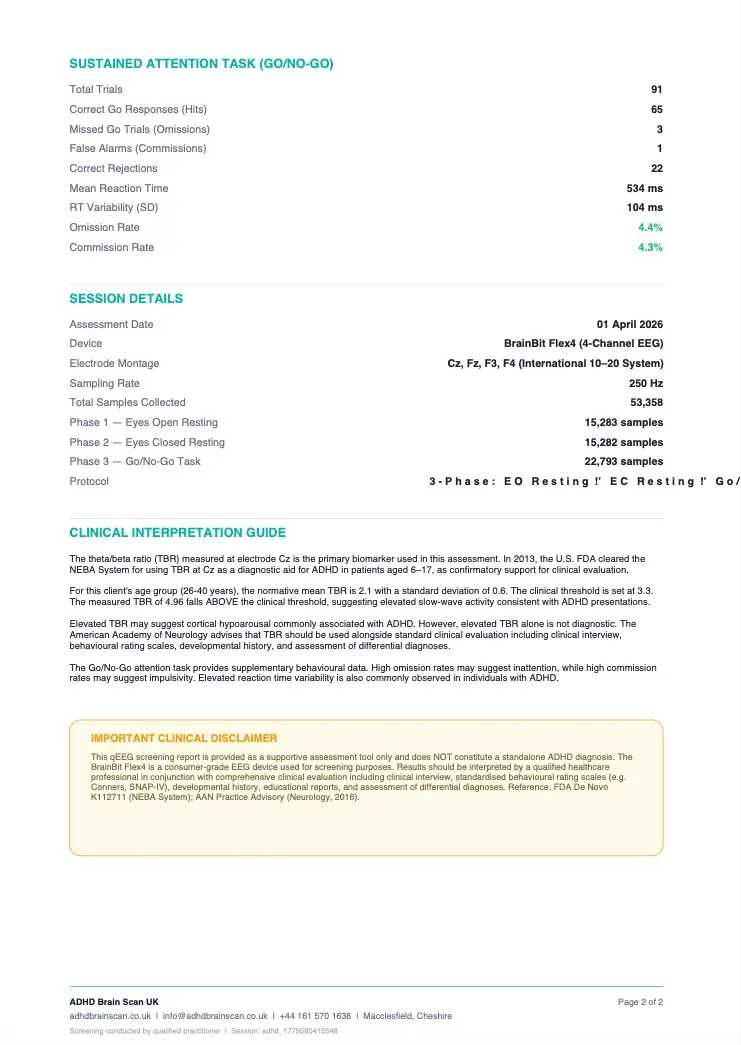
Detailed qEEG frequency band analysis and Go/No-Go attention task results from ADHD brain screening report
Detailed results breakdown
Full frequency spectrum decomposition and Go/No-Go sustained attention task results with reaction time, omission errors, commission errors, and response variability metrics.
How to prepare

Do

  • Wash your hair on the day (no heavy products)
  • Get a normal night's sleep beforehand
  • Eat a light meal before the appointment
  • Arrive 5 minutes early to settle in
  • Bring reading glasses if you normally wear them
  • Complete the online intake form in advance
  • Bring a list of current medications

Avoid

  • Excessive caffeine on the morning of the test
  • Hair gel, wax, mousse or heavy styling products
  • Alcohol the night before
  • Skipping sleep — fatigue affects brain patterns
  • Rushing — arrive calm, not stressed from traffic

On ADHD medication? Discuss with your prescribing clinician whether to take your medication before the screening. We can scan you medicated or unmedicated — both have clinical value. Our Medication Scan (£345) is specifically designed to compare brain activity on and off medication.

What happens during a screening

A 60-second look at the ADHD brain screening experience.

Ready to see what your brain is telling you?

Book your ADHD brain screening today. Same-week appointments available. Have questions? Read our FAQ.

Book your scan → View pricing →